Acacia Wood Tea Boxes: A 2026 Buyer’s Guide for Brands, Hotels, and Gift Programs
A 2026 material-first sourcing guide for B2B brands and private-label buyers shopping for acacia wood tea boxes — with hardness data, food-safety comparisons, compartment layouts, finishes, lid styles, MOQ and FOB pricin

このページの内容
このページの内容
You are sourcing tea boxes. Your customer (or your buyer, or your retail planner) wants the box to look premium, feel premium, ship without warping, and pass a food-safety review. Every guide you read tells you to use acacia wood. This guide answers the next question: how do you actually order one without getting burned?
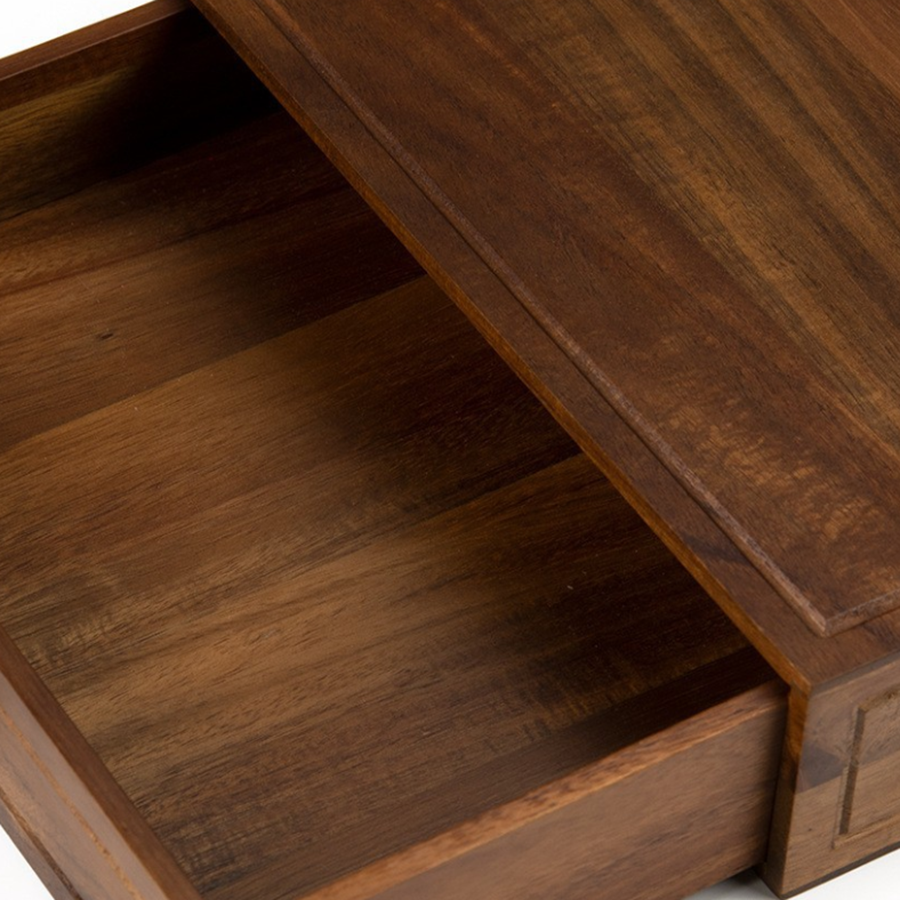
This is the playbook we use at our Xiamen factory when we quote acacia tea boxes for private-label tea brands, hospitality buyers, and corporate-gift programs. Real Janka numbers. Real defects we still see in cheap imports. Real FOB prices for 2026. And the 30-second decision matrix so you can self-select your spec before you read another word.
The 30-second decision matrix
Find the row that matches your project, then read only the sections highlighted.
| If you are… | Best fit | Sections to read |
|---|---|---|
| A tea brand launching 4–8 flavours | 6 or 8 compartments, hinged acrylic-window lid, laser-engraved logo | §3, §6, §10, §12 |
| A hotel / B&B / cafe buyer | 10 compartments, magnetic lid or sliding lid, food-grade oil interior | §4, §6, §7, §10 |
| A corporate-gift programme manager | 4 or 6 compartments, hot-foil or gold-laser brand mark, gift-ready packing | §6, §12, §15 |
| A subscription / box-of-the-month brand | 6 compartments, magnetic flip lid, custom UV print on the lid | §6, §12, §13 |
| A retailer doing an SKU refresh | Mixed 4/6/8 SKUs, sliding lid, neutral oiled finish | §6, §8, §13 |
Want a quote now? Send compartment count, lid style, branding method and target quantity through our contact form — we reply with an indicative FOB price within one business day.
Three buyers, three real scenarios
Most of the buying confusion in this category comes from mixing up which use-case is yours. Here are the three programmes we quote most often.
Scenario A — Tea-brand founder launching a six-flavour line
"I have six SKUs of loose-leaf tea, my retail price is $24 per box, and I need to look like Harney & Sons on the shelf without paying their unit cost."
- Recommended spec: 6-compartment acacia box, ~25×19×9 cm, hinged acrylic-window lid, mineral-oil interior, laser-engraved logo on the lid.
- Why it works: The window lets the shopper see all six tea selections without opening; the laser-engraved logo gives a heritage feel without a per-unit upcharge; the acacia grain photographs better than bamboo on a hero shot.
- Indicative FOB at 1,000 pcs: $6.50–$7.30 per piece.
Scenario B — Hotel group restocking turn-down service
"200 rooms, nightly turn-down service, the box has to survive housekeeping for two years and still look fresh on a tray."
- Recommended spec: 10-compartment acacia box, sliding lid (no hardware to break), beeswax-and-oil interior, hotel logo laser-engraved on the lid.
- Why it works: Sliding lid removes the single biggest failure point (hinges). Beeswax finish wipes clean after a tea spill. 10 compartments cover green, black, herbal, decaf plus seasonal.
- Indicative FOB at 500 pcs: $8.50–$9.20 per piece.
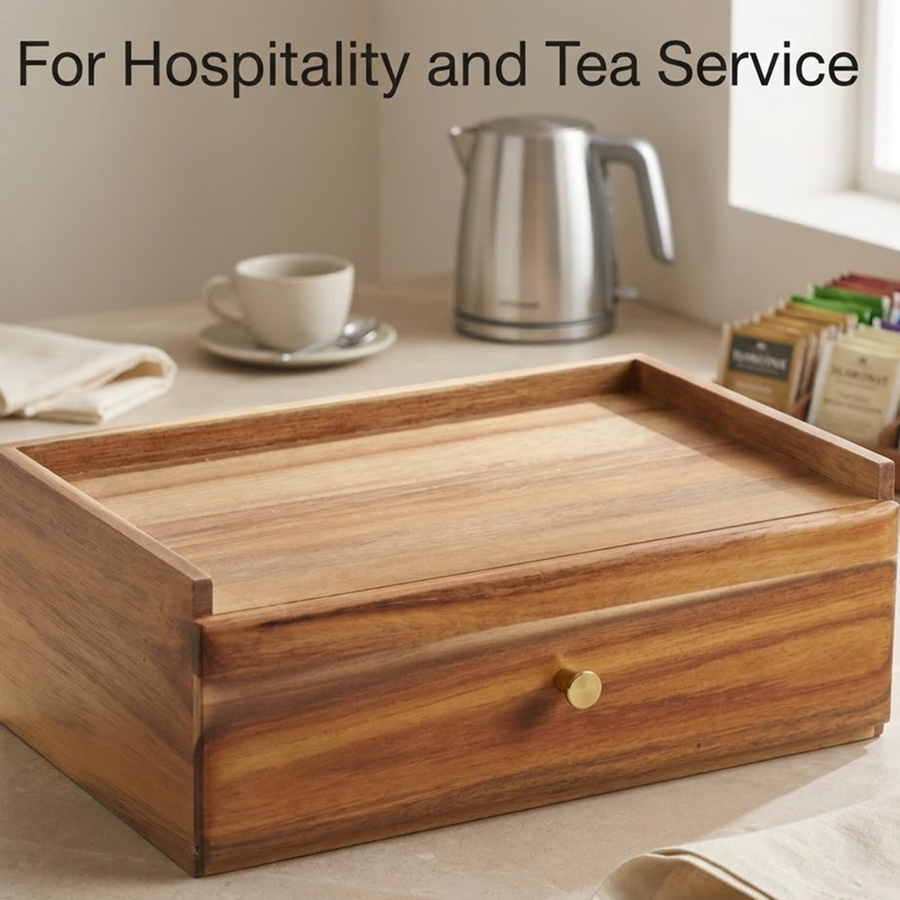
Scenario C — Corporate-gift programme manager
"Q4 client gift, 3,000 boxes, has to feel like a $60 gift but cost me under $15 landed."
- Recommended spec: 4-compartment acacia box, magnetic flip lid, hot-foil-stamped logo (gold or rose-gold), branded gift sleeve, individual color-box master cartons.
- Why it works: Magnetic lids deliver the "premium snap" unboxing moment. Hot foil reads as luxury. 4-compartment footprint keeps unit cost down on a high-margin program.
- Indicative FOB at 3,000 pcs: $7.20–$8.00 per piece (inc. gift sleeve, exc. tea contents).
Why acacia, not bamboo or pine?
Three properties make acacia win this category.
- It is dense. Janka hardness ~2,300 lbf — higher than red oak (1,290), walnut (1,010) and far above pine (380–870). Translation: the compartment walls don’t dent when a metal tea tin gets dropped in, and hinge edges hold their shape after thousands of open-close cycles.
- The grain is tight enough not to absorb tea aromas. Open-pore woods like pine pick up the smell of a strong oolong within a month. Acacia does not.
- The natural colour is already "premium". Honey heart to chocolate streaks — no staining required to look high-end on a Shopify hero shot, which keeps unit cost down.
For the full side-by-side, see our Acacia vs Bamboo organizer guide and the factory-floor comparison. Below is the version specific to tea-box use.
Material data: acacia vs bamboo vs paulownia vs walnut
One table, every spec your buyer might ask for.
| Property | Acacia | Bamboo | Paulownia | Walnut |
|---|---|---|---|---|
| Density (kg/m³) | 700–900 | ~700 | ~280 | ~640 |
| Janka hardness (lbf) | ~2,300 | ~1,380 | ~300 | ~1,010 |
| Color without staining | Honey–chocolate, dramatic grain | Pale gold or carbonized caramel | Pale cream, flat | Deep chocolate, fine grain |
| Aroma absorption | Low | Low (solid only) | Medium | Low |
| Food-safe out of can | Yes | Only solid one-piece | Needs sealing | Yes |
| Warp risk in humidity | Low | Low | Low | Medium |
| Typical FOB cost index | 1.0× | 0.9× | 0.7× | 1.6× |
What this means for you: bamboo is cheaper but loses the "premium gift" feel and brings melamine-leaching risk if it’s the laminated kind (see next section). Paulownia is much cheaper but visually flat — needs staining to feel high-end. Walnut beats acacia aesthetically but adds 60% to FOB cost.
Is acacia safe for direct tea contact?
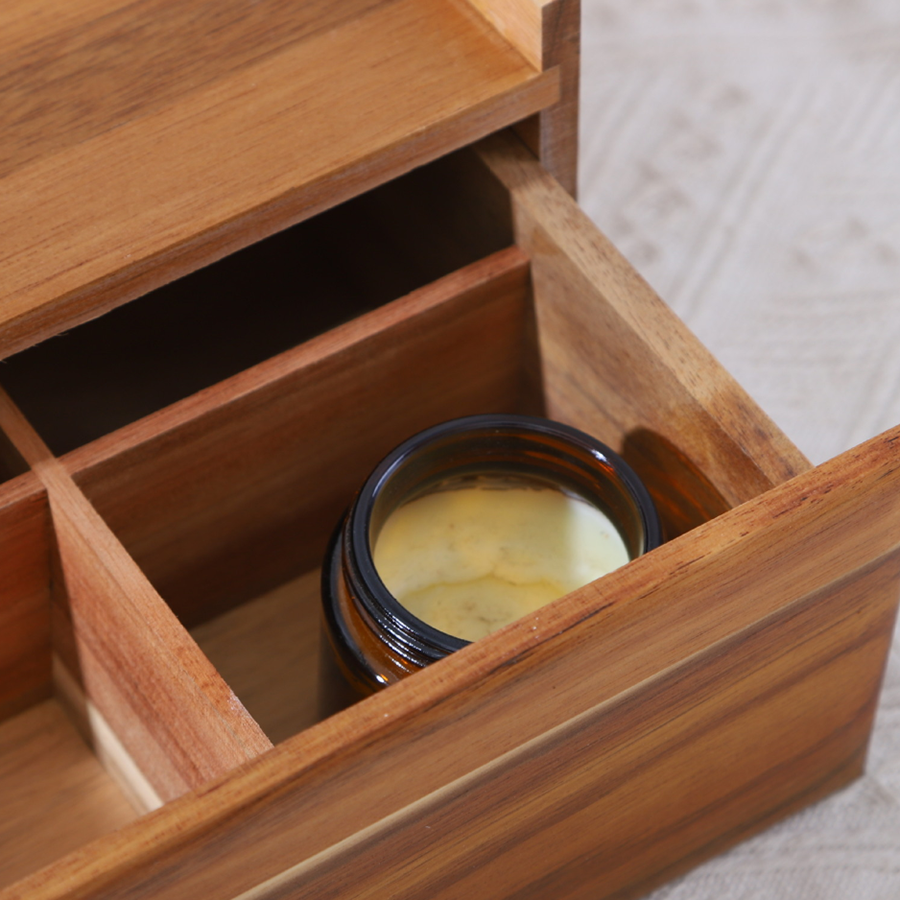
Short answer: yes, when finished correctly.
The kitchenware brand Misen ran independent tests exposing acacia, maple and bamboo to hot acidic liquid, then measured what leached out. Solid hardwoods like acacia released virtually no detectable chemicals. About 32% of bamboo samples leached melamine — not because bamboo is bad, but because most bamboo kitchenware is made from composite boards held together with melamine-formaldehyde glue.
For your tea-box programme that gives acacia three regulatory advantages over composite bamboo:
- Easier FDA / LFGB / EU 10/2011 food-contact compliance.
- Fewer questions on a Prop 65 review for California retailers.
- A cleaner story for BSCI, FSC and eco-positioned buyers.
Buyer checklist on food safety:
- Interior must be finished with food-grade mineral oil, food-grade plant oil (often labelled "butcher block oil") or beeswax. Nothing else.
- Reject any factory that uses PU lacquer on the interior — it’s not food-safe, looks glossy, and traps moisture where mould grows.
- Ask for the COA (certificate of analysis) for the oil used.
- Request the third-party FDA / LFGB test report for your target market.
How many compartments do I actually need?
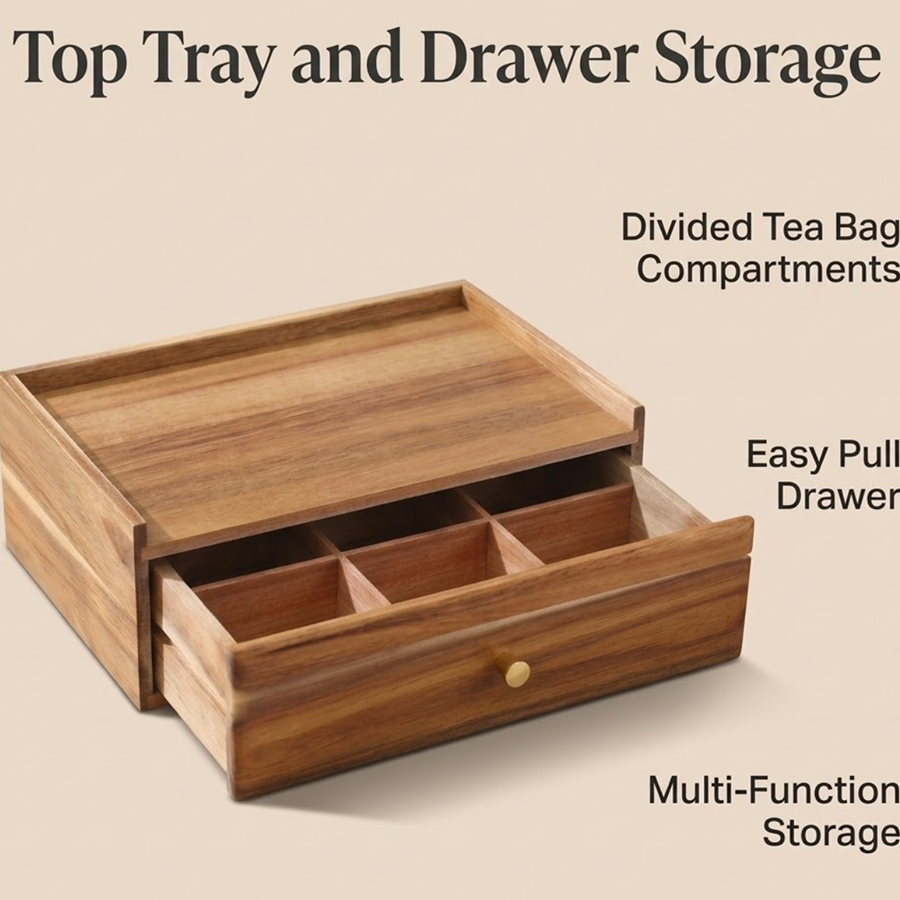
Compartment count is the single biggest SKU decision after material. Here is what actually sells in each lane after several hundred SKUs across global brands.
- 4 compartments — small home / gift market. Footprint ~25×15×9 cm. Best for tea-brand sampler packs. Lowest FOB cost. Common at Williams-Sonoma and Crate & Barrel price points.
- 6 compartments — the Amazon volume sweet spot. ~25×19×9 cm. Fits virtually any pyramid sachet or rectangular tea bag. The format most consumers can hand-organise by "day of the week".
- 8 compartments — the gift / registry tier. ~30×19×9 cm. Photographs beautifully on Instagram. Often paired with a glass window lid.
- 10 compartments — hospitality, B&B and coffee-station orders. ~38×19×9 cm. Holds enough variety for a guest amenity tray.
- 12 compartments — tea-brand merchandiser. ~38×25×9 cm. In-store retail fixture for specialty tea brands.
The detail nobody warns you about: compartment height matters more than compartment count. Pyramid sachets need 9 cm; flat tea bags need 7 cm. Send the factory your actual sachet dimensions before they tool the divider grid — or the lid won’t close.
Hinged window vs sliding lid vs magnetic flip — which lid do I pick?
Three lid styles dominate. Each has different cost, durability and shelf appeal.
Hinged lid with acrylic or glass window (bestseller)
The most-quoted spec. 3 mm acrylic sits in a routed groove on the acacia frame, held by two brass hinges. Buyers see the tea selection without lifting the lid — the single biggest UX upgrade you can make.
- Acrylic vs glass: acrylic survives drops and saves freight. Glass looks richer but is heavier and fragile.
- Cost adder vs sliding lid: roughly $1.20 per unit at 1,000 pcs (acrylic), $1.80 (glass).
- Recommend for: retail brand boxes, gift programmes.
Sliding lid (cleanest aesthetic, lowest cost)
No hardware. Just precision-routed grooves and a flat acacia lid that slides in and out. The cleanest exterior, and the single lowest-cost lid we make.
- Pro: no failure points. Survives hotel housekeeping.
- Con: no visibility into contents; can stick if humidity swings cause the wood to swell.
- Recommend for: hospitality, hand-numbered gift batches, minimal-aesthetic brands.
Magnetic flip lid (most premium feel)
Neodymium magnets routed into the back wall and the lid edge give an invisible "snap" close. The most premium feel and the best fit for upmarket subscription tea brands — the unboxing experience is part of the brand.
- Cost adder: +$1.20–$1.80 per unit.
- Spec must: N42 or stronger magnets, or the lid pops open when you tilt the box.
- Recommend for: subscription brands, corporate gifts, registry retail.
What finish should I order? (Skip this if the factory tells you "PU")
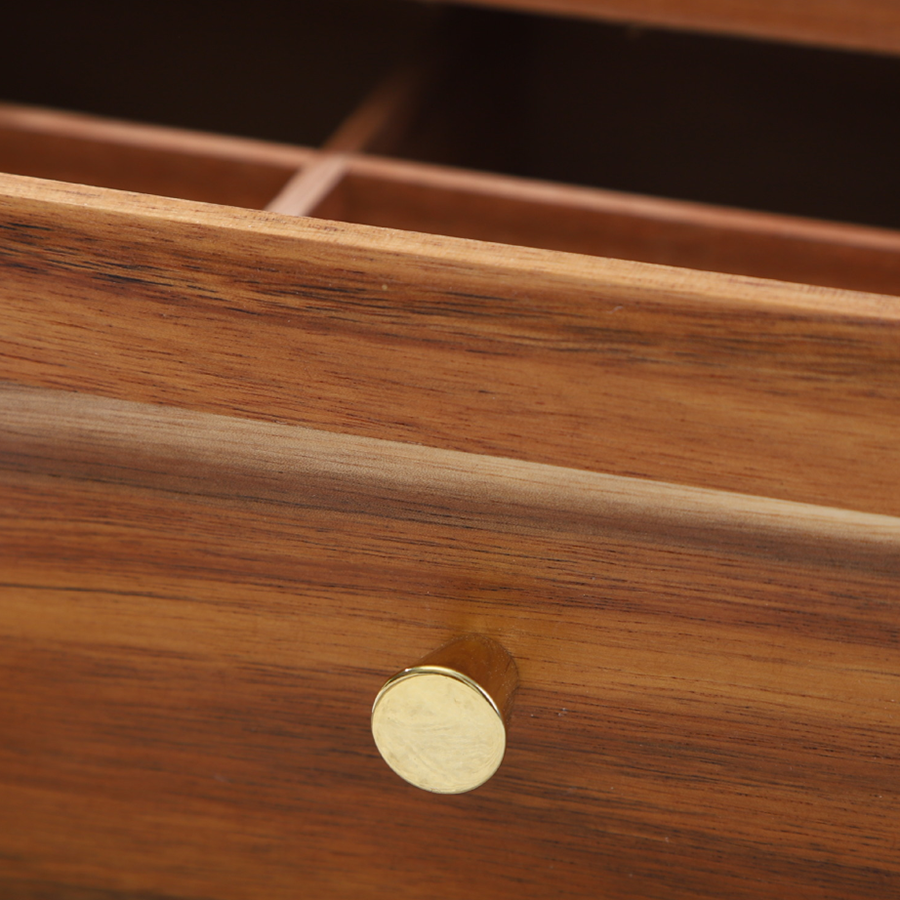
Acacia is naturally water-resistant but not waterproof. A good finish brings out the chocolate grain, locks in stability across humidity swings, and keeps the box food-safe for the life of the programme.
Three finishes we recommend (in order of buyer reach):
- Food-grade mineral oil — the default. Penetrates the grain, deepens the colour slightly, and the customer can re-apply at home for 5+ years of service. Lowest cost, fully food-safe, FDA-acknowledged.
- Beeswax + mineral oil blend ("butcher block conditioner") — richer satin sheen, slightly better water resistance. Worth the small upcharge for gift programmes.
- Food-safe matte lacquer — exterior only, never interior. Two coats of water-based matte adds fingerprint resistance. Pair with an oiled interior. Best for cafes and hospitality boxes that get wiped down constantly.
What to refuse: gloss PU lacquer, solvent-based stains used to deepen colour cheaply, and any "tung oil" that isn’t food-grade certified. The first two are unsafe for tea contact; the third is often a tung-oil substitute containing heavy-metal driers.
The four defects we still see on cheap acacia tea boxes
These are the issues that show up most often when we audit a competitor sample for a new brand — usually right before they switch supplier.
- Glued-up scrap blocks instead of solid panels. Cheap boxes use small acacia offcuts edge-glued into a panel, often hidden under a stain. Glue lines crack along compartment dividers within six months. Ask for a cut-through sample — you should see no more than two glue lines per side wall.
- Acrylic windows scratched in transit. The protective film should stay on the acrylic through the entire production line and only be peeled by the end-customer. Ask the factory to send a video of the film application station.
- Hinge screws driven into end-grain. End-grain screws pull out under repeated lid opening. Hinges must be screwed into face-grain, with pilot holes drilled to spec. Open the sample lid 100 times before signing off.
- Compartments under-sized for your sachet. We’ve seen Bigelow-sized rectangular bags get crushed because the factory built compartments for Lipton-sized squares. Send the sachet spec before tooling.
Can I put my logo on it? (Laser, UV print, hot foil)
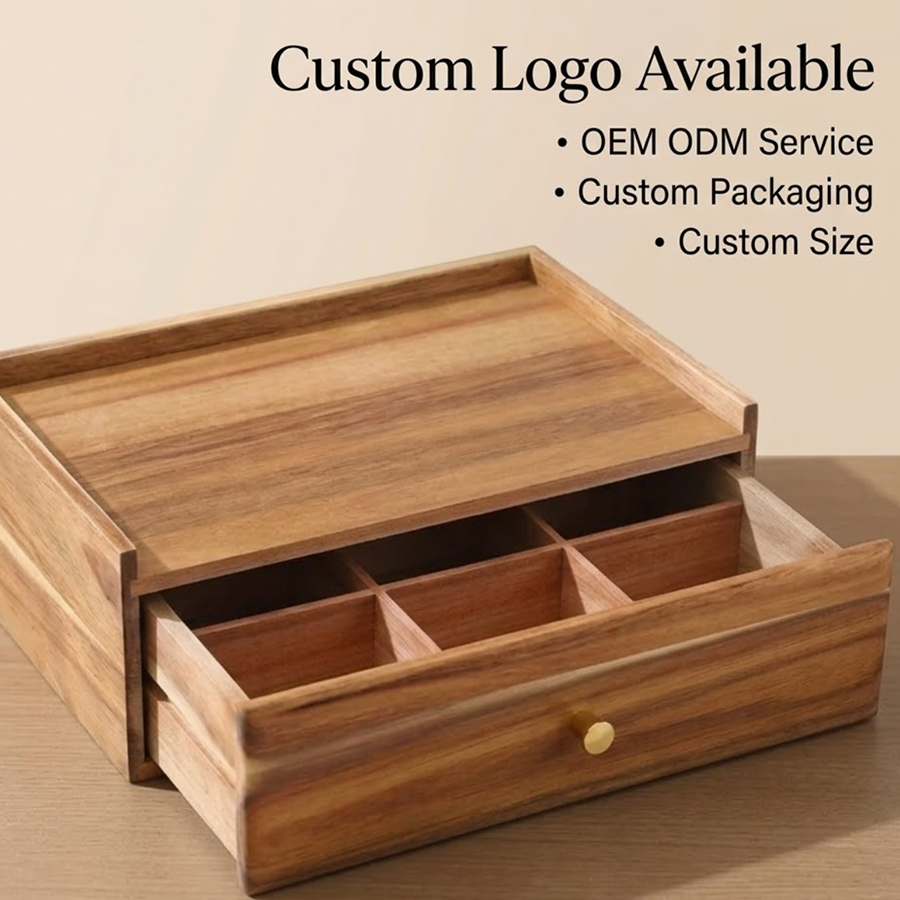
Acacia is a generous canvas. The dark heartwood streaks and lighter sapwood take laser and ink beautifully — usually in your favour.
- Laser engraving — our recommended default. CO2 laser burns the surface to espresso brown, contrasting with the honey heart. Holds fine type down to 5 pt. No per-unit cost adder. Best for logos, brand names, individual tea-variety labels on dividers, and limited-edition numbering.
- UV print — full-colour photographic print directly on the wood. Great for botanical artwork. +$0.40–$0.90 per unit at scale. Looks slightly flatter than laser because the print sits on the grain rather than burning into it.
- Hot foil stamping — gold or rose-gold foil for high-end gifting. Premium feel. Foil can chip if the box gets banged in transit, so use foil on the lid only.
- Screen print — less common on acacia; only use for solid-block logos (e.g. a circular medallion).
Pro tip: ask the factory for a laser-engraved sample on a scrap acacia panel before locking the artwork. The dark streaks in the grain affect how cleanly the laser burn reads — a logo that looks perfect on a Pantone PDF may need to be slightly bolder on real wood.
MOQ, lead times, and FOB pricing in 2026
These are the numbers we currently quote, indexed to a standard 6-compartment acacia box, hinged acrylic window, mineral-oil interior, laser-engraved logo. Other configurations move up or down from this baseline (adders listed below the table).
| Volume | Indicative FOB Xiamen (USD) | Sample lead time | Production lead time |
|---|---|---|---|
| 300–500 pcs (entry MOQ) | $7.50–$8.50 / pc | 7–12 days | 30–35 days |
| 1,000–2,000 pcs | $6.50–$7.30 / pc | 7–12 days | 30–35 days |
| 5,000 pcs+ | $5.80–$6.40 / pc | 10–14 days | 40–45 days |
| 20,000 pcs+ (annual programme) | $5.20–$5.80 / pc | 10–14 days | 50–60 days, staggered |
Adders to plan around:
- +$0.50–$1.20 / pc — premium finish (beeswax or matte lacquer)
- +$0.40–$0.90 / pc — UV print
- +$1.50 / pc — glass window over acrylic (at 1,000 pcs)
- +12% blanket — magnetic-lid SKUs
- +$0.08–$0.12 / pc — retail-ready master cartons with barcodes
Bottom line: even at the high end, acacia is still the cheapest premium-look hardwood tea box on the market — the others either look cheaper (paulownia, bamboo) or cost notably more (walnut, oak).
How do you protect the box during ocean shipping?
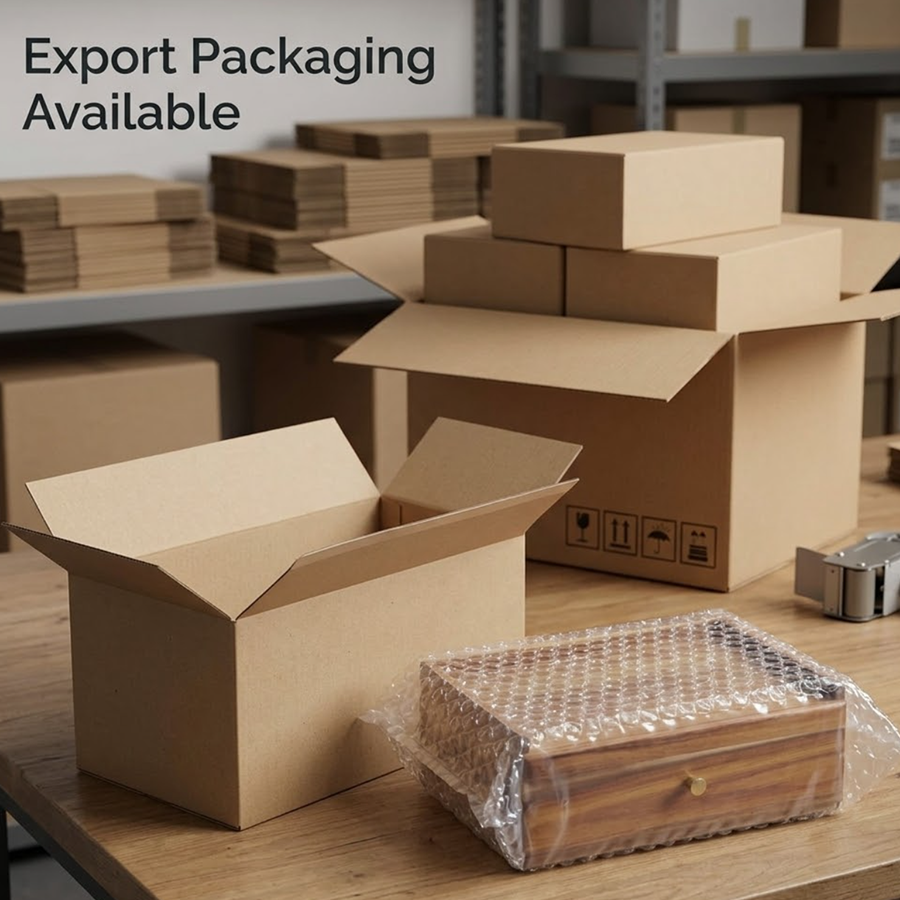
One of the most ignored factors in this category is what happens to the box after it leaves the factory floor. A 30-day container with humidity swings between 50% RH (port of origin) and 95% RH (tropical equator crossing) will warp any tea box that wasn’t packed properly.
Our standard export-packaging spec for acacia tea boxes:
- Inner pack: each box in a polybag with desiccant sachet (silica gel, 5g). Polybag is sealed, not just tucked.
- Color box (optional): brand-printed gift box around the polybag.
- Master carton: 5-ply corrugated, internal dividers, max 24 pcs per carton. Mark with country-of-origin and HS code.
- Pallet: heat-treated wood pallet (ISPM 15 compliant), max 4 layers high, strapped and stretch-wrapped.
- Drop test: AQL 2.5 sign-off. 80 cm drop onto concrete, four corners. No interior damage.
What this saves you: typical defect rate after a 30-day ocean container drops from ~3% (unprotected) to under 0.5% with this spec. On a 5,000 pc shipment that’s 125 fewer claimable units.
The sourcing checklist before you sign the PI
The checklist we send every new buyer before they sign a Proforma Invoice. Skip any step at your own risk.
- Send the exact sachet dimensions (L × W × H) for the bag the box must fit — before tooling.
- Ask for a cut-through panel sample — confirms solid acacia, not glued scrap.
- Request the COA for the interior oil and the FDA / LFGB / EU 10/2011 test report if listing on those markets.
- Specify hinge type, hinge material (brass or chromed zinc-alloy), and confirm pilot-hole drilling on hinge mounts.
- Open the sample lid 100 times and tilt the closed box upside-down 10 times. Lid should not pop; no compartment should rattle.
- Confirm moisture content of the acacia panels is 8–12% on the cut sample. Above 14% and you will see warping after a 30-day ocean container.
- Sign off on the master carton drop test: 80 cm onto concrete, four corners. No interior damage.
- Get the QC partner’s final inspection report (AQL 2.5) in writing before container release.
None of this is CHIC-specific. It is the same checklist that protects you from any wooden-box factory, including ours.
Where to go from here
If you are weighing acacia against another material, the short answer is: pick acacia unless your unit-price target is below $5 FOB or your buyer specifically requested walnut. The food-safety, visual and freight-economics stories all line up in your favour.
For a quote against your spec, send the following through our contact form:
- Compartment count + sachet dimensions
- Lid style (hinged window / sliding / magnetic)
- Finish (oil / beeswax / matte lacquer)
- Branding method (laser / UV print / hot foil)
- Target quantity and delivery month
- Destination port (FOB Xiamen by default)
We reply with an indicative FOB and a sample lead time within one business day.
Related guides
- Wooden Tea Box Manufacturing Guide for Distributors and Gift Brands — the procurement-side companion to this material guide.
- Multi-Compartment Wooden Tea Boxes: What Buyers Should Check Before Bulk Orders — QC and bulk-order checklist.
- How to Choose the Right Wooden Tea Bag Organizer for Coffee Stations — hospitality and coffee-station angle.
- Acacia vs Bamboo Organizer: Why 2026’s Top Home Brands Are Pivoting to Acacia — the broader material comparison.
- Browse our wooden tea box product range
- CHIC material guide — acacia, walnut, paulownia, bamboo and pine compared
よくある質問
発注前にバイヤーがよく尋ねる質問
Is acacia wood food-safe for direct tea contact?
Yes — when the interior is finished with food-grade mineral oil, food-grade plant oil ("butcher block oil"), or beeswax. Independent testing has shown solid hardwoods like acacia release virtually no detectable chemicals even under hot, acidic conditions. The risk is not the wood itself; it is interior PU lacquer, so insist on food-grade oil and reject any factory that uses lacquer on the inside.
How many compartments should my tea box have?
Match the count to your programme: 4 for sampler / corporate-gift; 6 for the Amazon retail volume sweet spot; 8 for premium gift / registry; 10 for hospitality and coffee-station; 12 for tea-brand retail merchandisers. More important than the count is the compartment height — 9 cm for pyramid sachets, 7 cm for flat tea bags. Send your sachet dimensions before tooling.
How does an acacia tea box compare to a bamboo one?
Bamboo is slightly cheaper and equally stable, and reads as "eco". But composite/laminated bamboo can leach melamine when exposed to acidic liquids — for tea storage, only solid one-piece bamboo is safe. Acacia avoids that risk entirely, looks more premium straight from the factory, and photographs better on a retail hero shot. For mid-to-premium tea brands, acacia wins on perceived value at nearly the same unit cost.
Will an acacia tea box warp during a 30-day ocean container?
Not if it is built right. Acacia panels need to be kiln-dried to 8–12% moisture content and sealed with food-grade oil before packing. Above 14% MC, warping is virtually guaranteed in tropical humidity. Our standard export-pack adds desiccant sachets and 5-ply corrugated master cartons — defect rate after ocean shipping drops from ~3% (unprotected) to under 0.5%.
What is the MOQ, sample lead time and production lead time?
Entry MOQ is 300–500 units per design. Samples in 7–12 days; mass production 30–35 days after sample approval. At 1,000 units you save roughly 10% per unit; 5,000+ saves closer to 25%. Annual programmes of 20,000+ units run on staggered 50–60-day production cycles to keep inventory turning.
Can you laser-engrave my logo? Is there an extra cost?
Yes — acacia is one of the best woods on the market for CO2 laser engraving. The honey heart contrasts beautifully with the laser-burned dark espresso line, so logos, brand names and individual compartment labels read crisply down to 5-pt type. Laser engraving is included in our FOB quote with no per-unit upcharge and is the most popular branding method for B2B acacia tea-box programmes.
What food-safety certifications can I get for the program?
Standard documentation includes FDA food-contact compliance (US), LFGB and EU 10/2011 (EU markets), Prop 65 reports for California shelf placement, and FSC chain-of-custody if the buyer requires forest certification. BSCI factory audit is also available on request, covering labour-standards compliance.
What happens if a batch arrives damaged?
Our final inspection (AQL 2.5) report is shared with you in writing before the container is released — you can refuse release if defects exceed the AQL threshold. Once shipped under FOB terms the risk transfers to you, but we cover replacement units against manufacturing defects (warping, hinge failure, cracked panels) at no charge for 12 months. Cosmetic damage from transit handling is a freight-forwarder claim, which is why the packaging spec above matters.
続きを読む
関連記事

May 16, 2026 · Buyer Guides
中国からカスタム木製チーズボードを購入する方法: 2026年バイヤーズガイド
フォームファクター、材料、食品接触仕上げの質問、MOQ階層、FOB価格設定、FDA/LFGBコンプライアンス、および自社ブランドの木製チーズボードの12週間の調達タイムライン。
記事を読む →
May 16, 2026 · Buyer Guides
中国からカスタム木製のスパイスラックを調達する方法: 2026年のバイヤーズガイド
フォームファクター、材料、MOQ層、FOB価格設定、ジャーフィット公差、FSC/REACH / CARB/FDAコンプライアンス、および木製のスパイスラックプライベートラベルランの12週間の調達タイムライン。
記事を読む →
May 16, 2026 · Buyer Guides
中国からカスタム木製バスキャディーを調達する方法: 2026ソーシングプレイブック
木製のバスキャディーにラベルを付けるための工場直接のプレイブック: 材料、MOQ層、FOB価格設定、設計するための4つの欠陥、FSC/REACH/CARBコンプライアンス、および現実的な12週間の調達タイムライン。
記事を読む →