How to Source a Custom Wooden Bath Caddy from China: A 2026 Sourcing Playbook
The factory-direct playbook for private-labelling a wooden bath caddy: materials, MOQ tiers, FOB pricing, the four defects to engineer out, FSC / REACH / CARB compliance, and a realistic 12-week sourcing timeline.

On this page
On this page
A wooden bath caddy looks like a simple piece of bent timber sitting across a tub. From a sourcing standpoint, it is anything but simple. It has to expand smoothly, grip a porcelain rim without slipping, hold a 600 g hardback at a 70° angle, resist the humidity of a daily soak for at least three years, and survive an ocean container in a 95% RH hold — all while looking spa-shop premium on a Shopify hero shot. Get any one of those wrong and your reviews fall to four stars within a quarter.
This is the playbook our factory uses with the brands we manufacture for — from a luxury bath D2C in California to a Scandinavian gifting label. It is bath-caddy-specific, with the actual moisture numbers, FOB prices, MOQ thresholds, and certification clauses that move quotes in 2026. If you are evaluating whether to private-label a wooden bath caddy from China, this is what we wish every first-time buyer knew before the first email.
Why a wooden bath caddy is a 2026 private-label opportunity
Three forces stack in favour of this category right now. First, the wellness-at-home spend that exploded in 2020 has not retreated — it has shifted from peloton-tier gear to micro-luxury bath rituals. Second, wooden homeware is a strong fit for the eco-conscious millennial buyer who is the centre of gravity for D2C bath. And third, the product has high perceived value (a buyer feels they got a $60 spa-shop piece) on a landed cost that can sit under $9 if you spec it well.
That margin profile is rare in homeware. The catch — and this guide exists because of it — is that the cheap end of this category is a quality minefield. The brands that win private-label this product are the ones who specify it like a piece of furniture, not a tray. The rest of this article shows you how.
Picking the right wood: bamboo, acacia, paulownia, teak
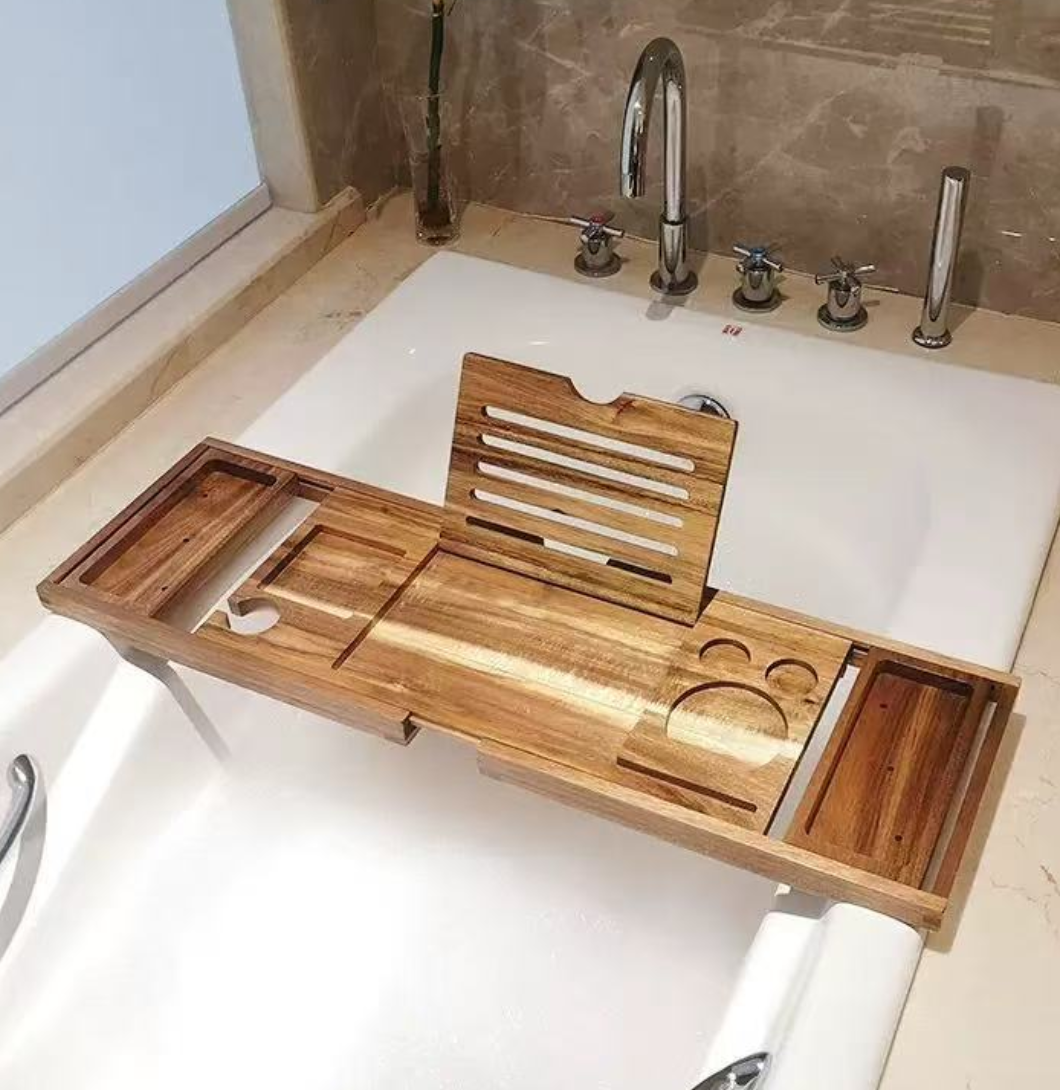
The "wood" choice is the single biggest cost-and-quality lever you have. Here is how the four common options compare for an over-tub caddy, based on the orders we run for export buyers.
| Material | FOB cost index* | Moisture resistance | Weight | FSC available? | Best fit |
|---|---|---|---|---|---|
| Moso bamboo (laminated) | 1.0× | Strong if sealed; native silica helps | Light | Yes — FSC 100% or Mix | Volume D2C, eco-positioning |
| Acacia | 1.3× | Very high — naturally oily | Medium-heavy | Yes — FSC Mix common | Premium, farmhouse / rustic |
| Paulownia | 0.85× | Moderate — needs robust finish | Very light | Yes — but rarer | Gifting, lightweight packs |
| Teak | 2.4× | Best in class — marine-grade | Heavy | Yes — FSC strongly recommended | Luxury / hospitality |
*FOB cost index = relative material cost normalised to bamboo at 1.0×, for a 80 cm expandable caddy at 5,000 units. Actual unit price also depends on hardware, finish, and packaging.
Most first-time private-label orders we ship are laminated Moso bamboo, because it hits the eco-narrative cleanly, takes laser engraving beautifully, and lands at the sub-$9 wholesale tier that lets a Shopify brand price at $39-$49 with healthy margin. The brands going premium pick acacia; the gifting brands building seasonal SKUs at low landed cost reach for paulownia. Teak only makes sense if you are positioning around $80+ retail, because the raw material cost almost doubles.
The anatomy of a bath caddy that does not fall apart
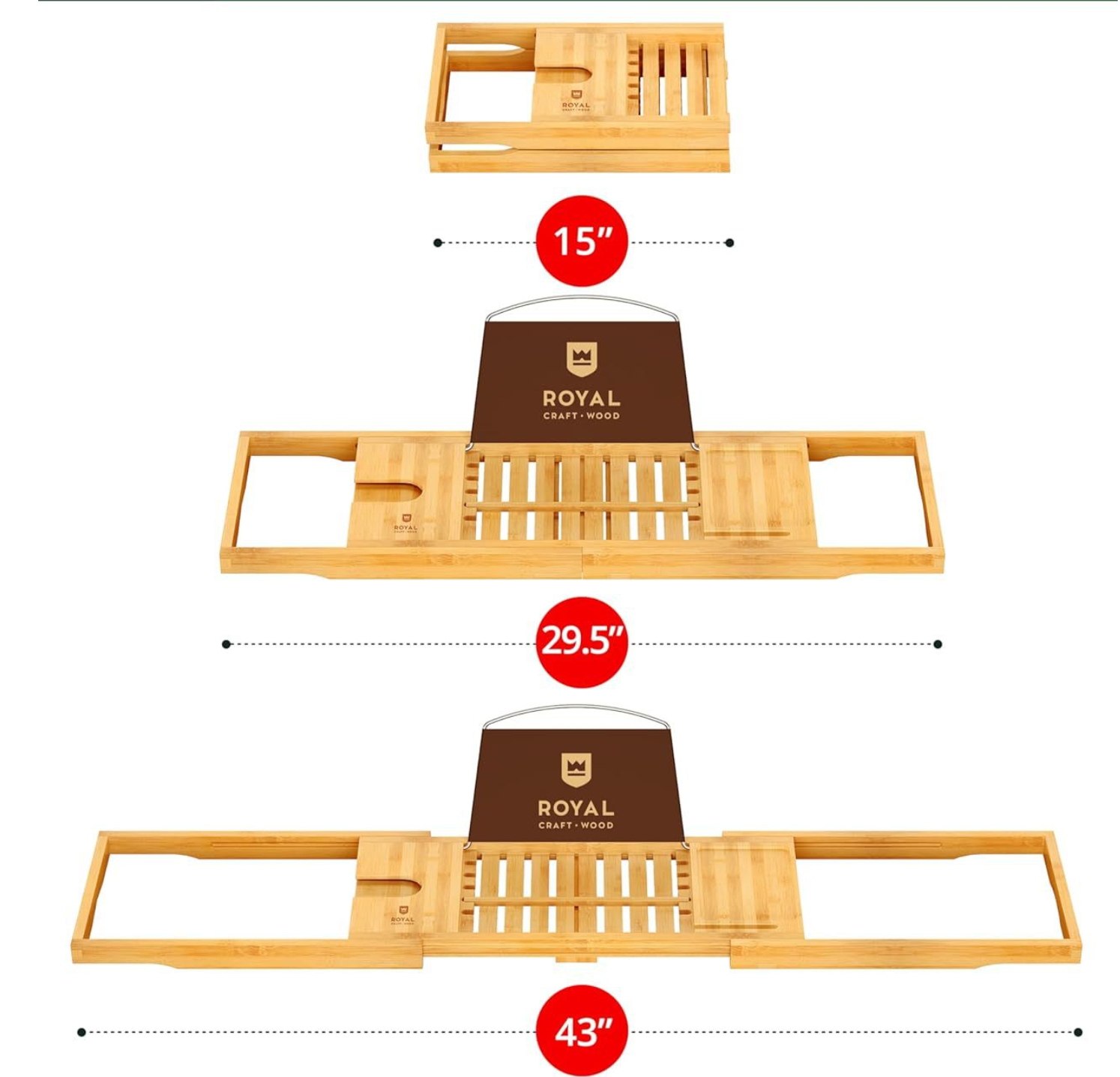
A great wooden bath caddy is engineered as four interlocking systems. Knowing what each one should look like lets you tell a serious quote apart from a thin one.
1. The expanding mechanism
Most US and EU bathtubs sit between 27" and 36" wide externally. A serious caddy expands from roughly 70 cm to 100 cm (28"-40") so it spans both alcove and freestanding tubs. The arms should run on dovetailed slides, not glued tracks — dovetails do not loosen when the wood cycles through humidity. Cheaper caddies use a glued channel; within a year that joint creeps and the arms wobble.
2. The grip system
Look for food-grade silicone pads at the contact points where the arms rest on the tub rim. Rubber discolours and hardens; silicone stays compliant for 8-10 years. Each pad should be a flush-set insert (slightly recessed into the wood), not a stick-on dot — adhesives fail in bathroom humidity.
3. The finish
For a daily-use bath product, ask explicitly for a water-based polyurethane finish with at least three coats, sanded between each. Oil-wax finishes look beautiful in product photos but need re-oiling every six months — most consumers will not, then complain about water marks. Reject "natural / unfinished" specs for over-tub use no matter how Instagrammable the photo looks; bare bamboo absorbs splash water and grows mildew at the end-grain inside a season.
4. Drainage
The book-holder slot and the wine-glass cradle should have channels at the bottom so puddled water drains, not pools. We mill a 2 mm continuous slot in the wine well of every caddy we make — that single detail eliminates 90% of mildew complaints.
Four defects we still see in cheap bath caddies
When buyers send us a competitor's sample to benchmark against, four problems show up over and over. They are all preventable upstream:
- Warping after 60 days. Caused by under-dried lumber. Bamboo strips should be kiln-dried to 8-12% moisture content before lamination; anything above 14% will warp in service. Ask suppliers for kiln logs — a real factory has them.
- Glue line creep. The horizontal seam between bamboo strips opens into a hair-thin gap after a month of bathroom humidity. Root cause: low-grade urea-formaldehyde adhesive. Specify an E0 or E1-grade emission adhesive (also matches CARB Phase 2, see below).
- Splintering at the slot edges. The book-holder cutout, wine well, and arm-end ferrules all need to be hand-sanded to 240 grit minimum. Robotically-sanded caddies leave a rougher edge that catches skin.
- Mildew along the lower edge. The strip of caddy that sits below the tub rim never fully dries. Solution: drainage milling (point 4 above) plus a UV-cured edge sealer applied separately from the top-face coating.
The 12-week sourcing timeline
From the day you first email a Chinese factory to the day the container clears your port, plan on 10-12 weeks for a first run. Here is how that decomposes:
flowchart LR
  A[Week 1
Spec brief sent] --> B[Week 1-2
Quote returned + sample fee paid]
  B --> C[Week 2-3
Sample produced + air-shipped]
  C --> D[Week 4
Sample approval +
30% deposit wired]
  D --> E[Week 4-7
Mass production
3-4 weeks for 5k units]
  E --> F[Week 7
Pre-shipment QC
AQL 2.5 inspection]
  F --> G[Week 8
Balance wired +
BL released]
  G --> H[Week 8-11
Sea freight
Xiamen to West Coast]
  H --> I[Week 11-12
Customs + last mile
to your 3PL]
The biggest hidden risk in this timeline is the sample loop. Buyers who approve a sample without a written checklist often discover at production that the factory interpreted "rich walnut tone" differently than they did. Build a one-page sample-acceptance form with dimension tolerances (±2 mm), finish reference (PMS or Munsell code), and a written "do-not-ship-if" clause for each of the four defects above.
MOQ and price tiers in 2026
Pricing is design-dependent, but the table below reflects the FOB Xiamen price band most factories quote in mid-2026 for a standard expandable bamboo caddy with silicone grips, water-based PU finish, and laser-engraved logo. Specialist mechanisms (folding arms, integrated mirror, soap-pump well) add 10-25%.
| Order volume | FOB / unit (USD) | Typical MOQ tier | What you usually unlock |
|---|---|---|---|
| 300 - 499 units | $9.80 - $12.50 | Trial / sample MOQ | Stock design only, basic logo |
| 500 - 1,999 units | $7.20 - $9.40 | Standard private label | Custom stain + logo + branded sleeve |
| 2,000 - 4,999 units | $5.80 - $7.50 | Scale tier | Bespoke dimensions + colour box + insert tray |
| 5,000+ units | $4.60 - $6.20 | Dedicated production run | New mould / mechanism, custom packaging artwork |
The economics flip sharply around 2,000 units. Below that, the factory is mostly amortising sample and tooling cost; above it, you start to see real volume discounting. Brands launching this category on a tight budget often run a 500-unit pilot to test the listing, then re-order at 2,000+ for proper unit economics.
A worked example: 5,000 units, FOB Xiamen, full colour box
To make the numbers concrete, here is the cost stack we routinely quote for a 5,000-unit run of an 80 cm expandable bamboo caddy with silicone grips, water-based PU finish, custom Pantone stain, hot-stamped foil logo, and a printed colour box. FOB Xiamen per unit lands at roughly $6.40 — a $32,000 PO. Sea freight on a 40-foot HQ container to Los Angeles or Long Beach runs $3,800-$5,200 in mid-2026 depending on the carrier and the week. US import duty at HS code 4419.19 is currently 0% under the most-favoured-nation tariff, though the additional Section 301 ad valorem surcharge applies — confirm the current rate with your broker. Add roughly $1,200 for customs brokerage, drayage to the 3PL, and last-mile palletisation. Landed unit cost for a 5,000-piece run usually settles between $7.40 and $8.20 — well under the typical $39-$49 D2C retail price these caddies command.
Customisation: where private label actually gets interesting
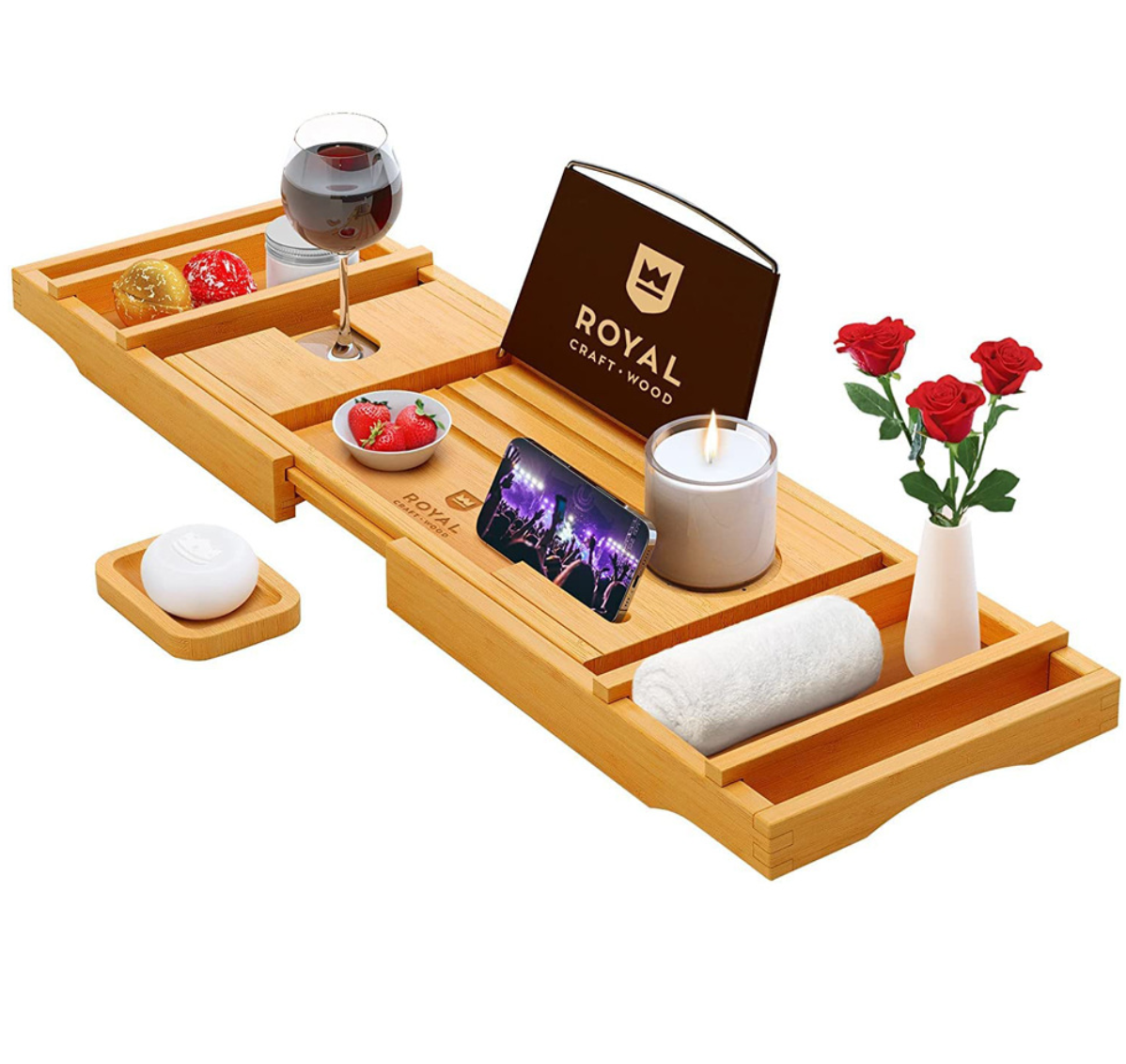
The customisation menu is wider than most buyers expect. The most common levers, and what they cost on a 5,000-unit run:
- Logo branding. Laser engraving is included free at most factories (including ours) — it is the right choice for premium positioning. UV-printed logos add roughly $0.18/unit and allow full colour. Hot-stamped gold or silver foil adds $0.35/unit and reads luxury at retail.
- Wood tone. Five stock stains (natural, walnut, espresso, whitewash, charcoal) are usually free. A custom Pantone-matched stain costs a one-time $200 sample and adds nothing per unit at scale.
- Accessories. Wine-glass cradle, tablet groove, book holder, soap-dispenser well, integrated mirror, hooks for a loofah — each adds $0.30-$1.20 in unit cost and 5-10 days of tooling time.
- Packaging. Plain export carton is free. Branded sleeve adds ~$0.45/unit. Full custom-printed colour box with insert tray adds $1.10-$1.80 and is what we recommend for any brand selling above $35 retail — the unboxing matters.
- Inserts. A printed care card, a microfibre cloth, or a 30 ml bottle of caddy oil all become useful upsells; expect $0.40-$0.90 each in your landed cost.
Compliance: the four certifications your buyers will ask about
A serious B2B buyer will ask for paperwork. Marketplaces (Wayfair, Faire, Amazon) will too. Make sure your supplier can produce — or at least credibly source — each of these:
- FSC chain-of-custody — Forest Stewardship Council certification that the bamboo or hardwood came from a responsibly managed source. Two grades matter: FSC 100% (single-source certified forest) and FSC Mix (blended; the most common for laminated bamboo). Ask for the supplier's FSC licence code, then verify it on the FSC public register.
- REACH (EU) — The European chemical-safety regulation. For a finished bath caddy, REACH covers the residual chemistry of the lacquer, stain, and adhesives. A factory that supplies the EU should be able to produce a REACH SVHC declaration on request.
- CARB Phase 2 (US / California) — California's formaldehyde-emissions limit on composite wood. Federal TSCA Title VI mirrors this and applies nationwide. Critically relevant because laminated bamboo uses adhesive between strips; specify E0 (CARB Phase 2 compliant) glue at quote stage.
- ISPM-15 (export packaging) — Internationally agreed phytosanitary standard for the wooden pallets and dunnage in your container. Almost always handled by the freight forwarder, but worth checking — a non-compliant pallet can force fumigation at the destination port.
For brands targeting Canada or Australia specifically, also check the destination's wood-import phytosanitary requirements; the USDA APHIS guidance is the cleanest reference document for North American practice. Australia's BICON system is stricter than most buyers expect — finished and fully sealed wooden bath caddies generally pass without fumigation, but anything with a "natural / unfinished" spec will be flagged at the border.
The certificate paperwork itself is cheap; the cost shows up if a supplier cannot produce it. A REACH declaration takes a credible factory 24 hours to issue; if you are still waiting after a week, that tells you something. The same goes for FSC: a real holder of a chain-of-custody licence will paste their FSC code into a reply within an hour. A delay means the licence is borrowed, expired, or never existed.
Vetting a supplier: seven red flags
The factory landscape splits roughly into three tiers: real factories that own their cutting and laminating lines (the minority), trading houses that subcontract to two or three factories (the majority), and shell listings on Alibaba that re-sell from whoever is cheapest that week (avoid). Here is how to tell them apart from a desk in Brooklyn:
- They cannot send a factory video on request. Any real factory can dispatch a 30-second walk-through within a day.
- Quote includes no Incoterm. A real exporter quotes FOB, CIF, or DDP by default. "Per piece" with no port and no Incoterm is a re-seller.
- The "sample" image is a stock photo. Reverse-image-search the product photos in the quote. If they exist on three other suppliers' sites, it is a generic listing.
- No FSC code, just an FSC logo. A code (e.g. FSC-C012345) is verifiable on the FSC public register; the logo alone means nothing.
- They cannot quote per-unit cost at three volume tiers. A real factory has a unit-cost curve and will share it; a re-seller picks a number that protects their margin and stays there.
- Payment terms are 100% upfront. Industry-standard private label is 30% deposit, 70% before BL release. A demand for 100% upfront is either a scam or a factory with no working capital.
- No third-party inspection access. If a supplier refuses to allow SGS, BV, or QIMA pre-shipment inspection, walk away.
Logistics: Incoterms and container math
An 80 cm expandable bath caddy in a printed colour box averages 1.4 kg and packs at roughly 40 × 18 × 10 cm. That means:
- A 20-foot container holds ~3,800-4,200 caddies depending on stack pattern.
- A 40-foot HQ container holds ~8,500-9,800 caddies — usually the right ship unit for a 5,000+ run with packaging inserts.
- The product HS code is 4419.19 (tableware and kitchenware, of wood; covers wooden bath caddies in most jurisdictions). Verify with your customs broker — the right code matters for duty.
On Incoterms: FOB Xiamen is the cleanest base term — you pay for the goods at the rail of the ship and your forwarder handles the rest. DDP is operationally simpler for first-time importers because the supplier handles everything including duty, but you pay roughly 15-20% more landed and lose flexibility on customs disputes. For volumes above 1,000 units we recommend setting up your own forwarder relationship and quoting FOB.
Where to go from here
The cheapest mistake at the start of a private-label run is to under-specify. The expensive ones — warped product, mildewed reviews, a customs hold for fumigation that costs three weeks and $4,000 — are all upstream of the first PO, in the spec sheet. If you take one thing from this guide, take that: a clear, written spec sheet is worth twenty back-and-forth WeChat messages.
If you would like a second pair of eyes on a quote you have received, or a sample of how we run this category, our team is happy to put a no-pressure proposal in front of you. We have run this product for Australian, US, German and Scandinavian brands; the spec sheet template above is on the house.
Frequently asked questions
Questions buyers ask before placing an order
What's the minimum order quantity for a custom wooden bath caddy?
Industry standard for a private-label wooden bath caddy is around 500 units with custom logo and stain — that is where most factories (ours included) start to offer real volume pricing. We accept trial runs from 300 units on stock designs with basic laser engraving, but the per-unit cost is roughly 35-45% higher than a 2,000-unit run.
How long does it take from first email to a container at my port?
Plan on 10-12 weeks for a first-time order: 1 week for the quote, 2 weeks for the custom sample, 3-4 weeks for mass production once the deposit clears, 1 week for pre-shipment QC, and 3-4 weeks of sea freight to a US West Coast or EU North port. Repeat orders are faster — usually 7-8 weeks total because sampling is skipped.
Bamboo or acacia — which is better for a bath caddy?
It depends on positioning. Laminated Moso bamboo is lighter, ~30% cheaper FOB, and matches an eco-positioning cleanly. Acacia is heavier, has richer grain visually, and resists moisture slightly better thanks to its natural oils — so it fits a premium farmhouse or rustic aesthetic. For the sub-$50 retail tier, bamboo wins on economics. Above $60 retail, acacia or even teak start to make sense.
Can you produce a sample with my logo before I commit to a full order?
Yes — sample fees run roughly $40-$80 depending on complexity (mechanism, finish, packaging) and are usually credited back against the first production order. Sample lead time is 5-7 working days for an existing mechanism, 10-14 days if you want a new accessory like a soap-dispenser well or integrated mirror that requires tooling.
What certifications should I ask my supplier for?
For a wooden bath caddy specifically: an FSC chain-of-custody code (verifiable on the FSC public register), a REACH SVHC declaration if you sell into the EU, CARB Phase 2 / TSCA Title VI compliance on the lamination adhesive if you sell into the US, and ISPM-15 fumigated pallets in the export container. Ask any serious supplier to issue all four before you place a deposit.
Does the caddy come fully assembled?
Yes — every caddy we ship is fully assembled, finish-coated, and individually polybagged before being placed in either an export carton or a branded colour box. End consumers receive a single-piece product; they extend the arms to fit their tub and place it. There is no end-user assembly required.
Can I get my brand on the packaging, not just the product?
Yes. There are three packaging tiers we run for brands. (1) Plain export carton — no cost but no shelf appeal. (2) Branded sleeve over a kraft inner — about $0.45/unit and a good fit for D2C. (3) Full custom colour-printed box with die-cut insert tray — $1.10-$1.80/unit and what most premium brands choose for retail and gifting. Artwork files in AI or PDF format, packaging dummies in 7-10 days.
What payment terms do you offer?
Standard private-label terms for a first order are 30% deposit by T/T, 70% balance by T/T before the bill of lading is released. PayPal is accepted for the sample fee only — bank fees make it impractical for production amounts. For repeat orders, established buyers move to L/C at sight or open-account terms after the third PO.
How do I avoid the warping problem I keep reading about in Amazon reviews?
Three controls together solve 95% of the warping issue. First, ask for a written moisture content figure on the kiln-dried lumber — 8-12% is what you want, anything above 14% will warp in service. Second, specify a water-based polyurethane finish with three coats, sanded between each. Third, insist on drainage milling in the wine well and book slot so puddled water cannot soak into the end grain. We make all three of these standard.
Can you handle door-to-door shipping (DDP) or do I need my own freight forwarder?
Both. For first-time orders or pilots under 1,000 units, DDP to the door is operationally simpler and usually worth the 15-20% premium over FOB — we handle customs and duty. Above 1,000 units, almost every brand we work with moves to FOB Xiamen with their own forwarder; the savings get meaningful and you keep optionality on customs disputes. We are happy to quote either way at the sample stage so you can compare.


Ready to source?
Reading is great — but a real quote moves the project forward.
Have a wooden product in mind? Send us a brief, sketch or reference photo — we'll come back with a quote and a sample timeline within 24 hours.