Carved Wooden Boxes Wholesale: A Practical OEM Guide for B2B Buyers
A China factory's guide to sourcing carved wooden boxes wholesale: carving methods (CNC, laser, hand), material choice, MOQ logic, pricing, lead time and bulk-production QC.

On this page
On this page
Introduction
For overseas buyers sourcing carved wooden boxes wholesale, the real challenge is rarely the design — it is manufacturing stability at scale. Carving affects material choice, MOQ, unit cost, yield rate and delivery risk all at once. Without understanding how carving interacts with wood structure and batch production, buyers routinely end up with a beautiful sample and an inconsistent mass order.
This guide is written from a China OEM/ODM factory perspective — focusing on the production constraints that actually determine cost and quality, not decorative marketing claims.
What “Carved Wooden Boxes Wholesale” Really Means for Bulk Buyers
In B2B sourcing, a carved wooden box is not a simple upgrade from a flat wooden box. It represents a different production model with much higher technical sensitivity.
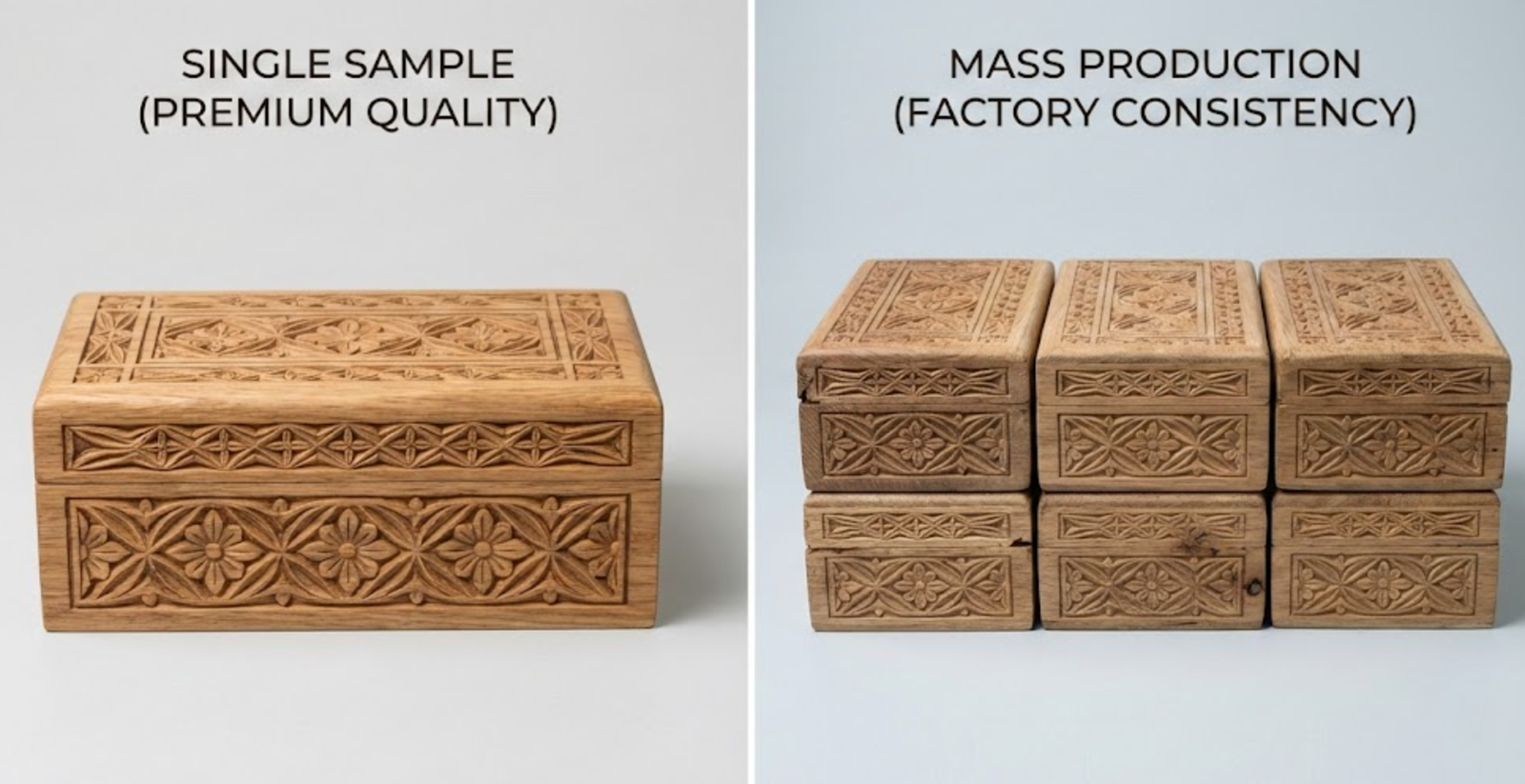
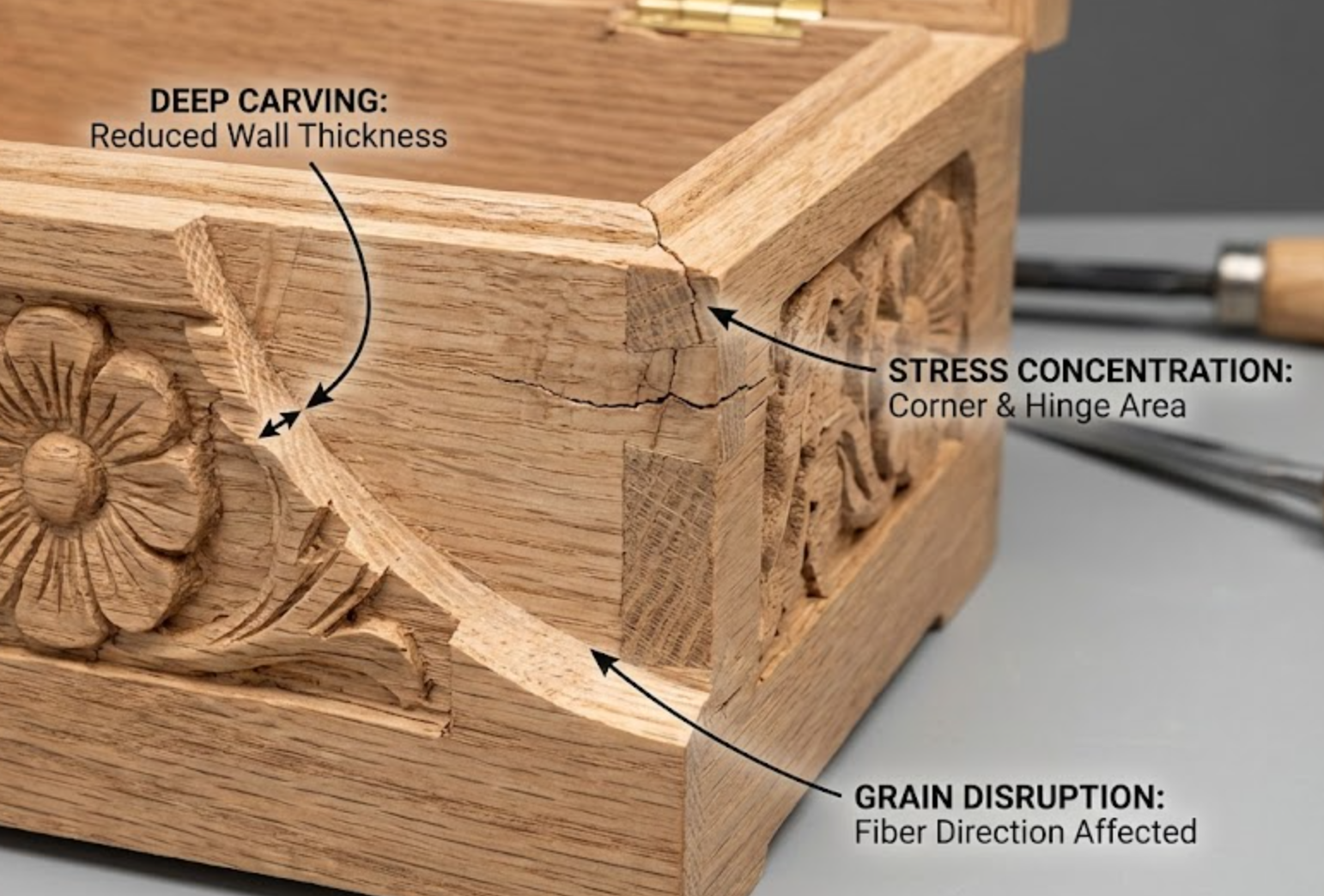
From a factory standpoint, carving matters because it changes wood thickness and stress distribution, raises tooling and setup costs (which push up the MOQ), and makes design quality the deciding factor in whether mass production is actually repeatable. Buyers who treat carving as surface decoration almost always underestimate these three factors.
Common Buyer Misunderstandings (Factory Reality)
1. “Carving is just an extra process”
In practice, carving directly affects crack risk during drying and shipping, hinge and corner strength, and the minimum acceptable wall thickness. Deep carving without a matching structural adjustment is one of the most common causes of bulk defects we see.
2. “All woods carve the same”
Different species react very differently to carving pressure and tool paths. Material choice defines both the visual result and the rejection rate — a pattern that looks crisp in walnut may tear out badly in soft pine.
3. “If the sample looks good, mass production is safe”
Samples often involve quiet manual correction by a skilled worker. Wholesale production needs carving designs that can be repeated by machine with stable tolerances — without a craftsman fixing each piece by hand.
Material Differences That Affect Carving Results
From OEM experience, carving performance by material breaks down roughly like this:
- Pine / Paulownia — lower cost and easy to cut, but limited carving depth and prone to fuzzing on fine detail. Best for decorative or gift-oriented SKUs.
- Acacia / Rubber wood — balanced hardness and grain stability, suitable for medium-depth carving. The most common choice for retail and wholesale programs.
- Walnut / dense hardwoods — sharp, crisp carving definition, but higher tooling wear and cost, usually requiring a higher MOQ.
Because the species you pick changes both appearance and reject rate, it pays to settle the material before locking the pattern. Our complete wood materials guide breaks down each species we stock, and for a deeper species comparison see paulownia vs pine vs acacia.
Carving Methods Explained: CNC, Laser and Hand Carving
In wholesale orders the carving method determines cost predictability as much as the design does. There are three common routes, and most programs end up using one as a base with another for accents.
| Method | Consistency at scale | Setup cost | Best for |
|---|---|---|---|
| CNC routing | High — identical every unit | Higher (programming + tooling) | Repeat SKUs, relief patterns, long-term programs |
| Laser engraving | Very high — digital file driven | Low-medium | Logos, fine line art, shallow surface detail |
| Hand-assisted carving | Variable — depends on the worker | Low setup, high labor per unit | Small artisan batches, deep 3D relief |
For most B2B buyers, CNC routing for the relief plus laser engraving for logos and fine detail gives the best balance of cost and repeatability. Hand carving looks beautiful but is risky for large-volume consistency and hard to price reliably.
MOQ & Customization Limits (Factory View)
Carved wooden boxes almost always carry a higher MOQ than plain boxes, because tooling and programming costs are fixed, yield loss has to be absorbed somewhere, and setup time does not scale down linearly on small runs.
The typical OEM logic: simpler surface carving means a lower MOQ; deeper or edge carving means a higher MOQ; and each new pattern counts as a separate SKU with its own setup. Most factories — us included — recommend standardizing the box size first, then varying the carving pattern on top of that shared body. That keeps your per-unit cost down while still giving you a range of designs.
Lead Time and Pricing Expectations
For a carved-box program, plan on roughly 7–14 days for a custom sample and 25–40 days for mass production depending on order size, carving depth and finish. Carving adds cost in three places: tooling/programming (one-time), slower machine cycle time per unit, and a higher reject allowance than a plain box. As a rule of thumb, expect a carved box to land somewhere between 20% and 60% above the equivalent plain box, with the gap shrinking as volume rises and the fixed tooling cost spreads across more units.
Bulk Production Checklist (What Experienced Buyers Verify)
Before confirming mass production, professional buyers usually check:
- Moisture content suitable for carved structures (8–12%)
- Minimum wall thickness retained after carving
- Carving-depth tolerance held consistent across batches
- Edge sharpness and burr control
- Protective packaging designed for carved surfaces
For compliance-sensitive markets, requirements often also include FSC-certified wood (Forest Stewardship Council) and formaldehyde-emission limits such as US EPA TSCA Title VI / CARB Phase 2 for any engineered-wood components.
How CHIC Homeware Handles Carved Wooden Boxes Wholesale
At CHIC Homeware, carved wooden boxes are treated as engineered products, not craft items. Our OEM approach centers on a design-for-production review before sampling, matching carving depth to how each wood actually behaves, clarifying MOQ and cost breakpoints early, and deliberately avoiding carving designs that secretly rely on manual correction to look right.
The priority is repeatability and batch stability — exactly what long-term wholesale programs need. You can see the formats we already produce on our custom wooden boxes page.
Final Thoughts for B2B Buyers
Sourcing carved wooden boxes wholesale is less about artistic complexity and more about controlled manufacturing. The right supplier is not the one who promises the deepest carving — it is the one who can deliver consistent carving, stable cost and predictable lead time at scale, order after order.
Related guides
- OEM Wooden Packaging Boxes for Cosmetics: A Cost‑Efficient, Step‑by‑Step Production Guide
- Custom Wooden Boxes for Brand Packaging: Material, MOQ and Logo Decisions Buyers Should Make First
- China-Made Wooden Stash Box: How to Source a Reliable OEM Manufacturer
- Carved Wooden Box Manufacturer (custom & wholesale)
Frequently asked questions
Questions buyers ask before placing an order
What is the typical MOQ for carved wooden boxes wholesale?
Because tooling and programming costs are fixed, carved boxes carry a higher MOQ than plain boxes. Simple surface carving can start around 500 units, while deeper relief or edge carving usually needs 1,000+ units to absorb setup cost. Standardizing the box body and varying only the pattern is the cheapest way to keep MOQ down.
How much more do carved wooden boxes cost than plain boxes?
Expect roughly 20% to 60% more than the equivalent plain box. The premium comes from one-time tooling, slower machine cycle time per unit, and a higher reject allowance. The gap narrows as volume rises because the fixed tooling cost spreads across more units.
Which carving method is best for bulk orders — CNC, laser or hand carving?
For most wholesale programs, CNC routing for the relief plus laser engraving for logos and fine detail gives the best balance of cost and repeatability. Hand carving produces beautiful deep relief but is hard to keep consistent at volume and difficult to price reliably.
What is the best wood for a carved wooden box?
Acacia and rubber wood are the most popular for wholesale carved boxes thanks to balanced hardness and stable grain. Walnut and other dense hardwoods give the sharpest detail but cost more and wear tooling faster. Soft woods like pine and paulownia suit shallow decorative carving on gift-oriented SKUs.
What is the lead time for custom carved wooden boxes?
Plan on about 7–14 days for a custom sample and 25–40 days for mass production, depending on order size, carving depth and finish.
Why does my sample look better than the mass-production units?
Samples are often quietly hand-corrected by a skilled worker. If the carving design relies on that manual correction, it will not reproduce cleanly by machine at volume. A good factory runs a design-for-production review so the pattern is repeatable without hand fixing.
Can I get a custom carving pattern or my logo on the box?
Yes. Logos and fine line art are best done with laser engraving, while three-dimensional relief patterns are cut by CNC. Each new pattern is treated as a separate SKU with its own setup, so it is most economical to apply different patterns to one standardized box size.
Do carved wooden boxes crack more easily during shipping?
They can if carving is done without structural adjustment, because carving removes material and changes stress distribution. Proper moisture control (8–12%), adequate wall thickness after carving, and packaging designed for carved surfaces keep crack rates low.
Are FSC-certified and low-formaldehyde carved boxes available?
Yes. For compliance-sensitive markets we can supply FSC-certified wood and meet formaldehyde-emission limits such as US EPA TSCA Title VI / CARB Phase 2 for any engineered-wood components. Confirm the requirement at quotation stage so it is built into the BOM.
How do I choose a reliable carved wooden box supplier?
Look for a factory that reviews your design for production before sampling, explains MOQ and cost breakpoints up front, and commits to carving-depth tolerances across batches — not the one simply promising the deepest carving. Consistency, stable cost and predictable lead time matter more than showpiece samples.
Continue Reading
Related articles

May 16, 2026 · Buyer Guides
How to Source a Custom Wooden Cheese Board from China: A 2026 Buyer's Guide
Form factors, materials, the food-contact finish question, MOQ tiers, FOB pricing, FDA/LFGB compliance, and a 12-week sourcing timeline for a private-label wooden cheese board.
Read article →
May 16, 2026 · Buyer Guides
How to Source a Custom Wooden Spice Rack from China: A 2026 Buyer's Guide
Form factors, materials, MOQ tiers, FOB pricing, jar-fit tolerances, FSC / REACH / CARB / FDA compliance, and a 12-week sourcing timeline for a wooden spice rack private-label run.
Read article →
May 16, 2026 · Buyer Guides
How to Source a Custom Wooden Bath Caddy from China: A 2026 Sourcing Playbook
The factory-direct playbook for private-labelling a wooden bath caddy: materials, MOQ tiers, FOB pricing, the four defects to engineer out, FSC / REACH / CARB compliance, and a realistic 12-week sourcing timeline.
Read article →Ready to source?
Reading is great — but a real quote moves the project forward.
Have a wooden product in mind? Send us a brief, sketch or reference photo — we'll come back with a quote and a sample timeline within 24 hours.