Custom Wooden Serving Tray Manufacturer in China: 2026 Sourcing Guide
Solid wood vs plywood vs MDF bases, the handle systems that survive, food-contact and CARB compliance, 2026 FOB price tiers, MOQ, nesting logistics and a 12-week sourcing timeline for a custom wooden serving tray from Ch

On this page
On this page
A wooden serving tray is deceptively simple — a flat base with two handles. Yet it is one of the most-returned wooden homeware categories on Amazon, and the reasons are always the same three: a handle that pulls loose, a base that warps or delaminates, and a felt bottom that peels off the first time it gets damp. None of those are bad luck. They are the predictable result of buying on price from a supplier who builds the cheapest tray that photographs well, not the one that survives a year of real use. For a private-label brand, that is the opening: serving trays sell year-round across home decor, hospitality, spa, vanity and gifting, the average product is fragile, and the construction details that fix it are cheap to specify once you know what they are.
This is the sourcing playbook our factory uses with the brands we manufacture serving trays for — the base construction that decides whether a tray warps, the handle systems that account for most returns, the food-contact rules that apply when a tray actually carries food, the real 2026 FOB price bands, and the logistics quirk that makes trays cost more to ship than cutting boards. If you are evaluating whether to private-label a wooden serving tray from China, this is what we wish every first-time buyer knew before sending the first email.
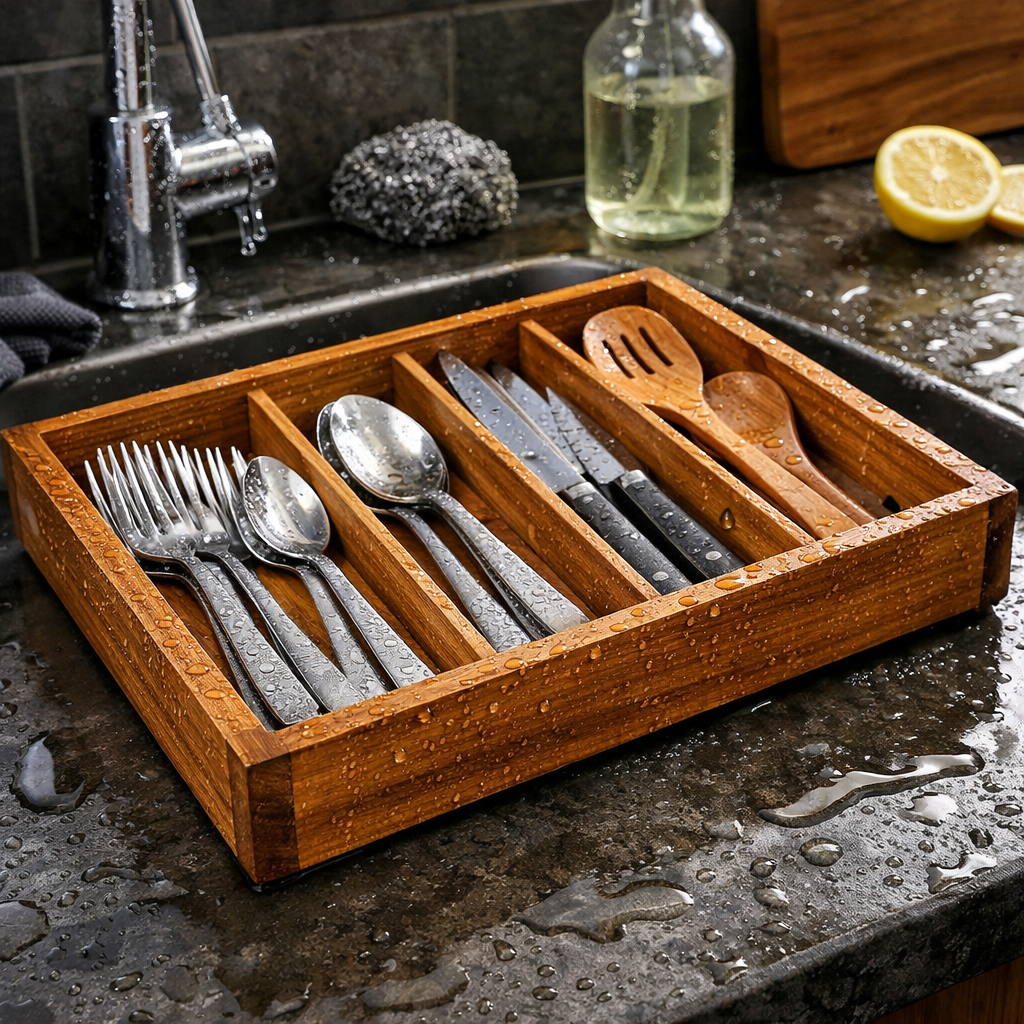
Why wooden serving trays are a strong private-label category in 2026
Three forces make this category attractive. First, demand spans many shelves: the same factory tray sells as a coffee-table decor piece, an ottoman tray, a vanity/perfume tray, a bathroom counter tray, a spa amenity tray and a breakfast-in-bed tray — six search intents, one product. Second, the unit economics are clean: a tray that retails at $29-$69 lands at $2.5-$12 FOB depending on size, wood and base construction, leaving real margin after Amazon FBA fees. Third, the category rewards visible quality — a chamfered solid-wood edge, a felt-lined base and a brass handle are upgrades a buyer pays 2-3x more for, so differentiation is achievable without inventing a new product.
The trap is that "wooden tray" hides three completely different products at three different costs — and a thin quote almost always means the cheapest of the three. Getting the base construction right is the whole game.
The base construction decision: solid wood vs plywood vs MDF
This is the single most important spec in a serving tray and the one cheap suppliers blur. The base is most of the surface area, so it decides durability, weight, look and price. Decide this before anything else.
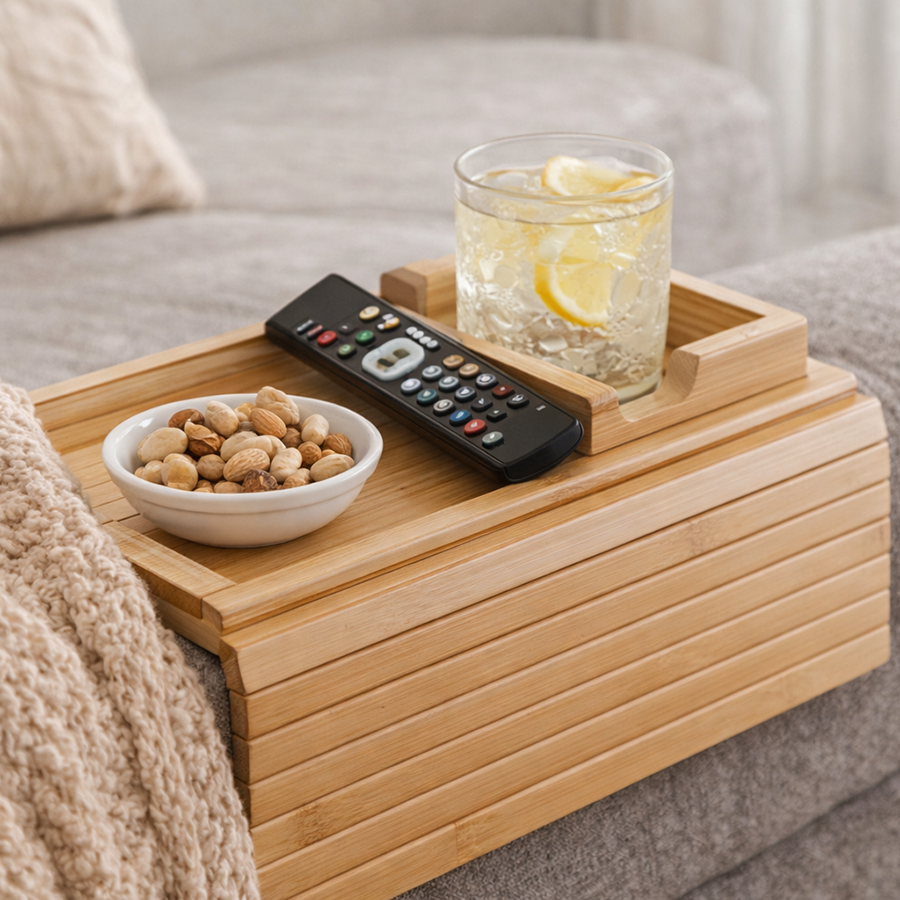
| Base | FOB cost index* | Durability | Look & feel | Best fit |
|---|---|---|---|---|
| Solid wood | 1.6–2.2× | Highest — if kiln-dried & cleated against warp | Premium, real grain, heirloom weight | $45-$99 decor, gifting, vanity, food-contact |
| Plywood / bamboo ply | 1.0× | High — dimensionally stable, won't cup | Clean, light, modern; edge band needed | The workhorse: $29-$59 D2C and Amazon volume |
| MDF (veneer or painted) | 0.75× | Low — swells permanently if it gets wet | Flawless paint/print surface, no grain | Dry decor only; never for food or bathroom use |
*FOB cost index normalised to plywood base at 1.0×, for a 40 × 30 cm tray at 2,000 units.
The practical rule: plywood (or bamboo ply) is the right default for volume retail — it is dimensionally stable, light and cheap, and a solid-wood edge band hides the plies so it reads as solid. Use solid wood when the price point ($45+) and the story (real grain, food-contact, heirloom) justify the cost and weight. Treat MDF as dry-decor only: it gives a perfect painted or printed surface but swells permanently the first time a wet glass sweats on it, so it must never be sold for food service or bathroom use. A supplier who quotes a single "wooden tray" price without asking which base you want is quoting MDF and hoping you won't notice.
Picking the right wood

| Wood / material | FOB cost index* | Strengths | Best fit |
|---|---|---|---|
| Acacia | 1.4× | Bold grain, dense, water-tolerant | Premium solid-wood decor & food trays |
| Bamboo (laminated) | 1.0× | Light, eco-positioned, stable | Volume D2C, kitchen & breakfast trays |
| Rubberwood (Hevea) | 0.95× | Even tone, FSC-friendly, paint/engrave-ready | Budget solid edge, painted & printed trays |
| Paulownia | 0.85× | Very light, won't warp easily | Large decorative trays where weight matters |
| Walnut | 2.6× | Dark, luxury look | $79+ premium gift & decor trays |
| Rattan / seagrass accent | +0.3–0.6× | Texture, "boho" aesthetic, lightweight panel | Mixed-material decor & spa trays |
*FOB cost index normalised to bamboo at 1.0×, plywood-base 40 × 30 cm tray at 2,000 units. Rattan/seagrass shown as an add-on to a wood frame.
Acacia is the premium workhorse — every tray has a unique grain so a mass run still photographs as hand-selected. Bamboo wins on price and eco-positioning for kitchen and breakfast trays. Paulownia is the secret weapon for large decorative trays where shipping weight and warp resistance matter. Rubberwood is the cleanest canvas for painted or laser-engraved trays. A woven rattan or seagrass panel set into a wood frame is the cheapest way to make a stock rectangle look designer. (For a deeper material breakdown see our wood material guide.)
The anatomy of a serving tray that lasts
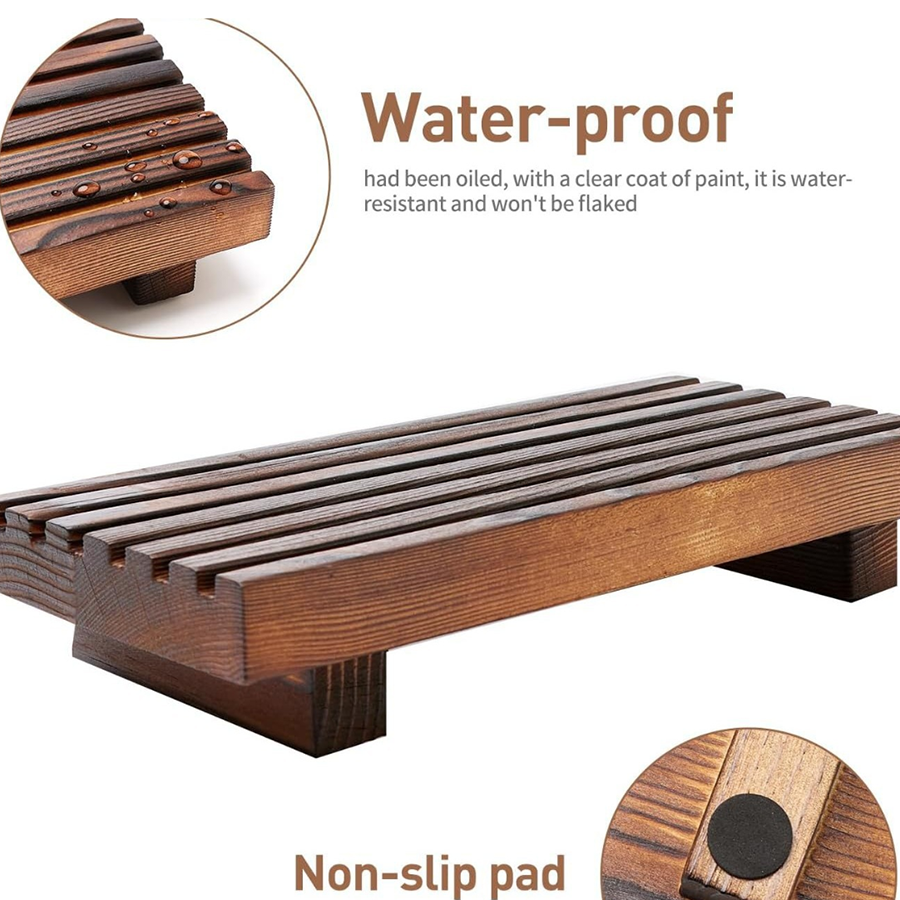
A good tray is engineered as five interlocking systems. Knowing what each should look like lets you tell a serious quote apart from a thin one.
1. Base and warp control
A solid-wood base must be kiln-dried to 8-12% moisture content and, on anything wider than ~30 cm, cleated or framed underneath to resist cupping. A plywood base should be 9-12 mm with a hardwood face veneer and a sealed underside. Ask the factory to log the MC — a supplier who can't is a re-seller.
2. The gallery edge (the raised wall)
The wall that stops cups sliding off. The joint where the wall meets the base is the #2 failure point after handles. Specify a glued and pinned/rabbeted joint, not a butt joint held by glue alone. A 15-25 mm wall height suits most serving trays; bar and breakfast trays go higher.
3. Joinery
Corners should be mitred and reinforced (spline, dowel or bracket), not just glued and stapled. Staples through a visible edge are the fastest tell of a bottom-tier tray. For multi-piece bases, require a D3/D4 water-resistant, low-formaldehyde glue (CARB Phase 2 / TSCA Title VI).
4. Finish
For a decor tray, a durable water-based PU or lacquer is fine and is what most buyers want. For a tray that will carry food, switch to a food-grade oil/wax on the contact surface and say so explicitly in the brief — the finish requirement is completely different and drives both cost and compliance. Spell out sheen (matte / satin / gloss) with a physical reference; "natural" means nothing across a 2,000-unit run.
5. Base protection (felt / feet)
A peeling felt bottom is a top-three return reason. Specify die-cut felt with a strong solvent-resistant adhesive, or — better for wet zones — small silicone or cork feet that won't lift when damp. Glued-on felt in a bathroom tray will fail; plan for it.
Handles: the part that gets returned

More serving trays are returned for handle failure than for any other reason, so treat the handle as a spec, not an afterthought:
- Integrated cutouts: routed into the gallery wall. The most durable — nothing to loosen. Best for spa, hotel and food trays.
- Metal handles: the look most retail buyers want. Specify solid brass or 304 stainless with machine screws into threaded inserts, never wood screws straight into end grain (they strip and pull out).
- Rope / leather: on-trend for boho lines; require reinforced anchor points and a pull-test spec.
- Rattan / cane wrapped: decorative; confirm the wrap is glued and pinned, not just tucked.
Whatever the style, put a handle pull-test (e.g. holds 5 kg for 30 seconds) in your acceptance form. It costs nothing and removes your single biggest return driver.
Food-contact and compliance — only when it applies
A decor or vanity tray that never touches food doesn't need food-contact certification — don't pay for tests you don't need. But the moment the tray is marketed for serving food or drink, the same rules as any food-contact wooden product apply, and marketplaces will ask for them:
| Standard | When it applies | What it covers |
|---|---|---|
| FDA 21 CFR | Food/drink trays, USA | Food-contact safety of the wood and finish |
| LFGB §30/31 | Food/drink trays, Germany / EU | Stricter food-contact migration testing |
| CARB Phase 2 / TSCA Title VI | Any plywood/MDF-base tray, USA | Formaldehyde emission limits for the panel & glue |
| California Prop 65 | USA (CA) | Warnings/limits on paints, stains & finishes |
Note the trap specific to trays: CARB / TSCA Title VI applies to any plywood- or MDF-based tray, food or not, because it covers formaldehyde in the panel and glue — so a "non-food" decor tray with a plywood base still needs it for US import. Add FSC chain-of-custody if you want a sustainability claim; we cover the paperwork in our FSC sourcing guide.
MOQ and price tiers in 2026
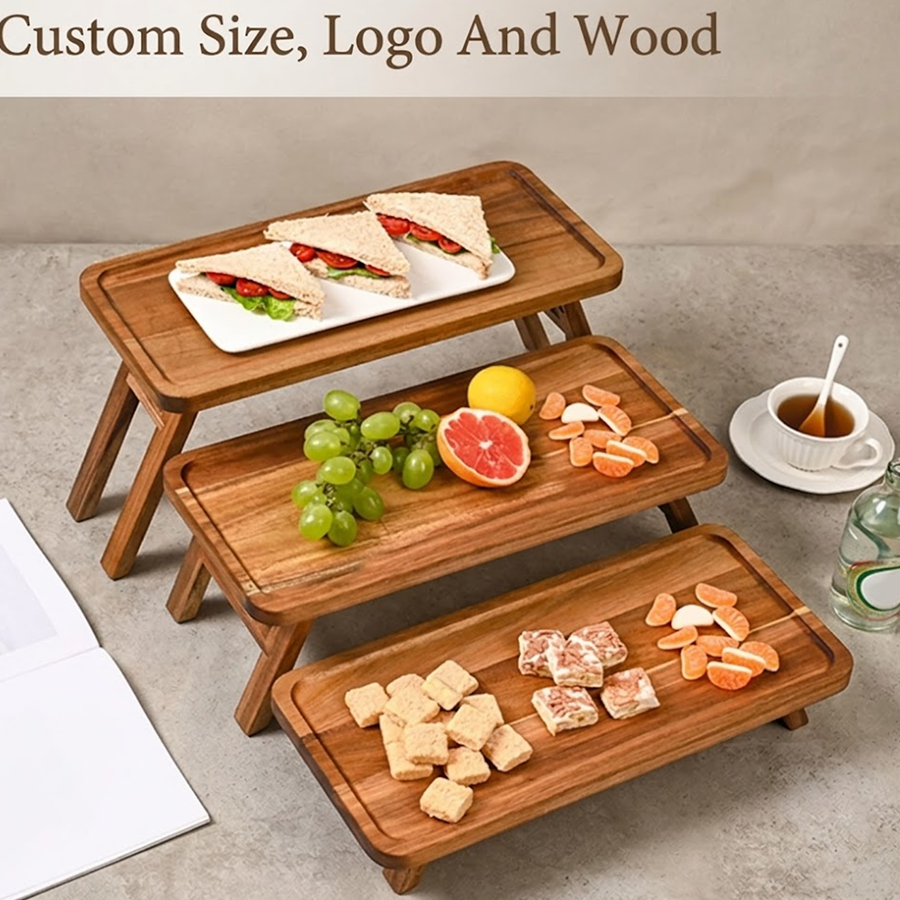
Typical MOQ for a custom wooden serving tray is 500-1,000 pieces per design — lower for a plain plywood tray, higher once you add metal handles, woven panels or a nesting set. Indicative 2026 FOB bands (Xiamen, plywood base unless noted):
| Tray | Size | FOB @ 1,000 | FOB @ 5,000 |
|---|---|---|---|
| Plywood decor tray, cutout handles | 35 × 25 cm | $2.8–$3.8 | $2.3–$3.0 |
| Bamboo tray, metal handles | 40 × 30 cm | $4.0–$5.5 | $3.2–$4.4 |
| Solid acacia tray, brass handles | 45 × 30 cm | $7.5–$10.5 | $6.0–$8.5 |
| Rattan-panel decor tray | 40 × 28 cm | $5.5–$7.5 | $4.4–$6.0 |
| Nesting set of 3 | set | $8–$13 | $6.5–$10 |
Indicative FOB Xiamen, excluding mould/hardware tooling and freight. Real quotes depend on base, wood, handle and finish — ask for the full 500 / 1,000 / 5,000-unit curve, not a single number.
A real factory shares the price curve across volume tiers and breaks out the base, handle and finish as separate line items; a re-seller quotes one bundled number and won't itemise. That single behaviour is the fastest way to tell them apart.
Custom and private-label options
- Branding: laser engraving (logo, monogram) is near-free at volume; UV-printing and pad-printing suit full-colour designs on a smooth plywood or MDF surface.
- Handles & hardware: swap cutout, brass, black-steel, rope or rattan to reposition the same base across price tiers.
- Finish & colour: stain to a PMS-referenced tone, or paint MDF/plywood any colour — the cheapest way to build a coordinated collection.
- Packaging: kraft sleeve, gift box, shrink + barcode — designed for retail shelf or Amazon FBA. We ship drop-tested, FNSKU-labelled cartons straight to Amazon warehouses; see custom packaging for Amazon sellers.
- Sets: nesting sets of 2-3 and tray-plus-accessory bundles are the proven path to higher AOV.
The 12-week sourcing timeline
From first email to trays in your 3PL, a first-order private-label serving tray runs about twelve weeks. Compressing it below eight is where quality corners get cut.
- Week 1: Send a one-page spec brief (size ±1 mm, base type, wood, wall height, handle system, finish & sheen, felt/feet, MC target, branding, packaging, MOQ, target FOB). A good brief returns a quote in 24-48 hours.
- Week 2: Compare quotes from 3-5 vetted factories across volume tiers; pay the sample fee ($40-$120) at your chosen supplier.
- Weeks 3-4: Receive and approve the sample against a written acceptance form (dimensions, finish reference, handle pull-test, "do-not-ship-if" defects).
- Week 5: Wire the 30% deposit by T/T to start mass production.
- Weeks 6-9: Mass production; request weekly progress photos and a mid-line inspection.
- Week 10: Pre-shipment QC at AQL 2.5 (SGS / BV / QIMA) once 80% is finished and packed; wire the 70% balance on pass.
- Weeks 11-12+: Sea freight, customs clearance and last-mile to your warehouse.
Vetting a supplier: seven red flags
- Quotes a single "wooden tray" price without asking which base (solid / ply / MDF) you want.
- Can't state a target moisture content or doesn't own a kiln.
- Uses wood screws straight into end grain for metal handles.
- Holds the gallery wall with glue alone (no pin, spline or rabbet).
- Can't produce CARB / FDA / LFGB certificates within 24 hours when the design needs them.
- Demands 100% payment upfront (industry standard is 30/70).
- Refuses a written handle pull-test or third-party inspection.
For the full factory-vs-trading-company breakdown, read factory-direct vs trading company sourcing; for the closely related tray format, see how to choose the right wooden sofa tray.
Logistics: why trays cost more to ship than boards
Unlike cutting boards, trays have a raised wall, so they don't ship flat — they ship as air. The fix is design for nesting: a slight taper lets trays stack inside each other and can cut shipping volume by 40-60%. Always ask the factory to quote the packed CBM per carton, not just the unit price; a tray that is $0.50 cheaper but doesn't nest can wipe out the saving in freight. FOB Xiamen is the cleanest base Incoterm; the common HS code for wooden tableware/kitchenware is 4419.90 / 4420.90 — confirm with your customs broker. Sea transit from Xiamen runs roughly 18-24 days to US West Coast, 28-34 days to US East Coast, and 32-40 days to EU North ports.
Why brands source serving trays from CHIC
We are a factory-direct wooden products manufacturer with our own production in Xiamen and Caoxian, China, making solid-wood, plywood and bamboo serving, ottoman, vanity, bathroom and spa trays for brands across 60+ countries. That means kiln-dried wood logged at 8-12% MC, reinforced handle systems with pull-test acceptance, CARB / FDA / LFGB documentation on request, nest-optimised packing to cut your freight, full private-label branding and Amazon-FBA-ready cartons shipped direct to your warehouse. We share the real price curve across volume tiers, support 500-piece pilot runs, and develop custom shapes from a sketch.
If you're ready to spec a tray, send us your brief for a quote in 24-48 hours, or browse the full wooden product catalog to see what we already tool.
Frequently asked questions
Questions buyers ask before placing an order
What is the MOQ for a custom wooden serving tray?
Solid wood, plywood or MDF base - which should I order?
What is the best wood for a serving tray?
Do wooden serving trays need food-contact certification?
Why do serving tray handles break, and how do I prevent it?
How much does a custom wooden serving tray cost FOB?
How do I stop a tray from warping or the felt peeling?
Can you private-label and ship to Amazon FBA?
Continue Reading
Related articles

May 29, 2026 · Buyer Guides
Custom Wooden Cutting Board Manufacturer in China: 2026 Sourcing Guide
Edge-grain vs end-grain construction, the woods that survive dishwashing, FDA/LFGB/CARB compliance, 2026 FOB price tiers, MOQ, private-label options and a 12-week sourcing timeline for a custom wooden cutting board from China.
Read article →
May 16, 2026 · Buyer Guides
How to Source a Custom Wooden Cheese Board from China: A 2026 Buyer's Guide
Form factors, materials, the food-contact finish question, MOQ tiers, FOB pricing, FDA/LFGB compliance, and a 12-week sourcing timeline for a private-label wooden cheese board.
Read article →
May 16, 2026 · Buyer Guides
How to Source a Custom Wooden Spice Rack from China: A 2026 Buyer's Guide
Form factors, materials, MOQ tiers, FOB pricing, jar-fit tolerances, FSC / REACH / CARB / FDA compliance, and a 12-week sourcing timeline for a wooden spice rack private-label run.
Read article →Ready to source?
Reading is great — but a real quote moves the project forward.
Have a wooden product in mind? Send us a brief, sketch or reference photo — we'll come back with a quote and a sample timeline within 24 hours.