How to Source a Custom Wooden Spice Rack from China: A 2026 Buyer's Guide
Form factors, materials, MOQ tiers, FOB pricing, jar-fit tolerances, FSC / REACH / CARB / FDA compliance, and a 12-week sourcing timeline for a wooden spice rack private-label run.

On this page
On this page
A wooden spice rack looks like a simple piece of joinery — a few shelves, some jars, maybe a drawer. The buyers we ship for know better. Spice racks live on a kitchen counter for years, in heat, splash and grease, with a dozen glass jars rattling against the wood every time the drawer opens. Get the spec wrong and the jars wobble, the drawer binds in summer humidity, the lacquer flakes off the rim within 18 months. Get it right and you have a category that quietly outsells your cutting boards two-to-one — high perceived value, repeat purchase as a wedding/housewarming gift, and a $39-$69 retail sweet spot.
This is the playbook our factory uses with the brands we manufacture for. It's spice-rack-specific — the dimension tolerances that actually matter, the jar-fit math, the four form factors, the FOB price band, and the compliance paperwork buyers should request before paying a deposit. If you're evaluating whether to private-label a wooden spice rack from China, this is what we wish every first-time buyer knew before the first email.
Why a wooden spice rack is a 2026 private-label opportunity
Three things make this category quietly excellent for a D2C or Amazon brand right now. First, the home-cooking boom that started in 2020 has stabilised into a permanent shift — kitchen organisation spend is up roughly 35% versus pre-pandemic baselines and shows no sign of retreating. Second, the spice rack lives in a customer-photogenic spot (the counter), making it a magnet for user-generated content on Instagram, Pinterest and TikTok. Third, the margin profile is unusually clean: a $39 retail SKU lands at $6-$8 FOB depending on whether you include glass jars, leaving ample room for a $39 price point with healthy gross margin.
The pitfall — and this guide exists because of it — is that the cheap end of this category has serious quality issues that only show up after the product is in service for 60-90 days. Brands that win this category are the ones who treat it like furniture, not a flat-pack import. The rest of this article shows you how.
The four form factors and who each one is for
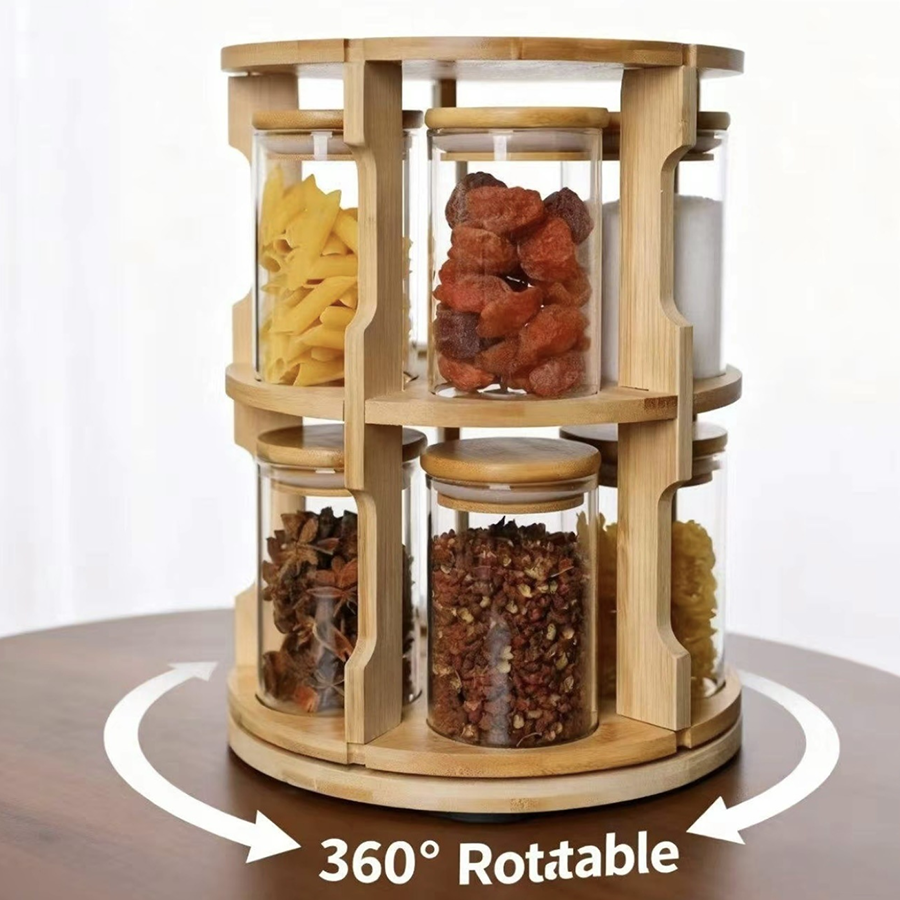
Before you brief a factory, decide which of these four shapes you're sourcing. Each has very different cost economics, packaging, and target customer.
1. Countertop tiered rack
Two or three step shelves, holding 8-16 jars in a footprint of roughly 30 × 18 cm. Cheapest to manufacture (around $2-$4 FOB without jars), easiest to ship, and the most generic. Best for D2C brands going for the highest volume, lowest price point. Limitation: it eats counter space, so cluttered kitchens look cluttered.
2. Rotating carousel ("lazy Susan")
A round base with a single or double-tier carousel spinning on a bearing, holding 12-24 jars. The "spin and pick" UX is the most photogenic and consistently drives the strongest review velocity on Amazon. FOB $4-$7 without jars; with 12-16 included glass jars and chalk labels, $6-$9. Best for D2C / gift positioning at $49+ retail.
3. Wall-mounted shelf
A horizontal rail or shelf bolted to the backsplash, holding 8-12 jars or hanging clips. Saves counter space, has strong appeal for small-kitchen / apartment buyers. FOB $3-$6. The cost gotcha: you must include 4-6 quality wall anchors in the box (drywall + concrete options). Cheap anchors cause returns.
4. In-drawer spice tray / organiser
A flat tray with angled slots that sits inside a kitchen drawer. Hides the spices but loses the visual merchandising. FOB $2.50-$5. Best fit for the "minimalist kitchen" aesthetic — Marie Kondo, Joanna Gaines tier buyers. Compatibility risk: standard US drawers vary 18-22" wide, EU drawers are metric — design for the widest market you'll ship to.
Picking the right wood
The wood choice is the single biggest lever on cost, perceived premium, and longevity. Here's how the four common options compare for a kitchen spice rack:
| Material | FOB cost index* | Heat / grease resistance | Weight | Best fit |
|---|---|---|---|---|
| Moso bamboo (laminated) | 1.0× | Good if sealed | Light | Volume D2C, eco-positioning |
| Acacia | 1.35× | Very high — naturally oily | Medium-heavy | Premium, farmhouse |
| Pine / spruce | 0.75× | Low — absorbs grease, stains | Light | Cheap promo / not recommended |
| Walnut | 2.2× | Excellent | Medium | Luxury, $79+ retail |
*FOB cost index = relative material cost normalised to bamboo at 1.0×, for a 16-jar tiered rack at 5,000 units.
Most first-time private-label orders we ship are laminated Moso bamboo: it's eco-positioned cleanly, takes laser engraving beautifully, and lands at the sub-$6 FOB tier that lets a Shopify brand price at $39-$49 with healthy margin. Brands going premium pick acacia for the grain story. Pine we actively talk buyers out of — it absorbs cooking grease and looks dingy by month four, generating the very 2-star reviews that kill new SKUs.
The anatomy of a spice rack that doesn't fall apart
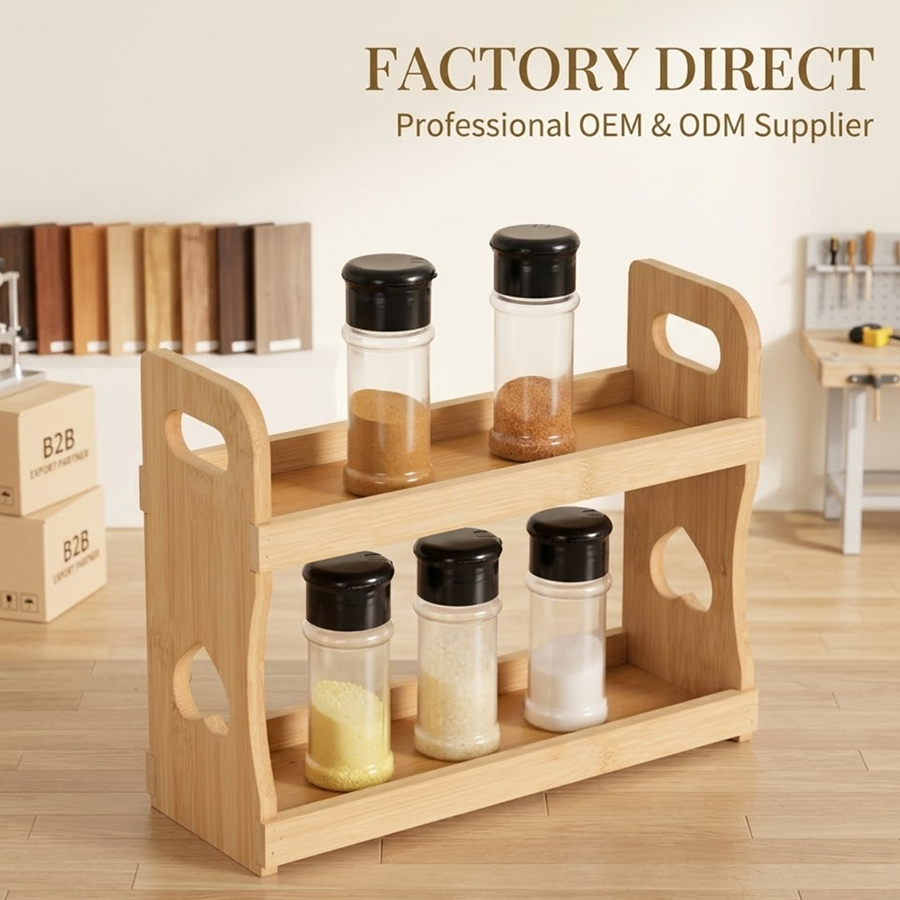
A great wooden spice rack is engineered as five interlocking systems. Knowing what each one should look like lets you tell a serious quote apart from a thin one.
1. Jar slot tolerance
The slot diameter for a glass jar should be 2.5-3.5 mm larger than the jar's outer diameter. Under 2 mm and jars stick when the wood absorbs summer humidity; over 4 mm and they rattle. The standard 4 oz hex spice jar is 47 mm OD — your slot should be 49-50 mm. We mill ours to 49.5 mm at 8% wood moisture content (so it stays inside the band even at 14% MC in service).
2. Drawer mechanism (if applicable)
If your design includes a drawer (some carousels and most countertop racks do), insist on soft-close ball-bearing slides, not the friction-fit wooden runners that cheap factories use. Ball-bearing slides cost $0.45/unit more but eliminate the #1 complaint we see in competitor reviews ("drawer keeps falling out / sticking in summer").
3. The finish
For kitchen use, ask explicitly for food-safe, water-based polyurethane with at least three coats sanded between each. Oil-wax finishes look amazing on day one but absorb cooking grease and need re-oiling every 6 months — most consumers won't, and complain. Pure mineral oil ("butcher block oil") is fine for a cutting board but inadequate for a spice rack near a stove.
4. The jars (when included)
If you bundle jars, specify flint glass (not soda-lime), thickness 2.0-2.2 mm, with stainless steel shaker lids and silicone gaskets. Cheap jars use 1.5 mm soda-lime glass that chips at the rim within a year. The price delta is roughly $0.12/jar — for 16 jars that's $1.92/unit landed cost, worth every cent in review velocity.
5. Labels
Three label options, ranked by perceived premium: blank chalk-label decals (cheapest, most flexible, sub-$0.05/unit), pre-printed bamboo veneer tags ($0.15/unit, photographs beautifully), and laser-etched glass jars ($0.35/jar, luxury tier). The chalk-label SKU is also a content marketing engine — buyers post their handwritten label photos and tag your brand for free.
Five defects we see in cheap spice racks
- Jar wobble after 60 days. Caused by under-dried lumber (>14% MC at lamination). Bamboo strips should be kiln-dried to 8-12% MC before they hit the press. Ask suppliers for kiln logs — a real factory has them.
- Drawer binding in summer. Friction-fit wooden runners swell when humidity crosses 70%. Solved by ball-bearing slides (above).
- Finish flaking near the stove. Single-coat or oil-only finishes can't cope with the heat-and-grease cycle. Three coats of water-based PU is the baseline; UV-cured topcoat is the upgrade.
- Glass jar chipping at the rim. Almost always cheap soda-lime glass under 2 mm thick. Switching to 2.0-2.2 mm flint glass is $0.12/jar.
- Lid threads stripping. Plastic shaker lids strip after 6 months of daily use. Stainless steel shaker lids add $0.20/jar and last the product's lifetime.
The 12-week sourcing timeline
From the day you first email a Chinese factory to the day the container clears your port, plan on 10-12 weeks for a first run. Here's how that decomposes:
flowchart LR
  A[Week 1
Spec brief + jar quantity sent] --> B[Week 1-2
Quote returned + sample fee paid]
  B --> C[Week 2-3
Sample produced
incl. jars + labels]
  C --> D[Week 4
Sample approval
30% deposit]
  D --> E[Week 4-7
Mass production
3-4 weeks for 5k units]
  E --> F[Week 7
Pre-shipment QC
AQL 2.5 + jar count]
  F --> G[Week 8
Balance + BL release]
  G --> H[Week 8-11
Sea freight Xiamen
to US/EU port]
  H --> I[Week 11-12
Customs + 3PL receiving]
The hidden risk in this timeline is the jar-fit loop. If your sample arrives with the wrong jar slot tolerance, fixing the mould adds 7-10 days. Build a dimension-acceptance form with the jar OD, slot diameter, and a written "do-not-ship-if" clause for each of the five defects above.
MOQ and price tiers in 2026
FOB Xiamen price band in mid-2026 for a standard bamboo countertop rack with 12 included flint-glass jars and stainless lids, water-based PU finish, laser-engraved logo:
| Order volume | FOB / unit (USD) | What you unlock |
|---|---|---|
| 300 - 499 units | $7.50 - $9.00 | Stock design only, basic logo |
| 500 - 1,999 units | $5.80 - $7.40 | Custom stain + branded sleeve + label set |
| 2,000 - 4,999 units | $4.20 - $5.80 | Bespoke dimensions + custom jar quantity + colour box |
| 5,000+ units | $3.20 - $4.40 | New tooling, custom-printed packaging artwork |
A worked example: 5,000 units, with 12 jars, FOB Xiamen
To make the numbers concrete, here is the cost stack we routinely quote for a 5,000-unit run of a bamboo two-tier countertop spice rack with 12 flint-glass jars, stainless steel shaker lids, water-based PU finish, custom Pantone stain, laser-engraved logo, chalk-label decal set, and a printed colour box with foam insert. FOB Xiamen per unit lands at roughly .40 — a 7,000 PO. Sea freight on a 40-foot HQ container to Los Angeles or Long Beach runs ,800-,200 in mid-2026 depending on the carrier. US import duty at HS code 4419.19 is currently 0% under the most-favoured-nation tariff, plus the applicable Section 301 surcharge — confirm the current rate with your broker. Add roughly ,200 for customs brokerage, drayage and palletisation. Landed unit cost typically settles between .40 and .20 — well under the 9-9 D2C retail price the bundled-jars SKU commands. The without-jars version of the same SKU lands at roughly .20 and supports a 9-9 retail price.
The without-jars version runs roughly $2-$3 cheaper per unit. The economics flip sharply at 2,000 units — below that you're amortising sample and mould costs; above it you start to see real volume discounting. Brands launching this category often run a 500-unit pilot to validate the listing, then re-order at 2,000+ for proper unit economics.
Customisation: where private label actually wins
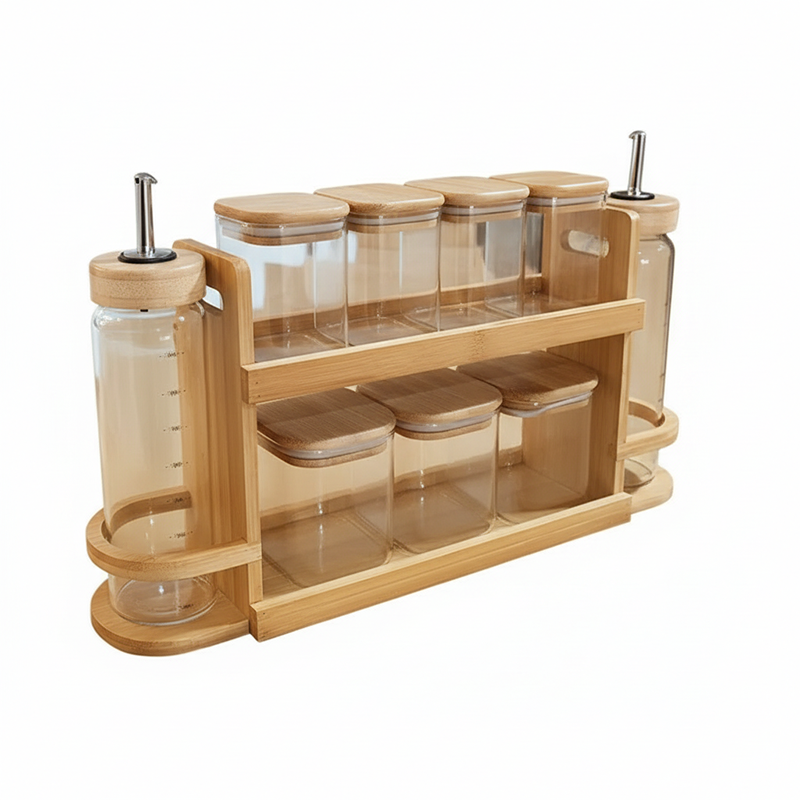
- Logo branding. Laser engraving is included free at most factories (ours included). UV-printed logos add ~$0.18/unit and allow full colour. Hot-stamped foil adds $0.35/unit and reads luxury.
- Wood tone. Five stock stains (natural, walnut, espresso, whitewash, charcoal) are free. Custom Pantone match: one-time $200 sample fee, no per-unit cost.
- Jar configuration. 8, 12, 16, 20 or 24 jars are stock SKUs. Custom jar shapes (round, hex, square) need a one-time tooling fee of $400-$1,200 depending on geometry, then run at +$0.05-0.20 per jar.
- Label set. Chalk decals (free), printed bamboo veneer ($0.15/unit), laser-etched glass ($0.35/jar) — pick one and price accordingly.
- Packaging. Plain carton free. Branded sleeve $0.50/unit. Full colour box with die-cut foam insert (best for gifting) $1.40-$2.10/unit.
- Inserts. A printed recipe card or label-writing chalk pen each add $0.25-$0.40 in landed cost and noticeably lift average order value.
Compliance: certifications buyers will ask about
Spice racks sit at the intersection of "food-contact" and "composite wood" regulations because the jars touch spices that touch food. Make sure your supplier can produce:
- FSC chain-of-custody — Forest Stewardship Council certification on the bamboo or hardwood. Ask for the supplier's FSC licence code and verify it on the FSC public register.
- FDA / LFGB food-contact — For the glass jars and any wood surface that touches loose spices. Both are testable; a factory that supplies the US/EU should have certs on file.
- REACH (EU) — Covers the residual chemistry of lacquer, stain, and the adhesives between bamboo strips. Ask for an SVHC declaration.
- CARB Phase 2 (US) — California's formaldehyde-emissions cap on composite wood adhesive. Federal TSCA Title VI mirrors this. Specify E0 (CARB-compliant) glue at quote stage.
- ISPM-15 — Phytosanitary mark on the wooden pallets in your container. Usually handled by the forwarder, but worth confirming — non-compliant pallets force fumigation at destination port.
For brands targeting North America specifically, the USDA APHIS guidance is the cleanest reference document on wood-import phytosanitary requirements.
Vetting a supplier: red flags
- Cannot send a factory video on request. Real factories dispatch a 30-second walk-through within a day.
- Quote excludes the jars and labels. A real spice-rack factory quotes the full assembled SKU, not "rack only, jars sourced separately." The "sourced separately" line is how trading houses hide a 25% markup.
- No FSC code, just an FSC logo. A licence code (e.g. FSC-C012345) is verifiable; the logo alone is meaningless.
- Refuses third-party inspection. A factory that won't accept SGS, BV or QIMA pre-shipment QC is hiding something.
- Demands 100% upfront payment. Industry standard is 30% deposit, 70% before bill of lading. 100% upfront is either a scam or a factory with no working capital — both are bad news.
- No glass-jar test reports. Any serious supplier of glass jars has SGS or BV test reports for thickness, drop-test, and lead-cadmium migration. Ask for them.
Logistics: container math
A 16-jar bamboo countertop spice rack in a colour box averages 2.6 kg and packs at roughly 32 × 22 × 14 cm. That means:
- A 20-foot container holds ~2,400-2,800 racks depending on stack pattern.
- A 40-foot HQ holds ~5,200-6,000 racks — usually the right unit for a 5,000+ run.
- HS code: 4419.19 (tableware and kitchenware, of wood). Verify with your customs broker.
On Incoterms: FOB Xiamen is the cleanest base — you pay for the goods at the rail of the ship, your forwarder handles the rest. DDP is operationally simpler for first-time importers (supplier handles everything including duty) but adds 15-20% to landed cost. For volumes above 1,000 units we recommend setting up your own forwarder relationship and quoting FOB.
Where to go from here
The cheapest mistake in a private-label spice rack is to under-specify the jar-fit tolerance. The expensive ones — wobbly jars, broken glass in transit, finish failure within a year — are all upstream of the first PO, in the spec sheet. If you take one thing from this guide, take that: spending an extra hour on the spec sheet saves three weeks of back-and-forth WeChat messages.
If you'd like a second pair of eyes on a quote you've received, or a sample of how we run this category, our team is happy to put a no-pressure proposal in front of you. We've shipped this product for US, EU, Australian and Japanese brands — the spec template above is on the house.
Frequently asked questions
Questions buyers ask before placing an order
What's the minimum order quantity for a custom wooden spice rack?
Industry standard is 500 units for a full private-label run with custom stain, logo and branded packaging. We accept trial runs from 300 units on stock designs with basic laser engraving, but per-unit cost is 35-45% higher than a 2,000-unit run.
How long from first email to the container at my port?
10-12 weeks for a first order: 1 week for the quote, 2-3 weeks for the custom sample (longer if jars / labels are included), 3-4 weeks of mass production, 1 week of pre-shipment QC, and 3-4 weeks of sea freight. Repeat orders run 7-8 weeks because sampling is skipped.
Should I include glass jars and labels in the box?
For D2C / Amazon, almost always yes — the bundled SKU converts better and commands a $10-$20 retail premium versus the rack-only version. Add roughly $1.50-$2.50 to your landed cost for 12-16 flint-glass jars with stainless steel shaker lids. For B2B / hospitality buyers selling to chefs, rack-only is often preferred since they have their own jar standards.
Bamboo or acacia — which is better for a spice rack?
Laminated Moso bamboo is lighter, ~30% cheaper FOB, and matches an eco-positioning cleanly. Acacia is heavier, shows richer grain, and resists kitchen grease slightly better thanks to natural oils. For sub-$50 retail, bamboo wins on economics; above $60 retail, acacia or walnut start to make sense. We routinely run both in parallel for brands that want a “good / better” SKU pair.
Can you produce a sample before I commit to a full order?
Yes — sample fees run $50-$120 depending on complexity (with or without jars, custom mould, custom packaging) and are credited back against the first production order. Sample lead time is 7-10 working days for an existing design, 14-21 days for a new mould (e.g. custom jar slot diameter or carousel base).
What certifications should I ask for?
For a wooden spice rack with included jars specifically: an FSC chain-of-custody code (verifiable on the FSC public register), FDA or LFGB food-contact certification on the jars, a REACH SVHC declaration if you sell into the EU, CARB Phase 2 / TSCA Title VI compliance on the bamboo lamination adhesive, and ISPM-15 fumigated pallets in the export container. We can issue all five — ask any serious supplier to do the same before you place a deposit.
Does it come fully assembled?
Yes — every rack we ship is fully assembled, jars are individually polybagged inside the rack slots, and the unit is shrink-wrapped before being placed in an export carton or branded colour box. End consumers receive a one-piece product; they only fill the jars and apply labels.
What payment terms?
Standard private-label terms for a first order are 30% deposit by T/T, 70% balance by T/T before the bill of lading is released. PayPal is accepted for the sample fee only — bank fees make it impractical at production volumes. Repeat buyers move to L/C at sight or open-account terms after the third PO.
What's the biggest quality issue you see in competitor samples?
Jar wobble within 60 days, caused by under-dried bamboo (above 14% moisture content at lamination). Bamboo strips should be kiln-dried to 8-12% MC before they hit the press, and the jar slot should be milled at the dry-end of that band (we mill at 49.5 mm for a 47 mm OD jar) so it stays inside tolerance even at 14% MC in service. Ask suppliers for kiln-log data; if they can't produce it, that tells you everything.
DDP or FOB?
Both. For first orders or pilots under 1,000 units, DDP-to-door is operationally simpler and usually worth the 15-20% premium over FOB — we handle customs and duty. Above 1,000 units, most brands we work with move to FOB Xiamen with their own forwarder; the savings get meaningful and you keep flexibility on customs disputes.
Continue Reading
Related articles

May 16, 2026 · Buyer Guides
How to Source a Custom Wooden Cheese Board from China: A 2026 Buyer's Guide
Form factors, materials, the food-contact finish question, MOQ tiers, FOB pricing, FDA/LFGB compliance, and a 12-week sourcing timeline for a private-label wooden cheese board.
Read article →
May 16, 2026 · Buyer Guides
Comment trouver un caddie de bain en bois personnalisé en provenance de Chine: un manuel de sourcing 2026
Le playbook usine-direct pour le privé-étiquetage un chariot en bois de bain: matériaux, niveaux de MOQ, prix FOB, les quatre défauts à machiner, conformité de FSC / REACH/CARB, et chronologie réaliste d'approvisionnement de 12 semaines.
Read article →
Apr 29, 2026 · Buyer Guides
Support à épices en bois personnalisé avec bocaux en verre: ce que les marques de cuisine doivent savoir avant de commander en gros
Read article →Ready to source?
Reading is great — but a real quote moves the project forward.
Have a wooden product in mind? Send us a brief, sketch or reference photo — we'll come back with a quote and a sample timeline within 24 hours.