How to Source a Custom Wooden Cheese Board from China: A 2026 Buyer's Guide
Form factors, materials, the food-contact finish question, MOQ tiers, FOB pricing, FDA/LFGB compliance, and a 12-week sourcing timeline for a private-label wooden cheese board.

On this page
On this page
A wooden cheese board is one of those product categories that quietly punches well above its weight. The retail SKU is small, simple, and ships flat. The market is enormous — every wedding registry, every Wayfair "entertaining" category, every gift shop carries them — and the average online review score for the cheap ones hovers around 3.4 stars, which is unusually weak for a category this popular. That gap, between "huge demand" and "average product quality," is exactly the kind of market a private-label brand can win in 12 months with a serious spec.
This is the playbook our factory uses with the brands we make cheese boards for. It's cheese-board-specific — the food-contact certifications that actually matter, the juice-groove geometry, the knife-magnet hardware, the FOB price band, and the supplier red flags. If you're evaluating whether to private-label a cheese board from China, this is what we wish every first-time buyer knew before the first email.
Why a wooden cheese board is a 2026 private-label opportunity
Three forces stack in favour of this category in 2026. First, the home entertaining trend that started in 2020 has matured into a permanent buying pattern — charcuterie nights, wine-and-cheese gifting, and the “girl dinner” aesthetic on TikTok have collectively kept search demand for “charcuterie board” growing 22% year-over-year. Second, the product is a quintessential gift SKU — wedding, housewarming, holidays, corporate gifting all drive repeat purchase from the same buyer. And third, the unit economics are exceptionally clean: a $59 retail SKU lands at $5-$8 FOB depending on size, material and accessories, leaving genuine margin even after Amazon FBA fees.
The pitfall is the food-contact compliance side. Buyers and marketplaces (Wayfair, Crate & Barrel, Williams Sonoma, even Amazon) increasingly require FDA / LFGB documentation on the wood AND any included accessories like knives, magnets, ramekins. A factory that can't produce these in 24 hours will lose your order to one that can.
The three form factors and who each one is for
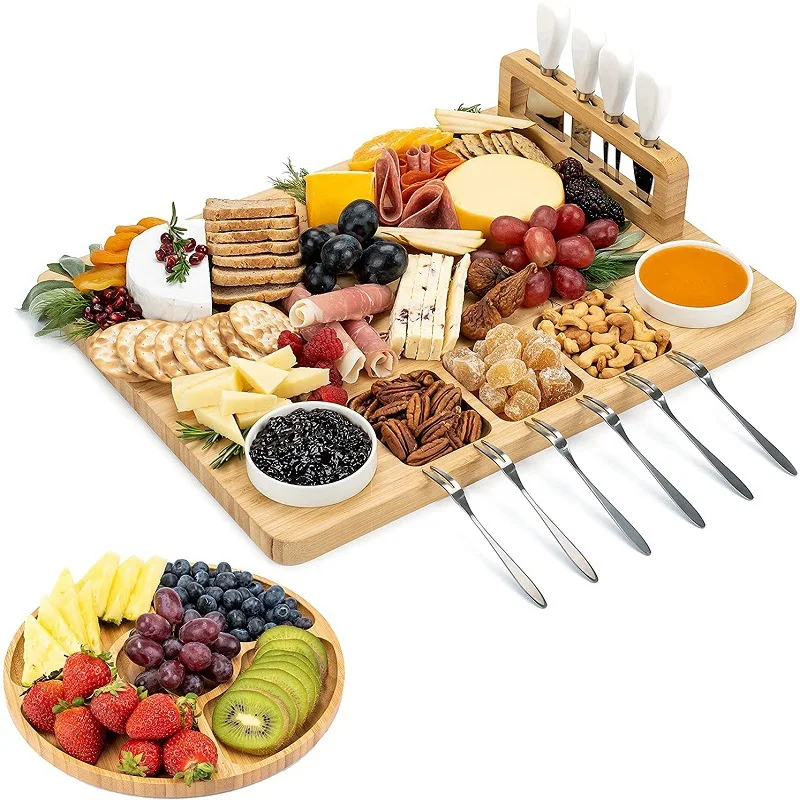
1. Single-piece flat board
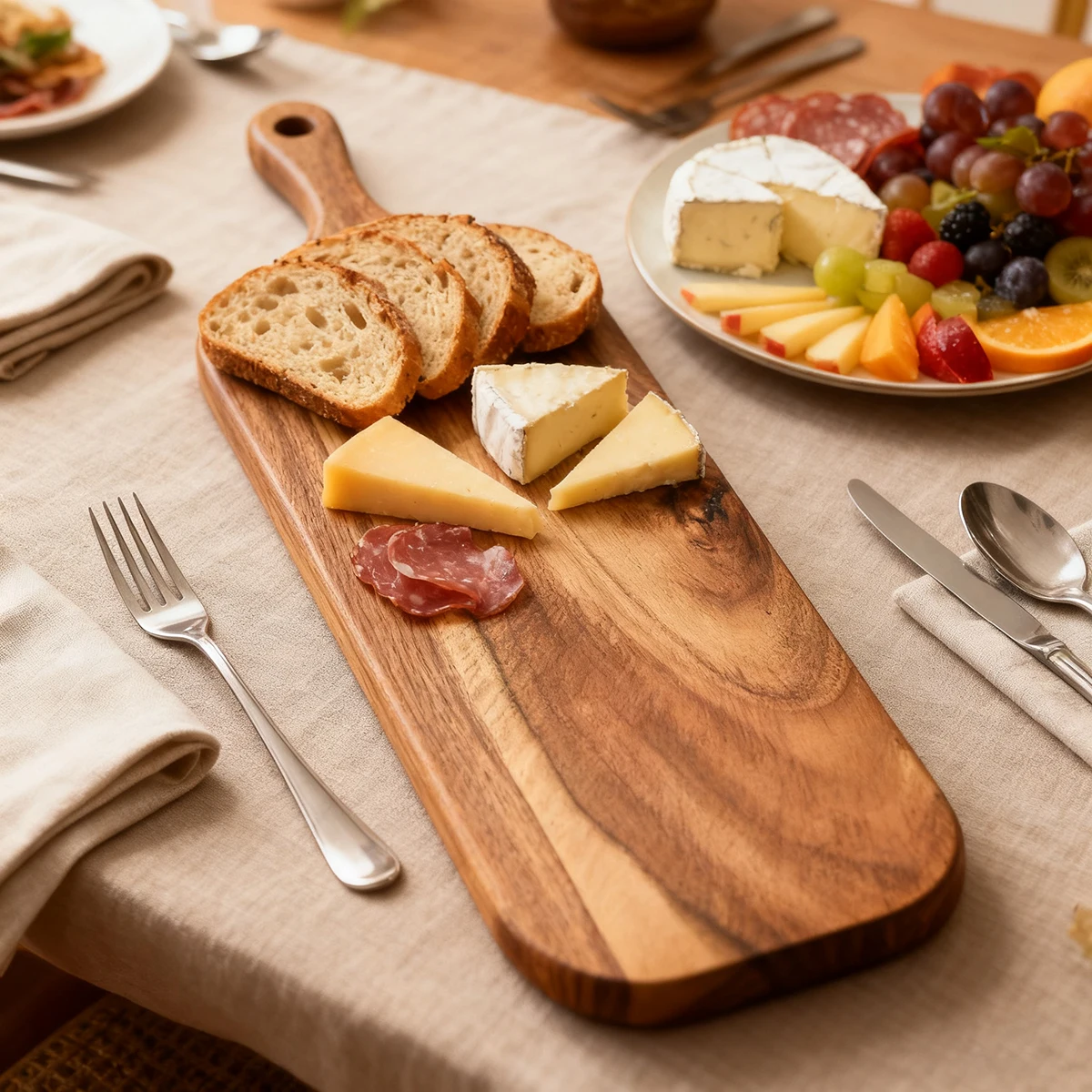
The classic shape: a single rectangle or round of solid wood, typically 30-46 cm long, with or without a juice groove. Cheapest to ship and the easiest to keep food-safe. FOB $2-$5 depending on dimensions and material. Best for D2C brands going for the highest volume, lowest price point. The risk is that with no accessories it can read as “cutting board with a marketing name change” — invest in finish quality and gift packaging to differentiate.
2. Multi-tier or slide-out drawer board
A solid board with a hidden drawer (or two) underneath, holding 4-6 cheese knives, a slate centre panel, and 2-4 ceramic ramekins. FOB $6-$11. The drawer-and-knives format is the dominant winner on Amazon and Wayfair in this category — review velocity is roughly 3x the single-board version because the unboxing experience is genuinely surprising. Best fit for the $59-$99 retail tier.
3. Lazy Susan / rotating charcuterie
A circular board on a rotating bearing, often with sectioned compartments for olives, nuts, jams. FOB $8-$14. Niche but high-AOV — these regularly retail at $99-$129 and have an unusually strong holiday-gifting bump. The bearing is the single highest-defect part — insist on a stainless steel ball-bearing, not nylon.
Picking the right wood
| Material | FOB cost index* | Food-safety | Grain look | Best fit |
|---|---|---|---|---|
| Acacia | 1.35× | Excellent — naturally antimicrobial oils | Bold, varied, “wedding-gift” aesthetic | Premium D2C, gifting, wedding registry |
| Moso bamboo (laminated) | 1.0× | Good if sealed; native silica | Even, light, modern minimal | Volume D2C, eco-positioning |
| Walnut | 2.4× | Excellent | Dark, dramatic, luxury | $79+ luxury / premium-gift only |
| Olive wood | 2.8× | Excellent — oily, naturally antimicrobial | Unique swirl pattern, very high-end | $99+ Mediterranean / luxury |
| Beech / maple | 0.95× | Good | Plain, pale, generic | Cheap promo / not recommended |
*FOB cost index normalised to bamboo at 1.0×, for a 40 cm single-piece board at 5,000 units.
Acacia is the workhorse of this category for one structural reason: every board has a unique grain pattern, so the marketing photos look hand-selected even when 5,000 are mass-produced. Bamboo wins for eco-positioning at sub-$50 retail. Walnut and olive wood only make sense for premium gifting at $79+; below that the raw material cost crushes margin.
The anatomy of a cheese board that lasts 5 years
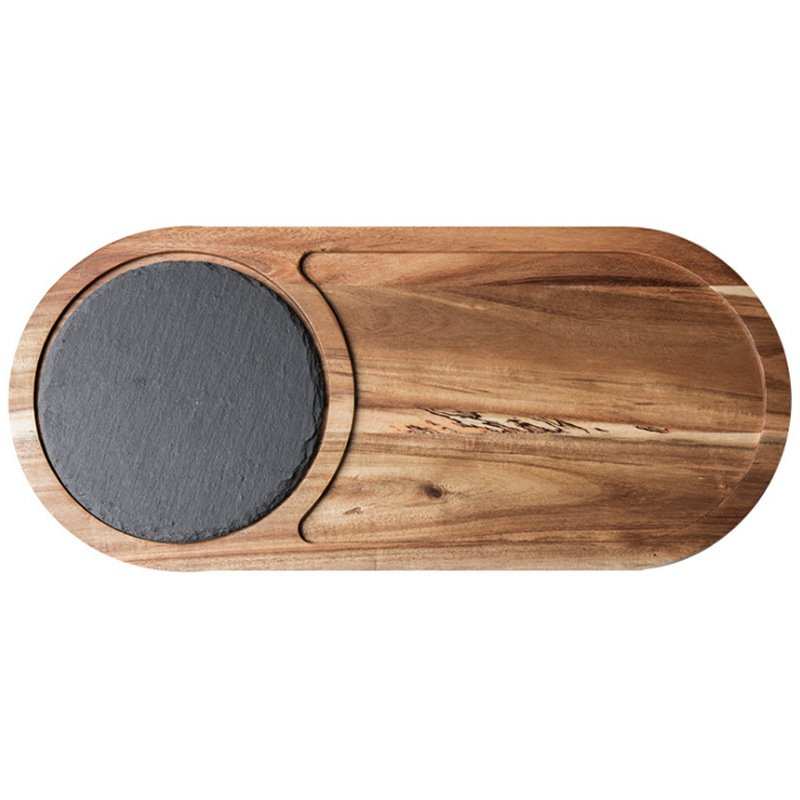
A great cheese board is engineered as five interlocking systems. Knowing what each one should look like lets you tell a serious quote apart from a thin one.
1. The juice groove
The perimeter channel that catches brie runoff, olive oil and cheese drippings. The ideal groove is 6-8 mm deep, 10-14 mm wide, with a rounded inner profile (not a sharp V). Anything shallower than 5 mm overflows in normal use; anything sharper than a soft U traps crumbs that won't hand-wash out. Cheap factories often skip the groove entirely or mill a token 3 mm trench that's pure cosmetics.
2. The finish
For a food-contact board, the only correct finish is food-grade mineral oil + beeswax / carnauba wax blend, applied as 3 saturating coats. NEVER use polyurethane, lacquer or any varnish on a cheese board — they're not food-safe under knife contact, and they fail visibly within months. Buyers care about this; we get explicit "no PU finish" specs from roughly 70% of EU buyers and 50% of US buyers.
3. The hardware (drawers, knives, magnets)
If your design has a knife drawer or magnet-strip knife storage, this is where cheap factories cut corners. Specify 304 stainless steel (not 201 or 410) for any food-contact knife or magnet. Drawer pulls should be solid brass or 304 stainless — chrome-plated zinc looks fine on day one and corrodes within a year of dishwashing. Ball-bearing slides, not friction-fit rails.
4. Knife sets (if included)
If you bundle a 4-knife set (standard charcuterie kit: cheese fork, hard-cheese knife, soft-cheese spreader, all-purpose), specify full-tang 304 stainless steel blades with wooden handles bolted through, not glued. Glued handles loosen within 2 years of dishwashing. The cost delta is roughly $0.40/knife. For a 4-knife set, $1.60/unit lift, well worth it for review velocity.
5. Slate panel (if included)
Many premium charcuterie boards integrate a slate insert for writing cheese names in chalk. Natural slate is heavy and ships well, but cheap factories substitute composite slate (resin-bonded slate powder) that chips at the edges. Specify natural Brazilian or Indian slate, 4-6 mm thick, with eased edges. Cost difference is about $0.50/unit.
Five defects we see in competitor samples
- Warping after first dishwasher cycle. Cheese boards should be hand-washed only, but consumers WILL put them in the dishwasher despite the care card. Boards from under-dried lumber warp permanently on first cycle. Solution: kiln-dry to 8-10% MC before lamination, then condition for 7 days in the assembly room.
- Juice groove cracking. Caused by milling against the grain. The juice groove should always be milled in the same direction as the wood's primary grain to avoid stress fractures. A real factory plans the grain orientation per board.
- Knife handle loosening. The cheap fix (glued tang) fails within 18 months of normal dishwashing. Specify riveted or bolted handles.
- Slate panel chipping. Composite slate fakes the look but fails at the edges within a year. Specify natural slate.
- Finish flaking. Almost always a polyurethane or lacquer finish (which is not food-safe in the first place). Specify mineral-oil-plus-wax and the issue disappears.
The 12-week sourcing timeline
flowchart LR
  A[Week 1
Spec brief sent
incl. knife set spec] --> B[Week 1-2
Quote returned + sample fee paid]
  B --> C[Week 2-3
Sample produced
incl. knives + slate + box]
  C --> D[Week 4
Sample approval
30% deposit wired]
  D --> E[Week 4-7
Mass production
3-4 weeks for 5k units]
  E --> F[Week 7
Pre-shipment QC
AQL 2.5 + food-contact test]
  F --> G[Week 8
Balance wired
BL released]
  G --> H[Week 8-11
Sea freight
Xiamen to US/EU]
  H --> I[Week 11-12
Customs + 3PL receiving]
The hidden risk in this timeline is the food-contact compliance loop. If your sample fails LFGB or FDA migration testing, the fix requires changing the finish or adhesive, which adds 7-14 days. Insist that the supplier produces existing FDA or LFGB test reports on the same finish at quote stage, before you pay the sample fee.
MOQ and price tiers in 2026
| Order volume | FOB / unit (USD) | What you unlock |
|---|---|---|
| 300 - 499 units | $5.20 - $7.80 | Stock single-piece board, basic laser engraving |
| 500 - 1,999 units | $4.00 - $5.80 | Custom dimensions + branded sleeve + included knife set |
| 2,000 - 4,999 units | $2.80 - $4.20 | Bespoke shape + drawer + slate + custom colour box |
| 5,000+ units | $2.10 - $3.20 | Dedicated production run, full custom packaging artwork |
These prices are for the single-board configuration. Add roughly $1.60 for a 4-knife stainless steel set, $0.50 for a natural slate panel, $0.80 for 2 ceramic ramekins. The fully-loaded gift set version typically lands at $6.50-$9.50 FOB at 5,000-unit volume, which supports an $89-$129 retail price.
A worked example: 5,000 units, full charcuterie set
For a 5,000-unit run of an acacia drawer-format cheese board with 4 stainless knives, a slate insert, 2 ceramic ramekins, custom Pantone stain, hot-stamped logo, and a printed colour box: FOB Xiamen per unit lands at roughly $7.20 — a $36,000 PO. Sea freight on a 40-foot HQ to Los Angeles or Long Beach runs $3,800-$5,200 in mid-2026 depending on the carrier. US import duty at HS code 4419.19 is currently 0% MFN; verify the Section 301 surcharge with your broker. Add roughly $1,200 for customs brokerage, drayage and palletisation. Landed unit cost typically settles between $8.20 and $9.10 — comfortably supporting a $69-$99 D2C retail tier.
Compliance: certifications buyers will ask about
Cheese boards sit squarely in food-contact regulation territory. Make sure your supplier can produce:
- FDA 21 CFR 175 / 177 food-contact — For the wood, finish, slate, and any ceramic ramekins. Migration testing reports should be on file with your supplier.
- LFGB (EU) — Equivalent German/EU food-contact certification. Required by most European retail buyers.
- FSC chain-of-custody — Forest Stewardship Council certification on the bamboo or hardwood. Ask for the supplier's FSC licence code, then verify it on the FSC public register.
- REACH (EU) — Covers any residual chemistry in the finish, especially relevant if you ever use anything other than pure mineral oil and beeswax.
- CARB Phase 2 (US) — California's formaldehyde-emissions limit on composite wood; relevant if your design uses laminated bamboo. Federal TSCA Title VI mirrors this.
- ISPM-15 — Phytosanitary mark on the wooden pallets in your container; usually handled by the freight forwarder.
For brands targeting North America, the USDA APHIS guidance is the cleanest reference on wood-import phytosanitary requirements. A real factory issues all of the above within 24 hours of a serious enquiry. A factory that delays is either borrowing certificates or doesn't have them.
Vetting a supplier: red flags
- No FDA / LFGB test reports. A cheese-board factory without food-contact migration tests on file is a trading house, not a real manufacturer. Walk away.
- Quote uses “polyurethane finish” or “food-safe lacquer”. No such thing for a cheese board. The correct finish is mineral oil + wax. A factory that proposes PU doesn't understand the product.
- Knives quoted separately as “additional optional accessory”. A real cheese-board factory quotes the full assembled gift set. Itemising the knives is how a trading house adds 25% markup.
- No FSC code, just the FSC logo. A licence code is verifiable; the logo alone is meaningless.
- Refuses third-party inspection. SGS, BV or QIMA pre-shipment inspection is industry standard. A refusal is a red flag.
- 100% upfront payment demand. Industry standard is 30% deposit, 70% before bill of lading. 100% upfront is a scam or a factory with no working capital.
Logistics: container math
A 40 cm acacia single-piece board in a printed colour box averages 1.1 kg and packs at roughly 42 × 22 × 4 cm. The drawer-format version with knives and slate packs at roughly 42 × 22 × 8 cm and 2.4 kg. That means:
- A 20-foot container holds ~5,500-6,500 single-piece boards or ~2,800-3,400 full gift sets.
- A 40-foot HQ container holds ~12,000-14,000 single boards or ~6,200-7,400 gift sets — usually the right unit for a 5,000+ run.
- HS code: 4419.12 (wooden chopping and cutting boards for the kitchen) is the most common classification. Some customs brokers use 4419.19 for serving / non-cutting boards. Verify with yours.
On Incoterms: FOB Xiamen is the cleanest base — you pay for the goods at the rail of the ship and your forwarder handles the rest. DDP is operationally simpler for first-time importers but adds 15-20% to landed cost. For volumes above 1,000 units we recommend setting up your own forwarder relationship and quoting FOB.
Packaging: this is where the gift-shop tier separates from the commodity tier
Cheese boards are bought as gifts more than any other category in our catalogue. Roughly 60% of orders we ship for D2C brands are tagged as gifting (wedding registry, housewarming, holiday) by the end customer. That has two consequences for sourcing. First, the packaging matters as much as the product — a $9 FOB board in a $1.80 colour box outsells a $14 FOB board in a kraft sleeve every single time. Second, the unboxing video is a content marketing asset; design the packaging to look good on TikTok and Instagram, not just in a shipping carton.
- Plain kraft sleeve. Cost: free to $0.30/unit. Adequate for B2B buyers / hospitality, weak for D2C.
- Printed colour sleeve. $0.50-$0.80/unit. The minimum we recommend for any D2C SKU above $39 retail.
- Full custom colour box with die-cut foam insert. $1.40-$2.10/unit at 5,000 volume. The standard for the $59+ gift-SKU tier, and almost universal at $79+. The foam insert holds the knives, slate and ramekins in place during shipping — no rattling.
- Magnetic-close gift box with ribbon pull. $2.40-$3.20/unit. Premium / luxury tier; the unboxing experience is the marketing asset.
Artwork files in AI or PDF format, dieline templates available on request. Packaging dummies (one physical sample of the printed box) take 7-10 days; production then runs in parallel with the board itself.
Where to go from here
The cheapest mistake in a private-label cheese board is to skip the food-contact compliance check at quote stage. The expensive ones — a return wave from finish failure, a Wayfair de-list because the LFGB cert doesn't exist, a TikTok review that goes viral over a chipped slate — are all upstream of the first PO. Spending an extra hour on the spec sheet is worth twenty WeChat messages later.
If you'd like a second pair of eyes on a quote you've received, or a sample of how we run this category, our team is happy to put a no-pressure proposal in front of you. We ship this product for US, EU, Australian and Scandinavian brands; the spec template above is on the house.
Frequently asked questions
Questions buyers ask before placing an order
What is the minimum order quantity for a custom wooden cheese board?
Industry standard is 500 units for a full private-label run with custom stain, logo and branded packaging. We accept trial runs from 300 units on stock single-piece designs with basic laser engraving, but per-unit cost is 35-45% higher than a 2,000-unit run.
How long from first email to a container at my port?
10-12 weeks for a first order: 1 week for the quote, 2-3 weeks for the custom sample (longer if a knife set, slate or ceramic ramekins are included), 3-4 weeks of mass production, 1 week of pre-shipment QC, and 3-4 weeks of sea freight. Repeat orders run 7-8 weeks because sampling is skipped.
Should I include knives and a slate panel?
For D2C / Amazon, almost always yes — the bundled gift set converts roughly 3x better than the bare board and commands a $30-$40 retail premium. Add about $1.60 for a 4-knife stainless set, $0.50 for natural slate, $0.80 for 2 ceramic ramekins. The fully-loaded version typically lands at $6.50-$9.50 FOB at 5,000-unit volume. For B2B / hospitality buyers the bare board often makes more sense.
Acacia or bamboo — which is better for a cheese board?
Acacia, almost always. Bamboo is fine for an eco-positioned $39 retail SKU, but acacia's bold grain pattern is the single biggest visual differentiator in this category. Each acacia board is unique, which doubles as a marketing asset for product photography. Bamboo wins only if you specifically need a lighter board for shipping economics or an eco-only narrative.
Is polyurethane finish OK on a cheese board?
No, never. The correct finish for a cheese board is food-grade mineral oil plus a beeswax or carnauba wax blend, applied as 3 saturating coats. Polyurethane, lacquer and varnish are NOT food-safe under knife contact and fail visibly within months of normal use. A factory that proposes a PU finish for a cheese board doesn't understand the product — treat that as a sourcing red flag.
What certifications should I ask my supplier for?
For a wooden cheese board specifically: FDA 21 CFR food-contact migration reports, LFGB for the EU, FSC chain-of-custody on the wood (with a verifiable licence code), REACH SVHC declaration, and ISPM-15 fumigated export pallets. If knives or a slate panel are included, food-contact certs must cover those too. A real factory issues all of these within 24 hours of a serious enquiry.
Does the board come fully assembled with its accessories?
Yes — every cheese board we ship is fully finished, the knives are seated in the drawer or on the magnetic strip, the slate panel is fitted, and ramekins (if included) are individually polybagged within the colour box. End consumers receive a single-piece gift-ready product.
Can I include a custom monogram or engraved family name?
Yes — laser engraving up to 80 characters is included free at most factories (ours included). For the personalised-gift D2C market, this is the highest-margin SKU we run: a basic acacia board at $4.20 landed plus a $5 engraving fee retails at $79-$99, with the engraving adding zero per-unit production cost.
What payment terms do you offer?
Standard private-label terms for a first order are 30% deposit by T/T, 70% balance by T/T before the bill of lading is released. PayPal is accepted for the sample fee only — bank fees make it impractical at production volumes. Repeat buyers move to L/C at sight or open-account terms after the third PO.
What is the single biggest quality risk in this category?
Warping after the first dishwasher cycle. Cheese boards are hand-wash only, but consumers WILL dishwasher them despite the care card. Boards from under-dried lumber warp permanently on first cycle, generating exactly the 1-star reviews that kill a new SKU on Amazon. Solution: insist on kiln-dried lumber at 8-10% moisture content and a 7-day conditioning period in the assembly room. Ask for kiln-log data — if a supplier can't produce it, that tells you everything.
Continue Reading
Related articles

May 16, 2026 · Buyer Guides
How to Source a Custom Wooden Spice Rack from China: A 2026 Buyer's Guide
Form factors, materials, MOQ tiers, FOB pricing, jar-fit tolerances, FSC / REACH / CARB / FDA compliance, and a 12-week sourcing timeline for a wooden spice rack private-label run.
Read article →
May 16, 2026 · Buyer Guides
Cómo obtener un carrito de baño de madera personalizado de China: un libro de jugadas de abastecimiento 2026
El libro de jugadas directo de fábrica para etiquetado privado de un carrito de baño de madera: materiales, niveles de MOQ, precios FOB, los cuatro defectos para diseñar, cumplimiento FSC / REACH / CARB y un cronograma realista de abastecimiento de 12 semanas.
Read article →
Apr 29, 2026 · Buyer Guides
Estante de especias de madera personalizado con frascos de vidrio: lo que las marcas de cocina deben saber antes de realizar pedidos a granel
Read article →Ready to source?
Reading is great — but a real quote moves the project forward.
Have a wooden product in mind? Send us a brief, sketch or reference photo — we'll come back with a quote and a sample timeline within 24 hours.