
Wooden Tea Box Manufacturing Guide for Distributors and Gift Brands
For distributors, gift brands, and online sellers, a wooden tea box is more than a decorative item. It is a branded, repeatable packaging and gifting solution that must pass through purchasing, logistics, and quality control without surprises. This guide walks you through how Chic Homeware approaches wooden tea box manufacturing from a factory perspective, so you can plan your next OEM or ODM project with clear expectations on materials, structure, customization, and export performance.
1. Defining the Wooden Tea Box Brief for B2B Projects
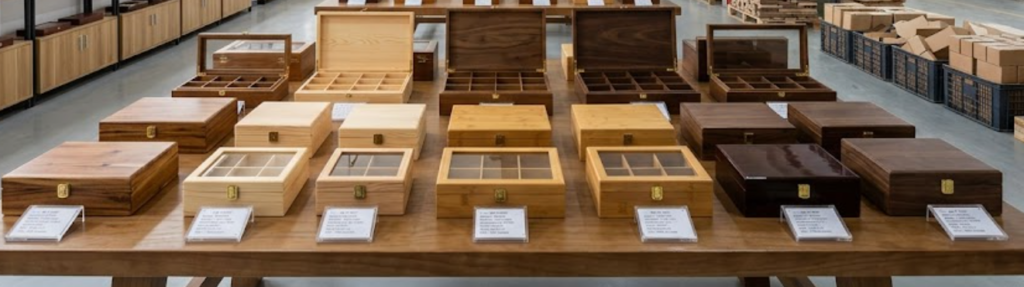
Every successful tea box project begins with a clear technical brief. Before sampling, we recommend that buyers consolidate internal requirements across marketing, packaging, and quality teams.
Key parameters to define at the start:
- Target use case: gift set, retail packaging, hotel amenities, subscription box, or promotional giveaway.
- Tea format: envelope sachets, loose leaf cans, pyramids, or mixed formats.
- Compartment plan: number of grids, fixed or removable dividers, space for non-tea items (honey sticks, spoons, envelopes).
- Brand level: entry-level promotional, mid-range gifting, or premium wooden tea chest for long-term use.
- Channel demands: e-commerce (Amazon, DTC), offline retail, corporate gifting, or subscription model.
- Target landed cost range: to help the factory balance material, sizing, and hardware choices.
With this information, a factory can quickly propose workable material options, dimensions, and surface finishes that match your price and brand positioning.
2. Choosing the Right Wood Material for Tea Boxes
Wood species selection directly affects the price point, perceived value, and stability of your wooden tea box. Chic Homeware works with acacia, pine, paulownia, bamboo, walnut, MDF veneer, and plywood veneer, each suited to different project types.
2.1 Acacia: For Warm, Mid- to High-End Tea Boxes
Acacia is dense, durable, and has a rich grain that works well for mid- to high-end tea gift sets.
- Advantages: natural color variation, good hardness, premium look with clear or light stain.
- Considerations: higher material cost vs softwoods, heavier weight which affects freight cost per carton.
- Best for: gift brands seeking a long-lasting tea chest or hospitality clients needing more robust boxes.
2.2 Pine: Balanced Cost and Natural Look
Pine is a common choice for wooden tea boxes where cost and appearance must stay balanced.
- Advantages: competitive pricing, easy machining, suitable for stains and paints.
- Considerations: visible knots if not carefully selected; needs focused moisture control to avoid warping.
- Best for: volume orders for retailers and distributors, especially when combined with colored finishes.
2.3 Paulownia: Lightweight for E-commerce and Mail-Order
Paulownia is a very light softwood, often preferred for projects where shipping weight is critical.
- Advantages: low weight, good for air shipments and small parcel networks, easy to work with.
- Considerations: softer surface, requires careful packaging and often a paint or thicker lacquer layer for protection.
- Best for: tea box sets for e-commerce sellers that must stay within strict dimensional weight brackets.
2.4 Bamboo: Eco-Focused Image and Clean Grain
Bamboo panels can present an environmentally conscious image and a clean, modern look.
- Advantages: strong, stable, visually uniform, works well with clear lacquer and laser engraving.
- Considerations: panel cost is usually higher than pine and paulownia; edges and end-grain patterns must match your design expectations.
- Best for: brands highlighting sustainable or eco-oriented storytelling, especially for wellness and premium tea lines.
2.5 Walnut: Premium Veneer or Solid Accents
Walnut is typically specified where the box itself is part of the long-term home decor, not just packaging.
- Advantages: dark, high-end appearance; strong perceived value in gift and corporate channels.
- Considerations: higher cost, color consistency must be controlled across batches; often used as veneer over engineered cores.
- Best for: premium corporate gifts, limited editions, and high-ticket tea assortments.
2.6 MDF Veneer and Plywood Veneer: Cost-Effective Stability
For certain designs, a core of MDF or plywood with wood veneer (such as oak, walnut, or generic veneer) is practical.
- Advantages: good dimensional stability; veneer provides consistent appearance; favorable cost for large runs.
- Considerations: edges require proper sealing; overall weight depends on board thickness; must align with your market’s perception of “real wood.”
- Best for: branded tea boxes with tight budget targets that still require a uniform wood-like appearance.
3. Critical Production Checkpoints for Stable Tea Box Supply
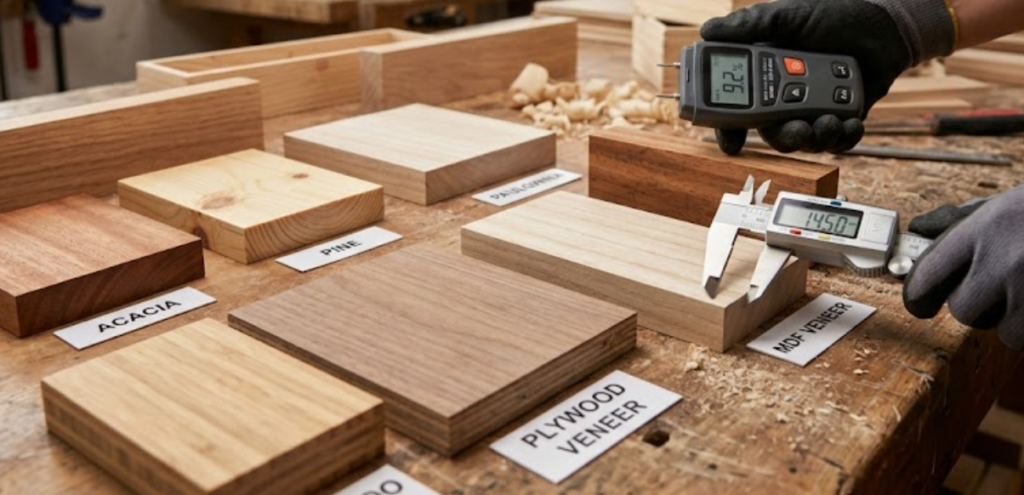
Tea boxes are functional packaging that often spend months in transit, warehouses, and end-user homes. Consistent quality across shipments matters more than a single perfect sample. Chic Homeware focuses on specific factory checkpoints that influence structural stability, appearance, and long-term performance.
3.1 Moisture Control and Warping Prevention
Moisture content is a core parameter for wooden tea box production. If wood is too wet at machining or assembly, boxes may warp, twist, or lid gaps may appear later.
- Incoming wood control: checking moisture levels of boards or panels before cutting.
- Climate consideration: adjusting drying and storage approaches based on your destination market (humid vs dry climates).
- Glue and assembly timing: allowing proper conditioning time before final sanding and finishing.
We encourage B2B buyers to include flatness and lid alignment requirements in their QC documentation, so moisture can be managed proactively during production.
3.2 Sanding Consistency and Edge Quality
Sanding impacts both appearance and safety. Inconsistent sanding leads to rough patches, visible machine marks, and a non-uniform finish after staining or painting.
- Grit sequence: defined sanding steps depending on wood type and finish (e.g., clear lacquer vs opaque paint).
- Edge treatment: slightly rounded or chamfered edges to reduce chipping and improve lacquer adhesion.
- Touch inspection: random checks to ensure surfaces feel smooth and aligned with brand requirements.
3.3 Stain, Paint, and Clear Finish Control
Tea boxes often use transparent stains to showcase grain or painted finishes to match brand colors.
- Color approval by sample board: confirming stain or paint tone against a reference board, not just photos.
- Layer control: defining the number of coats, sanding between coats, and target gloss level (matte, semi-matte, glossy).
- Food-contact context: while the box does not usually contact food directly, many buyers prefer low-odor, compliant coatings suitable for markets like the EU and US.
For multi-color branding, we often combine stained external surfaces with painted interior compartments to create a clear visual hierarchy at a manageable cost.
3.4 Logo Process: Engraving, Printing, and Metal Plates
Tea box buyers usually require brand presentation on the lid, front panel, or inner surface. Common processes include:
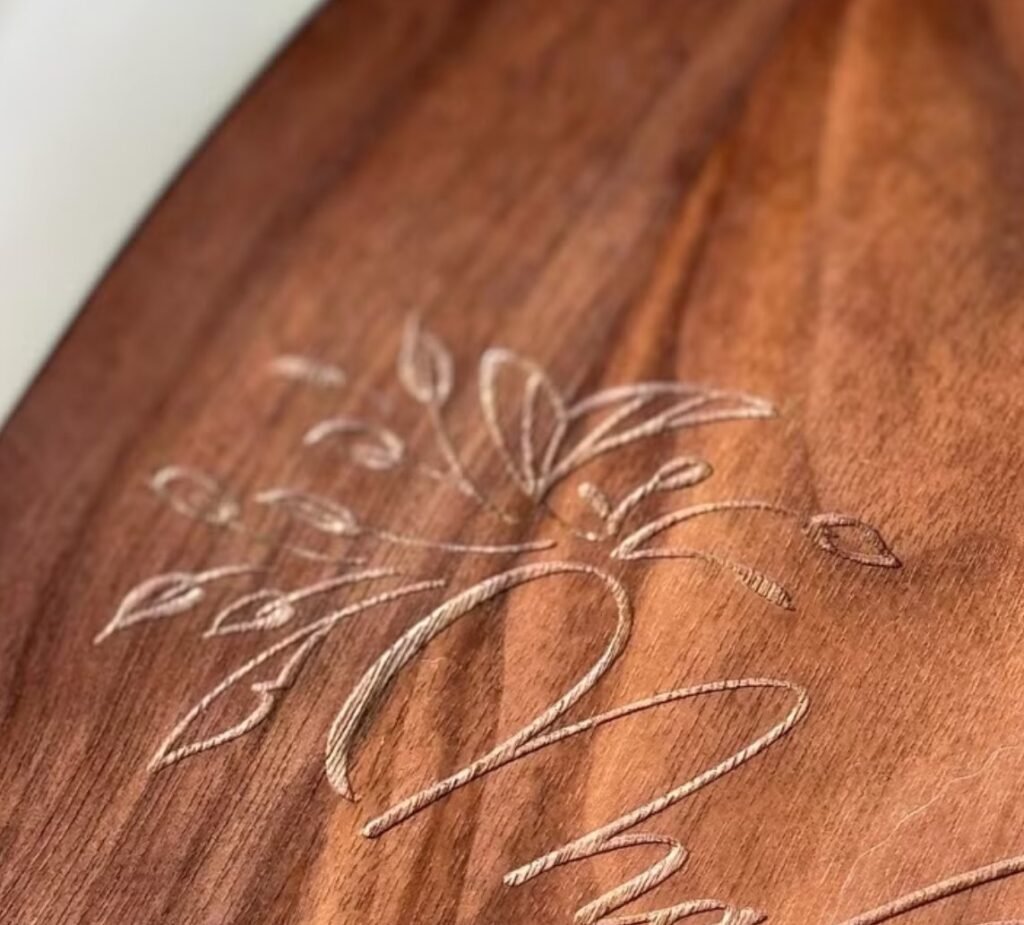
- Laser engraving: sharp, durable, cost-efficient for logos or small text on wood and bamboo.
- Silk-screen printing: solid-color logos on painted or stained surfaces; cost-effective for large runs.
- UV printing: full-color graphics, suitable for more complex designs or short runs with multiple SKUs.
- Metal or leather badges: for premium projects with a higher perceived value.
When you submit artwork, providing vector files and clear size/position guidelines reduces sampling rounds and improves logo consistency between batches.
3.5 Hardware Fitting: Hinges, Latches, and Magnets
Hardware selection influences usability, perceived quality, and assembly time.
- Hinges: standard butt hinges, piano hinges, or concealed hinges depending on design and budget.
- Front closures: simple hooks, hasp latches, or no hardware at all if magnets are used.
- Magnets: embedded magnets in the rim or lid provide a minimalistic closure, popular for modern designs and e-commerce packaging.
Pre-defining the maximum torque, opening angle, and preferred hardware finish (e.g., brass, black, silver) avoids late-stage changes when production is close.
4. Structuring Your Wooden Tea Box: Compartments, Inserts, and Mixed Materials
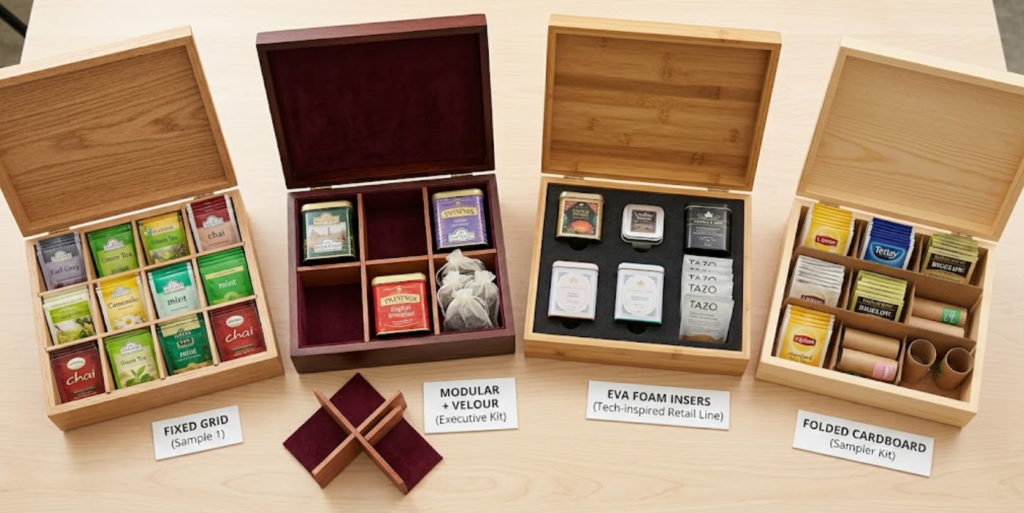
The internal layout of a wooden tea box determines how efficiently it can be packed, filled, and used. Chic Homeware supports custom compartment grids, inserts, and mixed material structures.
4.1 Compartment Design Aligned with SKUs
Start from your tea SKUs and packaging dimensions, then work backward to compartment sizing:
- Envelope tea bags: common layout is 4–12 compartments, each holding a defined stack height.
- Loose tea tins: fewer, larger compartments with reinforced bottoms.
- Mixed contents: one or two wider spaces for accessories alongside standard tea compartments.
We typically recommend leaving slight clearance in each compartment for smooth loading and end-user access, while still controlling internal movement in transit.
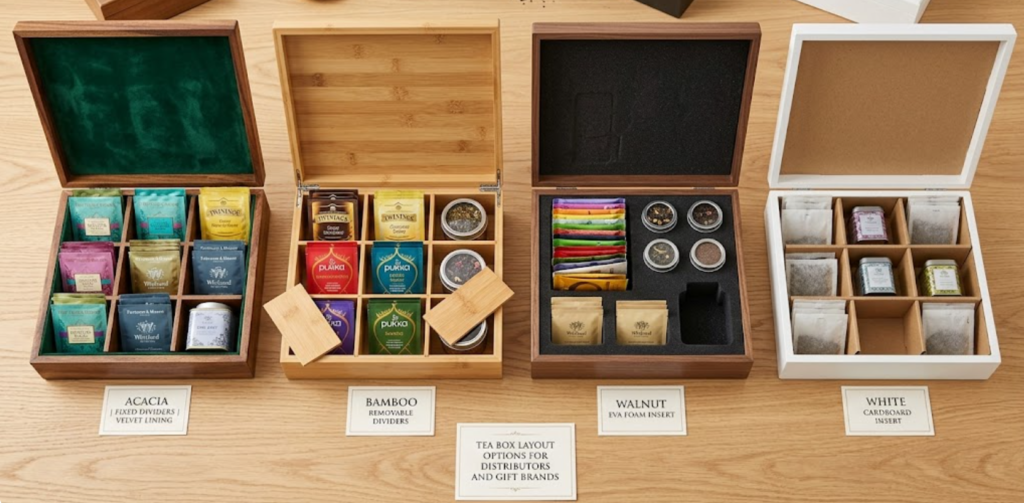
4.2 Dividers: Fixed vs Removable
Buyers often decide between fixed and removable dividers based on whether the box will be re-used after the original tea is consumed.
- Fixed dividers: lower complexity, higher structural rigidity, easier QC. Suitable for single-use gift sets or standardized SKUs.
- Removable dividers: more flexible for end-users, but requires tighter control on tolerance and may add assembly steps.
We can also combine fixed main dividers with removable sub-dividers, offering a balance between structural stability and flexibility.
4.3 Inserts: Foam, Cardboard, and Fabric
For higher-end sets and fragile tins, inserts are critical:
- Die-cut cardboard: cost-effective for basic positioning, especially in combination with a color box.
- EVA or PU foam: shaped cavities for tins or accessories, often used for premium or corporate gifts.
- Fabric lining: velvet or linen-style lining upgrades perceived value but needs careful color and adhesion control.
Inserts impact packing labor and unit cost; early alignment between your packaging designer and the factory avoids rework.
4.4 Mixed Material Suggestions
To achieve a balance between cost and branding, mixed material solutions can be effective:
- Solid pine or paulownia body with MDF or plywood lid panel for logo presentation.
- Bamboo frame with acrylic window insert to display tea bags.
- Wooden base with metal or leather handle for a giftable, reusable box.
Chic Homeware frequently proposes such combinations to hit targeted landed cost and brand positioning without compromising structural reliability.
5. B2B Customization Points: From Size to Carton Marks
Wooden tea box projects are rarely off-the-shelf. Most distributors and brands request customized details that fit their market and logistics model. Common customization points include:
- Size: overall length, width, height, and lid depth tailored to your tea formats and retail shelf constraints.
- Compartments: number, size, and layout, including future expansion plans for additional flavors.
- Hinges and magnets: functional and aesthetic alignment with your brand identity.
- Inserts: material, color, and printing on paperboard inserts if used as brand communication.
- Logo: placement, process (engraving, printing), and color.
- Color box: individual packaging design, open window vs fully enclosed, printing requirements.
- Mailer carton: especially for e-commerce; strong enough for single-unit shipping when necessary.
- Carton mark: standard export marks, EAN/UPC labels, batch codes, and any Amazon-specific labeling.
To speed up development, many buyers start from an existing box structure from our Custom Wooden Boxes portfolio and then modify dimensions, finish, and internal layout rather than designing from zero.
6. Export Packaging and Damage Control Strategy
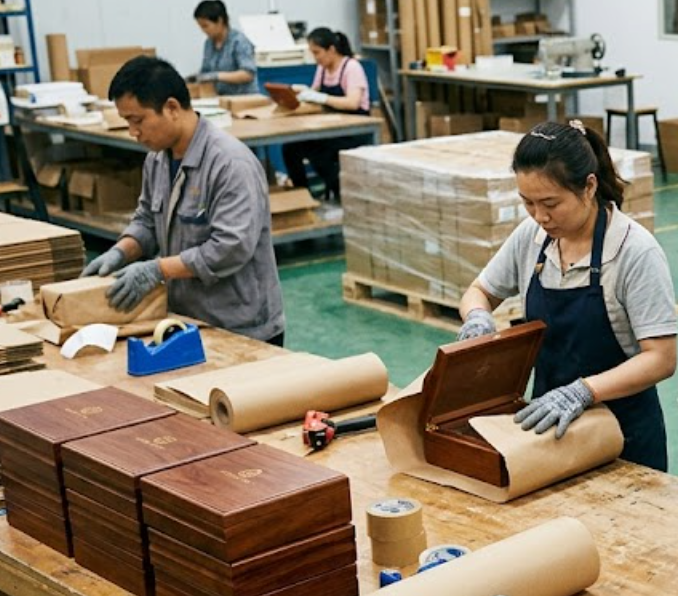
Tea box projects are sensitive to surface scratching, corner damage, and hardware bending during transport. Chic Homeware’s export approach focuses on protective layers and practical testing to reduce claims and returns.
6.1 Unit-Level Protection
Depending on the risk level and target channel, we typically combine:
- Dust bag or polybag: basic protection against dust and minor abrasion.
- Corner and edge protection: foam or cardboard pieces at corners for premium projects.
- Protective film: on acrylic windows or metal logos.
- Paper wrapping: to separate lacquered surfaces from direct contact with internal packaging material.
6.2 Inner Boxes and Color Boxes
If you require color boxes:
- We design inner supports to keep the tea box centered.
- Board thickness and construction are aligned with your drop-test requirements.
- Print finish (matte, gloss, spot UV) is chosen to match brand and budget.
6.3 Master Carton and Drop-Test Thinking
For master cartons, we consider:
- Carton strength: appropriate board grade for sea vs air freight and the stacking height in your warehouse.
- Carton configuration: number of units per carton, orientation, and use of inner dividers or separators.
- Drop-test mindset: designing packing with typical courier and warehouse handling in mind (drops at corners and edges).
Many buyers reference their own packaging standards or retailer requirements; we adapt carton construction to meet these guidelines and help reduce damage-related costs.
7. Managing MOQ, Sampling, Lead Time, and Cost
From a purchasing perspective, a wooden tea box must make sense in MOQ, cash flow, and inventory risk. Our OEM/ODM workflow is structured to give clarity on these issues early.
7.1 MOQ (Minimum Order Quantity)
MOQ depends on material, structure complexity, and finishing processes:
- Standard pine or paulownia boxes with simple finishing can often be produced at lower MOQs.
- Boxes requiring custom hardware, complex inserts, or multiple colors typically require higher MOQs to remain cost-effective.
- Mixed material designs and special veneers may have minimums driven by raw material suppliers.
We are open to discussing staged orders or color splits within a total MOQ where feasible, especially for new product launches.
7.2 Sampling and Development
Sampling is the key stage for aligning expectations between purchasing, design, and quality teams. A typical sampling flow:
- Review of drawings, reference photos, and functional requirements.
- Preliminary quotation with options on materials and finishes.
- Sample manufacturing, including logo, basic inserts, and representative hardware.
- Feedback round to refine dimensions, color, or compartment layout before confirming mass production details.
We recommend that buyers check the sample not only from a marketing perspective but also from a QC and logistics angle: lid alignment, smell of coatings after unpacking, packaging protection, and carton labeling.
7.3 Lead Time Planning
Lead time varies according to complexity and volume, but buyers can plan more accurately by considering:
- Sample development time, including any re-sampling.
- Material preparation and machining for new structures vs repeat orders.
- Peak vs off-peak production seasons, especially before major gift-giving periods.
- Transit times and customs clearance buffers.
For recurring tea box programs, aligning order placement with your sales cycles allows us to plan material procurement and capacity in advance, improving consistency and cost control.
7.4 Price Structure and Cost Drivers
To understand and negotiate better, it helps to know what drives cost in a wooden tea box:
- Wood species and thickness (acacia and walnut vs pine or paulownia).
- Box size and complexity of compartments.
- Surface finishing steps and coating types.
- Logo technique and number of logo positions.
- Insert materials and assembly labor.
- Packaging specification per unit and per carton.
By adjusting these variables, we can usually offer two to three cost scenarios—entry, standard, and premium—so you can match different markets or channels within your portfolio.
8. Ensuring Repeat-Order Consistency and Compliance
For distributors and brands, maintaining consistency between orders is as important as the first shipment. Chic Homeware emphasizes documentation, material control, and communication for long-term programs.
8.1 Production Records and Reference Samples
We keep reference samples, color boards, and finishing notes for confirmed orders. This allows us to reproduce:
- Color tones and gloss levels.
- Logo size, position, and process.
- Hardware specifications and locations.
- Carton layout and labeling.
Buyers are encouraged to retain their own golden sample and align it with our retained sample at the start of any repeat order.
8.2 FSC-Oriented and Responsible Sourcing Discussions
Many EU and US buyers now request forestry-related documentation or alignment with their internal procurement standards. While requirements differ by company and market, we can support FSC-oriented discussions and help identify suitable material routes that balance documentation with cost and availability.
8.3 Compliance for EU and US Markets
Wooden tea boxes are usually classified as homeware and gift items; however, destination markets often apply broader compliance expectations regarding coatings, labeling, and packaging content. We work on a project basis with buyers to:
- Discuss coating and component specifications aligned with your compliance framework.
- Plan any required documentation or test reports in advance.
- Incorporate labeling, warnings, or barcodes into the design and packaging layout.
Clear, early communication with your compliance team helps avoid last-minute changes that could affect timing or cost.
9. Why Partner with a Factory-Oriented Wooden Products Manufacturer
A wooden tea box is often part of a broader assortment of wooden gift packaging and homeware. Working with a single, factory-oriented partner simplifies sourcing and helps you standardize quality across categories.
Chic Homeware operates as a Custom Wooden Products Manufacturer with an OEM/ODM mindset. Beyond tea boxes, we support coordinated ranges of wooden organizers, trays, and storage items using compatible materials and finishes. This enables:
- Shared material sourcing for multiple SKUs to stabilize color and grain variation.
- Unified branding through consistent logo processes and packaging styles.
- Efficient container planning by combining different product lines in the same shipment.
For buyers who want insight into manufacturing capabilities, processes, and export experience, our background as a Wooden Products Factory in China offers transparency from raw material selection through to export packing.
10. Conclusion: Turning Your Tea Concept into a Practical Wooden Box Program
Successful wooden tea box programs combine brand storytelling with factory-level practicality: material selection, moisture control, finishing, hardware, inserts, and export packaging all aligned within a workable price structure. When these elements are defined early and documented clearly, you gain a repeatable item that can support long-term sales rather than a one-time promotion.
Whether you are a distributor planning a multi-country rollout, a gift brand building seasonal collections, or an online seller launching a new private label SKU, Chic Homeware can help translate your concept into a manufacturable, compliant, and export-ready wooden tea box.
If you are preparing a project brief or need feasibility feedback on sizing, materials, or packaging, you can share your ideas, drawings, or reference photos for a practical review of options, MOQs, and lead times. To discuss your next wooden tea box or broader wooden packaging range, please Contact Chic Homeware and we will respond with focused, project-based guidance.