
Wooden Box Sampling Guide: What to Confirm Before Bulk Order
Sampling is the most critical step between a good quotation and a successful bulk order. For wooden boxes, small deviations in moisture, finishing, hardware or packaging can quickly turn into quality claims once goods arrive in your warehouse or Amazon FBA center. A structured sampling checklist helps you lock specifications, avoid misunderstandings and secure repeatable results from your manufacturing partner.
This guide walks through what experienced importers, wholesalers and private label brands typically confirm at the wooden box sample stage with Chic Homeware, an OEM/ODM Custom Wooden Products Manufacturer in China. You can apply the same thinking to any wooden box project before placing your next bulk order.
1. Clarify the Project Scope Before Requesting Samples
Before you ask for a wooden box sample, spend time aligning internally on what the product must achieve. A well-defined brief saves multiple sample rounds and helps the factory suggest practical solutions instead of guessing.
1.1 Define the Use Case and Target Channel
Share how and where the wooden box will be used. This affects structure, finishing and packaging decisions:
- E-commerce / Amazon FBA: Focus on consistent color, logo accuracy, protective packaging, mailer-carton sizing and cost-effective materials that survive parcel handling.
- Retail / Gift sets: Prioritize visual impact, smooth touch, color-matched stain or paint, and inner presentation (foam insert, fabric lining, paper wrap).
- Food / Tea / Coffee / Dry goods: Consider lining material, odor control, moisture stability and clear communication on any food-contact related expectations.
- Luxury or corporate gifting: Emphasize premium wood species, hardware and special logo processes such as laser, metal plates or inlay.
1.2 Fix Preliminary Commercial Parameters
During sample request, also outline initial business conditions so the factory develops a realistic sample, not something that cannot be reproduced at your target price:
- Estimated annual volume and per-order quantity
- Target FOB or landed price range
- Required lead time and seasonality (Q4 peak, gifting season etc.)
- Preferred incoterm and port of discharge
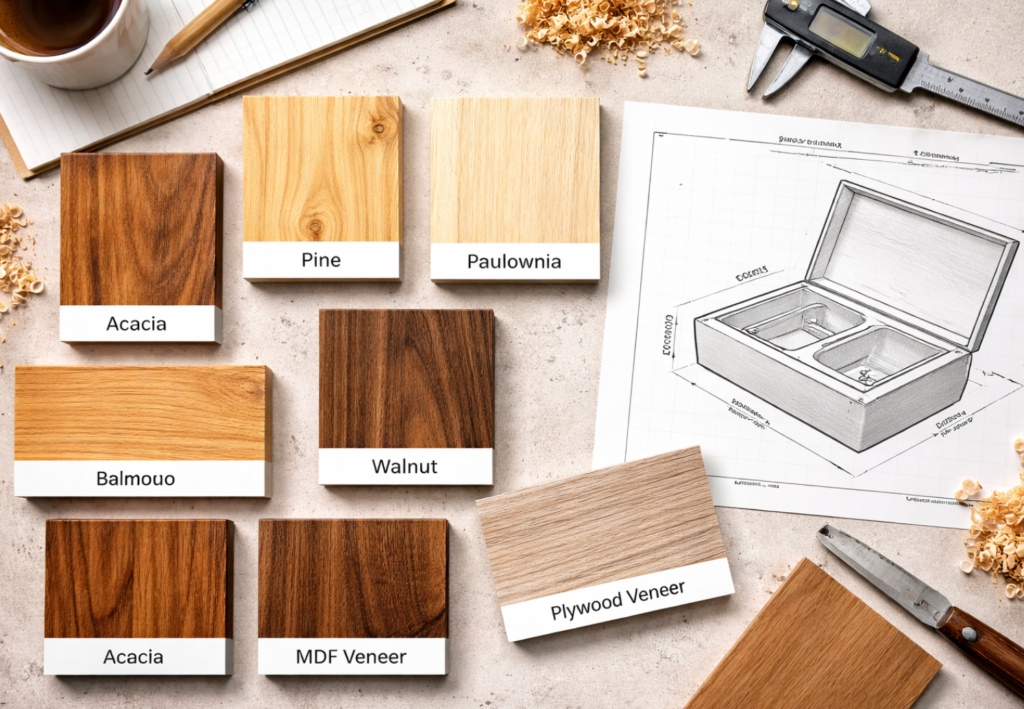
With these basics, an experienced wooden products factory can immediately suggest whether to use acacia, pine, paulownia, bamboo, walnut, MDF veneer or plywood veneer, and what finishing and structure are realistic within your price frame.
2. Confirm Material Choices at Sample Stage
Wood species selection is the foundation of any wooden box project. It influences stability, appearance, weight, price and how the surface accepts stain or paint. At sampling stage, make sure the material used on your sample is clearly named and documented.
2.1 Compare Common Materials for Wooden Boxes
| Material | Main Advantages | Typical Use Cases |
|---|---|---|
| Acacia | Rich grain, warm color, good hardness, premium feel | Premium gift boxes, watch boxes, liquor packaging, decorative storage |
| Pine | Cost-effective, easy to machine, light color for staining or painting | General storage boxes, craft boxes, mid-range packaging |
| Paulownia | Ultra-lightweight, stable, good for larger boxes where weight matters | Wine boxes, large gift hampers, stacked storage boxes |
| Bamboo | Sustainable perception, hard and stable, modern look | Tea boxes, kitchen storage, eco-positioned gift sets |
| Walnut | Dark, elegant grain, high-end appearance | Luxury packaging, corporate gifts, premium desk organizers |
| MDF Veneer | Stable, smooth surface, flexible shape, cost-efficient under veneer | Painted boxes, branded packaging, boxes with complex shapes |
| Plywood Veneer | Strong structure, good for larger items, more resistant to warping | Large storage boxes, heavy-duty packaging, tool or craft boxes |
2.2 What to Confirm on the Sample
When you receive the wooden box sample, confirm and document:
- Exact material name: e.g., “solid pine,” “bamboo panels,” “MDF with oak veneer.” Ask for photos of raw boards if needed.
- Wood thickness: Measure the panel thickness on sides, bottom and lid. Record it on your spec sheet.
- Grain direction: Check if the grain direction matches your aesthetic expectations on lid, sides and bottom.
- Weight: Weigh the sample. For e-commerce, this affects shipping cost and FBA fees.
- FSC-oriented sourcing: If your project requires FSC or controlled wood sourcing, clarify at sampling stage whether the proposed material route can support it, and how this affects price and lead time.
Any later substitution of wood species or thickness must be formally agreed, as it can change stability, color and cost.
3. Moisture Control and Structural Stability
Moisture control is a typical root cause behind warping lids, loose joints and cracking panels after shipment. During sampling for wooden boxes, request information and observe performance, not just appearance.
3.1 Questions to Ask Your Factory
- What moisture content range does the factory target for this wood species?
- How is the wood dried (kiln-dried, air-dried combination) and how long is it conditioned before production?
- Is there seasonal adjustment for shipments to humid or very dry markets?
3.2 Visual Checks on the Sample
When you inspect the sample wooden box:
- Check for early signs of warping: Lay the box on a flat table and see if any side lifts. Check lid flatness and fit.
- Inspect joints and corners: Look for hairline cracks or gaps where panels meet, especially at the base.
- Minimal movement test: If possible, keep the sample in your office for two or three weeks and observe any movement as humidity changes. This is particularly important for solid acacia, pine, paulownia and bamboo.
At Chic Homeware, moisture control discussions are part of early project communication, especially for buyers shipping boxes to climates very different from the production region.
4. Surface Preparation, Stain and Paint Finish
Even if the structure is solid, inconsistent sanding or finishing will create visible defects and returns. Sampling is the moment to freeze your finishing standard for the bulk order.
4.1 Sanding Consistency
Run your hand slowly over edges, corners and any routed details. In a good wooden box sample, you should not feel aggressive rough spots or sharp edges where users will touch frequently.
- Confirm the sanding grit level used before finishing (e.g., 180–240 grit).
- Specify whether rounded edges are required for a softer touch or child-friendly feel.
- Check inside surfaces and compartments; some factories only focus on outer surfaces unless instructed.
4.2 Stain, Paint and Clear Coat
Request a clear description of the finishing system used on the sample wooden box:
- Type of finish: water-based, PU, UV, oil, wax or a combination.
- Number of coats: e.g., 1x sealer + 1x top coat.
- Sheen level: matte, satin, semi-gloss or high gloss.
Check the sample under natural and artificial light for:
- Color consistency across different panels
- No obvious runs, bubbles or dust particles in the coating
- Even coverage inside compartments and under the lid (if required)
If you plan multiple SKUs with the same color family (for example for a wider range of Custom Wooden Boxes), agree on a master color standard. Many buyers keep one approved finish standard sample in their office and one stays in the factory as a reference for future orders.
5. Logo Application and Branding Details
For OEM and private label buyers, the logo treatment is often the most visible part of the product. Confirming logo specifications on your wooden box sample is essential for brand consistency.
5.1 Decide the Logo Process
Discuss with your manufacturer which logo techniques best fit your brand, budget and material:
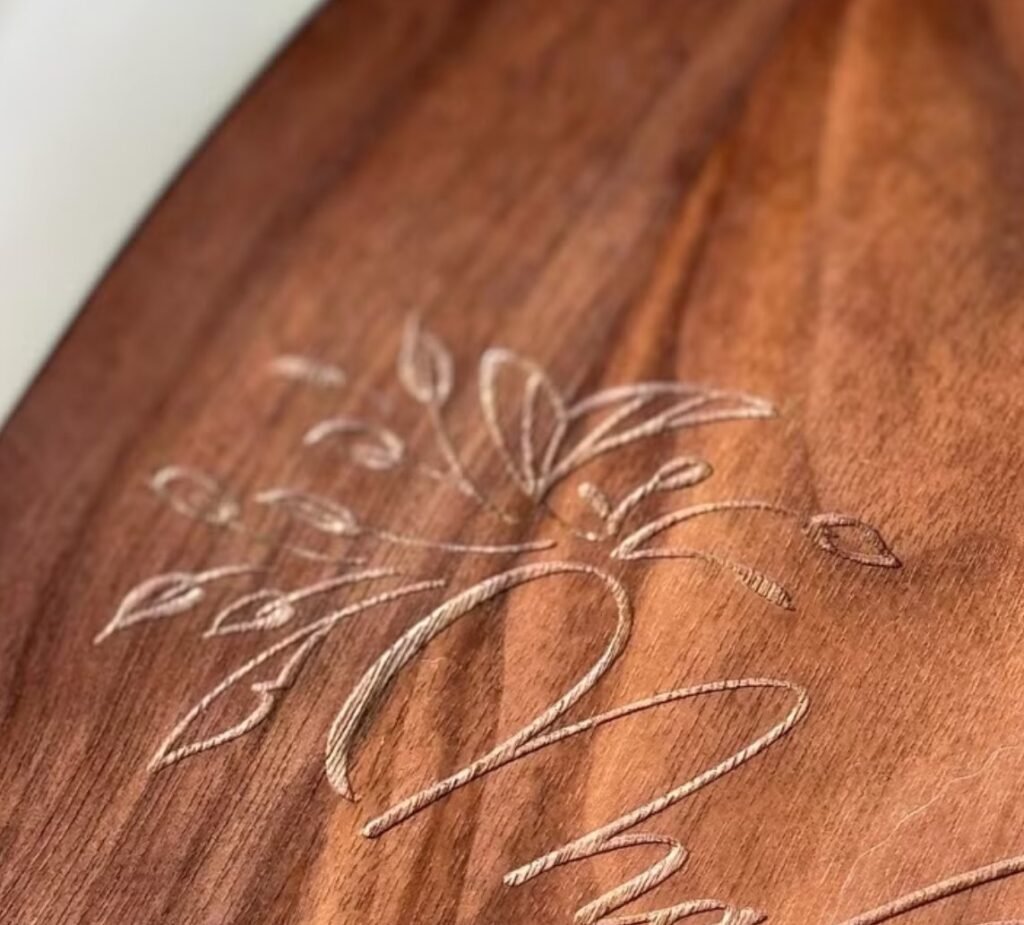
- Laser engraving: Clean, permanent, cost-effective, works well on most woods and bamboo.
- Silk-screen or pad printing: Good for color logos, works on painted and clear-coated surfaces.
- Heat stamping / foil: Metallic effect for premium gift packaging, more sensitive to surface flatness.
- Metal plates or badges: Suitable for high-end boxes; confirm how plates are fixed (screws, rivets, adhesive).
5.2 Sample Checklist for Logos
On the wooden box sample, verify:
- Logo size measured in millimeters.
- Exact position from reference edges (for example, “15 mm from bottom edge, center-aligned”).
- Color accuracy compared with your Pantone or brand guidelines.
- Clarity of small text or lines, especially on laser and print logos.
- Consistency between lid, sides and possible inner logos if multiple positions are used.
Lock these details in a drawing or artwork approval form before bulk production. For repeat buyers, Chic Homeware often keeps a dedicated logo tooling and process sheet to ensure consistent results over multiple runs.
6. Structure, Hardware and Functional Details
The functionality of a wooden box is defined by its structure and hardware. A factory may understand your aesthetic but misinterpret how you expect the box to open, close, stack or protect contents. Use sampling to test these aspects carefully.
6.1 Size, Compartments and Inserts
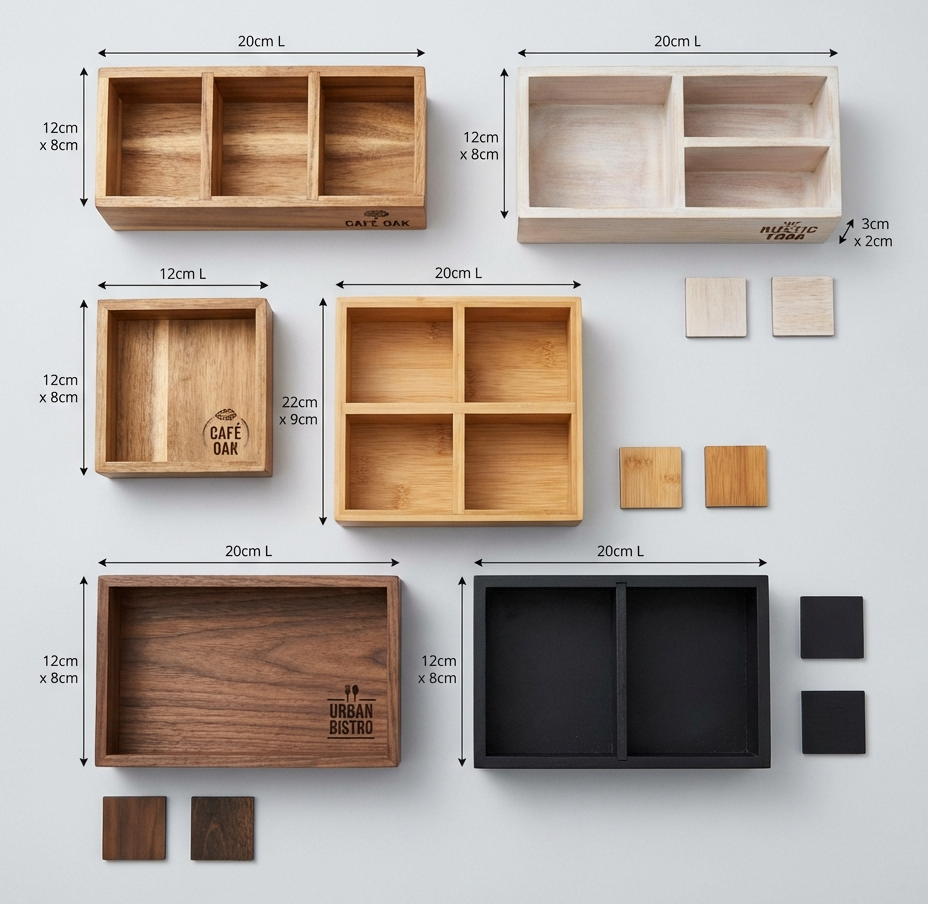
- External dimensions: Confirm length, width and height with a ruler and compare with CAD or spec sheet. Small variances are normal; define your acceptable tolerance (e.g., ±2 mm).
- Internal dimensions: More critical if the box is meant to hold bottles, jars, cards or any standardized product. Confirm fit with your actual product if possible.
- Compartments: Check divider thickness, flexibility, and whether dividers are fixed or removable.
- Inserts: For gift packaging, confirm materials (foam, EVA, cardboard, fabric) and how they are attached.
6.2 Hinges, Magnets and Other Hardware
Hardware choice and fitting directly influence perceived quality and durability:
- Hinges: Inspect alignment, screw tightness and smoothness of movement. Confirm type (butterfly, piano hinge, concealed etc.).
- Magnets: Confirm magnet size and closing strength. Box should close securely without being too hard to open.
- Clasps and locks: Open and close several times to test durability and alignment.
- Handle options: Rope, leather, metal or cutout handles; check comfort and load-bearing capacity.
Any hardware used in the sample should be from the same supply route planned for bulk production. If alternative hardware is needed due to availability or cost, request a revised pre-production sample to verify.
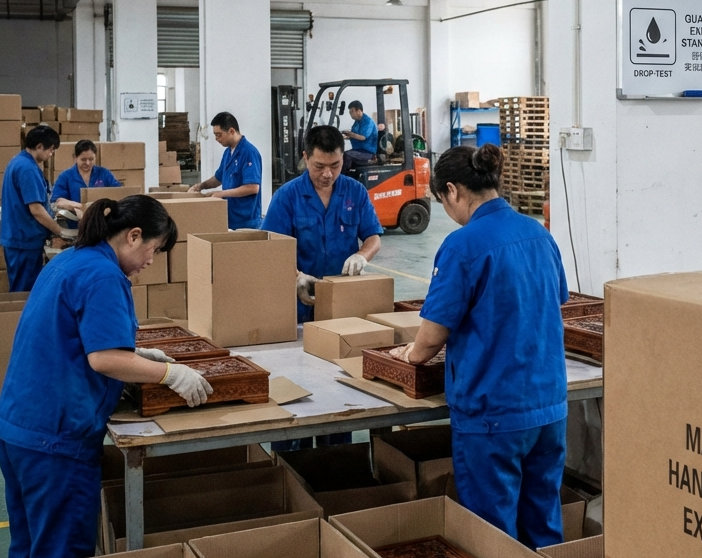
7. Export Packaging and Damage Control
For B2B buyers, the cost of damage during sea transport and last-mile delivery can quickly erode margin. A key part of wooden box sampling is validating export packaging and drop-test thinking, not only the product itself.
7.1 Inner Packaging Options
Discuss and confirm at sample stage:
- Protective wrap: Bubble bag, foam bag, non-woven bag or paper wrap around each wooden box.
- Individual box: Color box or mailer carton dimensions, material (E-flute / B-flute), and printing details.
- Void filling: If the wooden box contains glass bottles, ceramics or other fragile goods, specify internal protection design.
7.2 Master Carton Design
At sampling stage, align on master carton details even if you do not yet receive a full shipping carton sample:
- How many units per master carton and how they are oriented inside.
- Carton size vs. weight (avoid over-heavy boxes that are hard to handle or non-compliant with carrier rules).
- Carton board grade and fluting suitable for export.
- Carton mark layout: item code, color, quantity, carton number, country of origin, barcodes and any retailer-specific information.
7.3 Carton Drop-Test Thinking
You may not always run formal drop tests on samples, but you can still plan for them. Share your target testing standard if you have one, or at least describe typical handling conditions (e.g., small parcel carriers vs. full pallet shipments). Chic Homeware can then adjust internal packaging structure, corner protections and void-filling approaches accordingly.
8. MOQ, Sampling Fees, Lead Times and Price Structure
Technical confirmation is only half of sampling. The other half is commercial clarity. Experienced buyers lock these points before they approve a wooden box sample for mass production.
8.1 MOQ and Scalability
- Project-based MOQ: Confirm minimum order quantity per design, per color and per logo, not only a general MOQ.
- Material-driven MOQ: Some wood species or finishing systems require higher MOQs to be cost-efficient. Discuss alternative materials if your forecast is lower.
- Scalability: If you expect volumes to grow, ask whether productivity and capacity can scale without quality drift.
8.2 Sampling Fees and Lead Times
Clarify:
- Sample cost and whether it is refundable against bulk orders.
- Standard sample lead time vs. urgent sample lead time.
- Number of free revisions (if any) before extra sampling charges apply.
8.3 Price Structure and Options
Request price breakdowns that help you make decisions:
- Base price for box structure and material.
- Additional cost for logo processes, special hardware or inserts.
- Price difference between different wood species or thicknesses.
- Cost impact of packaging options (color box vs. plain mailer carton vs. bulk-pack).
This allows you to tune specifications without losing control over the budget. Many buyers work with the factory to build “good / better / best” configurations of the same wooden box concept using different wood, finishing and packaging combinations.
9. Repeat-Order Consistency and Documentation
A good sample is only valuable if it can be repeated. Before confirming bulk, make sure your specification and documentation setup can protect both your brand and your supplier relationship over multiple orders.
9.1 Spec Sheets and Golden Samples
- Create a spec sheet that includes material, dimensions, finishing details, logo specs, hardware descriptions, packaging structure and carton marks.
- Label your approved sample as the “golden sample,” sign and date it, and keep one copy in your office.
- Request the factory to keep at least one golden sample in the production office and one in the QC area as reference.
9.2 Quality Tolerance and AQL
If you apply specific AQL or tolerance standards, communicate them clearly before mass production:
- Color tolerance between batches.
- Acceptable variance in logo position and size.
- Permissible wood defects (knots, grain variations) and which should be avoided on visible faces.
Clear agreements turn your wooden box sampling process into a long-term quality control tool rather than a one-time event.
10. Working with a Factory-Oriented OEM/ODM Partner
Choosing a factory-oriented partner simplifies this entire wooden box sampling process. A manufacturer like Chic Homeware, operating as a Wooden Products Factory in China, aligns material routes, moisture control, finishing systems and export packaging with the realities of mass production from the very first sample.
Typical support during wooden box sampling includes:
- Material proposals across acacia, pine, paulownia, bamboo, walnut, MDF veneer and plywood veneer based on your price and positioning.
- Suggestions for structure optimization to balance weight, stability and cost.
- Professional finishing advice to match your brand’s color palette while respecting production feasibility.
- Logo process recommendations based on wood type and expected order volume.
- Export packaging and carton planning aligned with your logistics model and damage-control expectations.
For importers, wholesalers and Amazon sellers, this kind of integrated support reduces the number of sample rounds and gives more predictable results from the first shipment onwards.
Conclusion: Turn Wooden Box Samples into a Repeatable Standard
A wooden box sample is much more than a “preview” of your product. Used properly, it is a negotiation tool, a technical checklist and a long-term quality standard. By systematically confirming material, moisture, finishing, logo, structure, packaging, MOQ and price structure before approving bulk, you reduce risk and create a stable base for future development.
If you are planning a new range of storage boxes, gift packaging or kitchen-related wooden organizers, consider using your next sampling round to formalize these checkpoints. Chic Homeware supports OEM and ODM projects from concept and sampling through to export packing for global buyers.
To discuss your next wooden box project, share drawings, or request a structured sampling quotation, you can Contact Chic Homeware and our project team will respond with material options, sampling timelines and practical recommendations based on factory experience.