
If you’re sourcing or producing OEM wooden packaging boxes for cosmetics and fragrance, cost per unit is won or lost in dozens of tiny decisions—materials, tolerances, coatings, and how you run samples. This step‑by‑step guide is written for practitioners who need real specs and acceptance criteria, not fluff. We’ll focus on cost efficiency at scale while maintaining the look and durability expected in retail and e‑commerce.
By the end, you’ll have a practical blueprint for OEM wooden packaging boxes: what to specify, how to verify it, and where to trim cost without creating defects or delays.
Quick decision checklist before you RFQ
Make these five choices up front to avoid expensive rework and back‑and‑forth later.
- Scope and MOQ bands: confirm SKU dimensions, internal insert type (foam/pulp/board), and target price at 300 / 500 / 1,000 units.
- Construction: decide solid wood vs. engineered panel core (plywood/MDF); set wood moisture target 6–9% for indoor use based on equilibrium moisture content guidance from the USDA Forest Products Laboratory (see the Wood Handbook Chapter 4 in the USDA FPL Wood Handbook).
- Finish system: shortlist waterborne acrylic or UV‑cured where feasible for faster throughput and lower VOC exposure; define planned coats and total film build.
- Branding method: pick one primary method (UV digital, hot foil, laser, screen/pad) and require a T2 color/adhesion proof on the same wood species.
- Compliance: if using MDF/particleboard cores or inserts, require TSCA Title VI labeled materials for U.S. import per EPA’s composite wood standards (TSCA Title VI); align REACH/SVHC communications for EU/UK when relevant.
Materials and construction choices that lower cost
For cosmetics wooden gift boxes, stability and appearance matter, but they don’t need furniture‑grade joinery. Here’s how to minimize unit cost without sacrificing feel.
- Solid wood vs. engineered panels: Solid poplar or pine can be cost‑effective for small runs and stained looks, but panel yield may vary. Engineered cores (plywood, MDF) offer predictable yield and flatness—useful for precise lids and flat branding surfaces. If you choose MDF/particleboard, specify TSCA Title VI‑compliant panels for U.S. markets per the EPA program page cited above; solid wood is generally outside the TSCA Title VI scope.
- Moisture and conditioning: Target 6–9% moisture content for indoor packaging and acclimate parts 7–14 days at 40–60% RH before finishing; this aligns with equilibrium moisture content practices described by the USDA Forest Products Laboratory in the Wood Handbook’s EMC chapter. Log readings with a calibrated meter and reject batches outside range or recondition.
- Panel thickness standardization: Standardize outer walls and lids to common thicknesses (e.g., 8, 10, or 12 mm) to simplify CNC setup, reduce scrap, and allow better nesting. Avoid odd increments that force extra tool changes or non‑standard inserts.
- Inserts drive dimensional needs: Decide early between die‑cut EVA, molded pulp, or card platforms. EVA offers sharp geometry but off‑gassing risk if not specified correctly; molded pulp is eco‑friendly but needs more clearance. Cardboard platforms are cheapest but need tight flatness.
Acceptance criteria to put on the spec sheet:
- Wood MC: 6–9% at machining; re‑check post‑finish to confirm stability.
- CNC critical dimensions: ±0.5–1.0 mm for general assemblies; use ±0.1–0.2 mm on precision lid interfaces when RH is controlled.
- Lid gap: ≤0.5 mm uniform around the perimeter.
Design for manufacturability (DFM) for yield and labor
Think of DFM as your compounding cost reducer. A few smart constraints save minutes per unit (and rework) at scale.
- Optimize nesting and part orientation: Batch similar panels to minimize tool changes; rotate grain consistently to reduce post‑finish warp. A small improvement in nesting can increase yield by 3–5% on common box sizes.
- Simplify hardware: Where the design allows, switch from ornate quadrant hinges to embedded magnets with a cosmetic groove. You’ll cut routing time and assembly alignment risk.
- Standardize wall thickness and radii: Use common cutter radii in internal corners to avoid extra milling passes; specify minimum fillets rather than sharp internal corners.
- Plan unilateral clearances: Use +0.2/0.0 mm on mating lid parts to avoid binding as MC fluctuates.
Verification steps:
- First‑article jig check: Measure a full perimeter at 4 points for lid gap; record and sign off.
- Periodic in‑process checks: Every 50 pcs, confirm two critical dims with calipers; re‑zero fixtures if drift exceeds 0.2 mm.
The production flow — from lumber to packed boxes
Follow this end‑to‑end flow to keep quality steady and labor predictable.
- Incoming materials and conditioning
- Stage gate: Record MC for every lumber/panel batch; target 6–9% for indoor packaging. If using MDF/particleboard, file supplier TSCA Title VI labels and invoices for three years per EPA rules described on the EPA TSCA Title VI page.
- Cutting, CNC, and drilling
- Tools: Carbide cutters sized to standard wall thicknesses; sharp tooling reduces tear‑out on light species (poplar/pine).
- Tolerance: Hold ±0.5–1.0 mm on general panels; ±0.2 mm on lid interfaces where feasible.
- QC: First‑article inspection (FAI) on three key dimensions; then sample 2 pieces per 50.
- Assembly and jigging
- Adhesives: PVA for general joints; epoxy for magnet seating. Wipe squeeze‑out to avoid finish defects.
- Jigging: Use corner squares and lid alignment jigs; clamp times per adhesive manufacturer.
- Acceptance: Box squareness within 0.5 mm over 300 mm; seam gaps ≤0.3 mm.
- Sanding and surface prep
- Sequence: 150 → 180 → 220 grit for clear finishes; end at 320 if UV digital printing is planned for smoother ink laydown.
- Cleanliness: Remove dust with tack cloth and compressed air; avoid silicone contamination.
- Finishing (coatings)
- Choose the system (see next section) and document planned coats, total film build, and dry‑to‑sand windows. Verify film thickness and adhesion at T2 using cross‑hatch per ASTM D3359.
- Branding/printing
- For UV digital printing, seal/prime porous surfaces, fix the workpiece, and print color targets on the same species and finish stack. Record cure settings and ambient conditions. Equipment maker guides outline prep details; for example, process guidance in the ColDesi professional guide to UV printing on wood is a useful reference.
- Hardware and magnet installation
- Hinges: Use templates and pilot drills; hand‑drive screws to avoid strip‑out. For premium quadrant or pivot hinges, refer to maker documentation such as Brusso’s resources and model pages.
- Magnets: Select size by feel testing; validate polarity before epoxy. Real‑world pull is often below catalog ratings; application notes from K&J Magnetics on installation and pull explain why.
- Conditioning, flatness, and lid fit verification
- After finishing and hardware install, acclimate assemblies 24–48 hours at 40–60% RH.
- Acceptance: Straightedge flatness ≤0.2 mm over 300 mm; lid gap ≤0.5 mm at four points.
- Final inspection and packing
- Run a random inspection with AQL defaults (critical 0.1%, major 2.5%, minor 4.0) under ISO 2859‑1 Level II, as explained by practitioner guides such as QualityInspection.org’s AQL overview. Record defects and rework.
- If shipping via parcel/e‑commerce, plan packaging validation using ISTA methods: ISTA 3A for general parcel shipments; 6‑Amazon.com for Amazon programs. See ISTA’s procedure list and 3A overview for scope and selection.
Finishing and branding without blowing the budget
Choose a finishing system that balances throughput, VOC profile, and look. Then verify with simple measurements.
| System | Throughput | VOC profile | Typical use | Notes |
|---|---|---|---|---|
| UV‑cured (100% solids) | Very high (instant cure) | Very low | High‑volume, flat parts | Hard, durable; requires UV line; see UV‑curable coatings overview from Sherwin‑Williams Industrial Wood. |
| Waterborne UV | High | Low | Mixed volumes | Good balance of look, hardness, lower VOC; see waterborne UV finishes overview. |
| Waterborne acrylic | Moderate | Low | General purpose | Good clarity; verify dry‑to‑sand/stack windows from TDS. |
| Catalyzed lacquer / PU | Moderate | Medium–High | Premium gloss/depth | Excellent appearance; ensure ventilation and check recoat times per TDS. |
Verification checklist:
- Film build: Target a total of roughly 60–100 µm depending on system and look; confirm with a micrometer on witness panels.
- Adhesion: Cross‑hatch per ASTM D3359 at T2; must rate pass on your scale.
- Color proof: Approve a color swatch printed on the same species/finish stack.
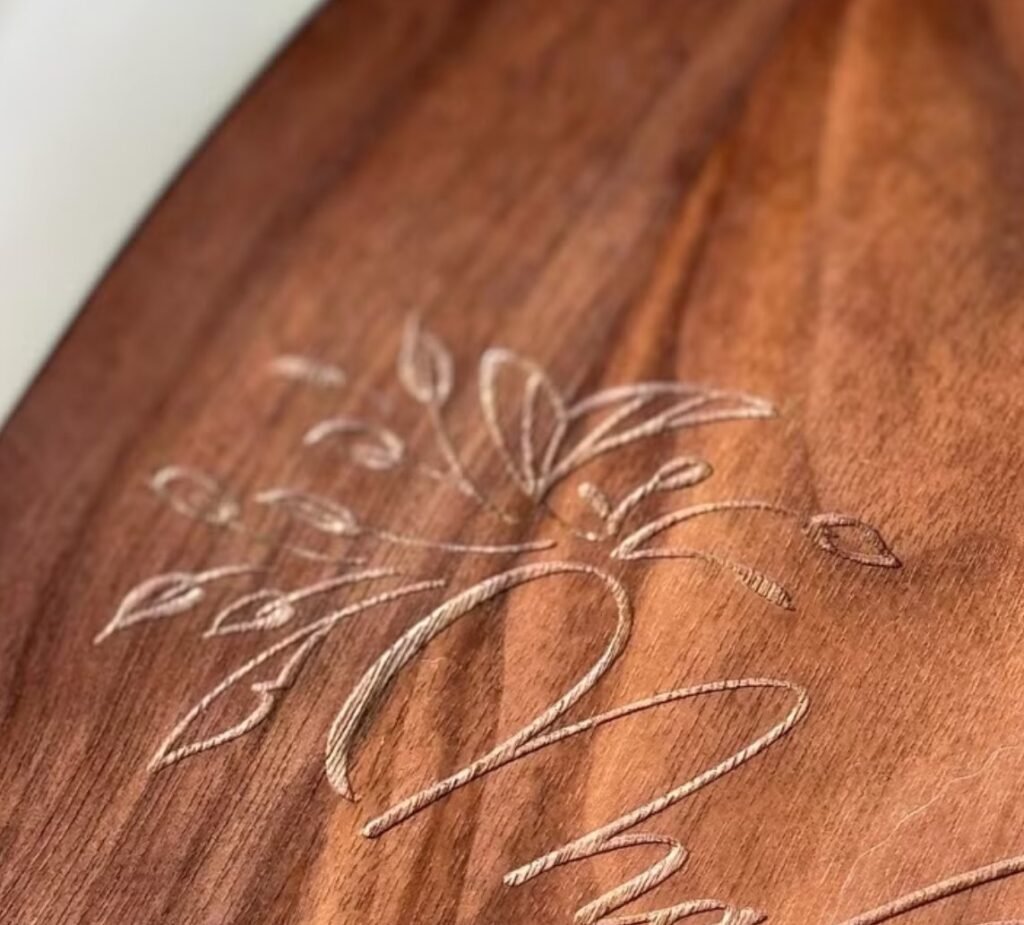
Branding methods: UV digital printing is flat‑surface friendly and scalable; hot foil delivers a premium mark on a primed panel; laser engraving is reliable on clear‑coated light woods but can char—verify on your finish stack.
Hardware and inserts — fit, feel, and tolerances
Hinges, clasps, and magnets define perceived quality; inserts define product security. Here’s how to get them right at the lowest practical cost.
- Hinges and clasps: Reserve complex quadrant hinges for hero pieces; use barrel hinges or simple butt hinges for core SKUs. Follow maker templates and pilot hole sizes; for premium hardware, see Brusso’s hinge documentation for tolerances and steps.
- Magnets: For small cosmetics lids, plan for a comfortable opening force—often around 0.5–1.0 kgf total, depending on lid geometry. Realized pull depends on gap and strike plate; application notes from K&J Magnetics’ articles show how mounting changes effective pull.
- Inserts: EVA for precise cavities, molded pulp for sustainability briefs, card platforms for lowest cost. Tie insert thickness to wall thickness so the lid sits flush without compressing the product.
Acceptance criteria:
- Hardware alignment: Lid overhang ≤0.3 mm; hinge reveal consistent within ±0.2 mm.
- Magnet polarity: 100% check before epoxy; retention pull within ±10% of target average.
Sampling, AQL, and packaging validation (ISTA)
Structure the sampling plan so each phase answers a specific risk question.
- T0 feasibility: Rough material/structure sample to validate concept and dimensions.
- T1 structure: Works‑like box with basic hardware; check dims, lid gap, and squareness.
- T2 finish/print DV: Validate finish stack, adhesion (ASTM D3359), color, and print resolution under production conditions.
- PP/Golden sample: Signed, sealed spec that future lots must match; archive two units.
Final QC and shipping tests:
- Random inspection using ISO 2859‑1 Level II; AQL defaults (critical 0.1%, major 2.5%, minor 4.0) per practitioner norms summarized in QualityInspection.org’s guides.
- For e‑commerce, plan ISTA 3A to simulate parcel handling; if selling via Amazon and pursuing FFP/APASS alignment, select the applicable 6‑Amazon.com project. Scope and selection are outlined on ISTA’s procedure pages and the 3A overview.
Example BOM and cost levers at different MOQs
Here’s a simple scenario to illustrate the biggest levers. Think of it this way: your unit cost is the sum of material yield, finish cycle time, hardware labor, and scrap.
- Base spec (fragrance 50 ml box): 10 mm poplar sides, 3 mm birch plywood lid insert, waterborne acrylic clear, UV digital logo, two 8 mm x 2 mm magnets, EVA insert.
- MOQs: 300 / 500 / 1,000 units.
Cost levers to model with your supplier:
- Material yield: Adjust nesting and switch the lid insert to MDF (TSCA Title VI compliant) for flatter print surfaces; expect a small yield gain and fewer rejects.
- Hardware simplification: Replacing quadrant hinges with embedded magnets removes precision routing and speeds assembly.
- Finish throughput: Where available, moving to waterborne UV shortens cure times and stacking delays; see the technology context in Sherwin‑Williams’ waterborne UV overview.
- Scrap reduction: Enforce MC 6–9% and a 24–48 h acclimation after finish to cut warp rework.
Lead time planning:
- Expect 25–45 days ex‑factory depending on tooling, finishing system, and queueing; verify with your chosen converter. If you need to compress, reduce finish complexity and hardware steps first.
Next steps (and a neutral supplier reference)
- Lock your spec sheet: include dims/tolerances, MC target, finish stack with planned coats, branding method, hardware model, insert material, and AQL/ISTA plans.
- Run T0/T1 fast: de‑risk structure before debating colors. Then do T2 to freeze finish/print.
- Set cost checkpoints at each MOQ tier: 300/500/1,000; request price breaks at 1k/3k/5k.
Disclosure: XMChic Homeware is our product. As an example supplier, XMChic Homeware supports OEM production of wooden cosmetic packaging and can provide factory‑direct quotations and sampling. Use whichever qualified manufacturer best fits your spec and timeline.
References and further reading
- Moisture and EMC for indoor wood packaging: See the EMC guidance in the USDA Forest Products Laboratory Wood Handbook, Chapter 4.
- TSCA Title VI composite wood standards and labeling: The EPA’s formaldehyde emission standards page (U.S., updated guidance and small‑entity compliance).
- Finishing technology context: UV‑curable coatings overview (Sherwin‑Williams Industrial Wood) and waterborne UV finishes overview.
- UV printing process guidance: Professional guide to UV printing on wood (ColDesi).
- Hardware documentation: Brusso resources and hinge documentation.
- Magnet selection and pull: K&J Magnetics application notes.
- AQL norms and inspection planning: QualityInspection.org’s AQL guide and inspection level explainer.
- Packaging tests for parcel/e‑commerce: ISTA procedure list and overviews and ISTA 3A overview.