
Hinges magnets and closures for wooden boxes
When a wooden box project moves from drawing to production, hardware details like hinges, magnets and closures quickly decide whether the item feels premium, ships safely and repeats smoothly. For importers, brand owners and e‑commerce sellers, these details also impact claim rates, reviews, compliance conversations and long-term supply stability.
At Chic Homeware, many OEM/ODM wooden box projects start from a simple brief: size, wood species, color and logo. Hardware is often decided later, yet it drives cost, assembly time and user experience. This article summarizes how to select suitable hinges, magnets and closures for wooden box projects, based on common factory checkpoints and B2B concerns such as MOQ, damage control and repeat-order consistency.
1. Start from the Project Scenario, Not the Hardware Catalog
Before discussing specific hinge or magnet types, it is important to define the use scenario in a way your manufacturing partner can translate into structure and hardware choices.
1.1 Key questions to clarify with your supplier
- Box purpose: gift packaging, keepsake box, watch/jewelry box, tea or spice organizer, cigar box, game piece box, document box, kitchen storage, etc.
- Frequency of opening/closing: single-use gifting, occasional use at home, or high-frequency use (e.g., kitchen or office organizers).
- Target user perception: luxury, rustic, minimal, natural, or functional/value-driven.
- Logistics and channels: Amazon FBA, retail distribution, DTC shipping, or bulk B2B gifting.
- Compliance and markets: EU, US or mixed markets, requirements for nickel-free or specific coatings, child safety considerations, etc.
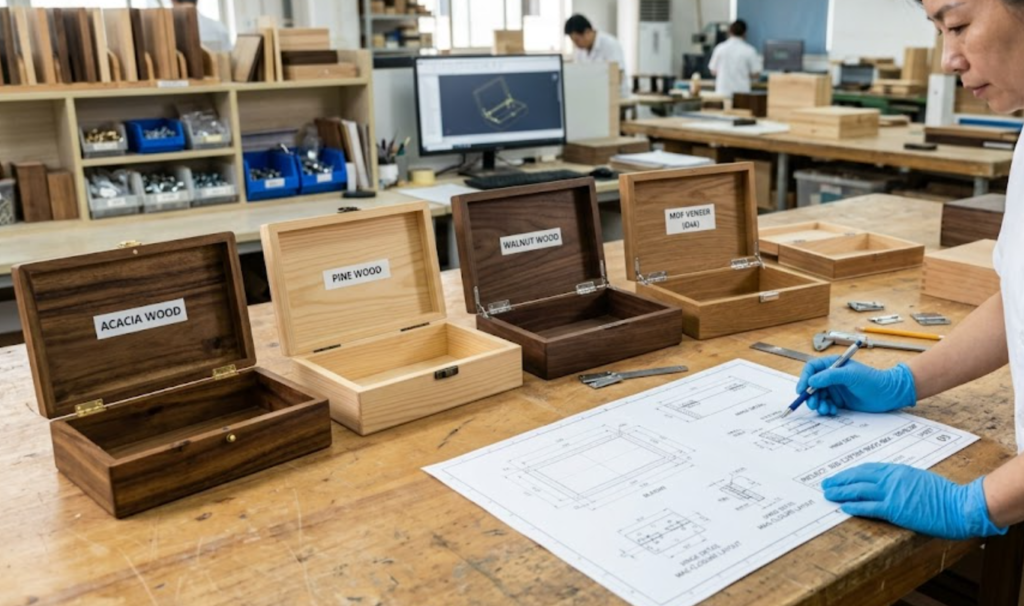
Once this framework is clear, your hardware selection can align with the box structure (acacia vs pine vs MDF veneer, for example), moisture control expectations, surface finishing plan and export packaging method.
2. Matching Hardware Choices with Wood Species and Construction
Common materials for wooden boxes include acacia, pine, paulownia, bamboo, walnut, MDF veneer and plywood veneer. Each material reacts differently to drilling, screw holding strength and hardware alignment. The same hinge design behaves differently on paulownia than on solid walnut.
2.1 Solid woods: acacia, pine, paulownia, walnut
- Acacia and walnut: denser, better screw retention, suitable for more substantial hinges and closures. Good for premium boxes, keepsake chests and gift packaging where a heavier lid is acceptable.
- Pine: medium density, workable and cost-effective. Works well with most standard hinges and magnets, but screw lengths and pilot holes need control to avoid splitting.
- Paulownia: very light and soft, popular for cost-sensitive and lightweight projects. Requires careful hinge selection (often smaller screws, sometimes additional glue support) and gentle assembly torque to protect the wood.
2.2 Engineered panels: MDF veneer and plywood veneer
- MDF veneer: smooth surface ideal for paint and uniform staining, common for branded boxes. Screw holding is moderate; hinge size and pre-drilling need planning to avoid bulging and cracking.
- Plywood veneer: stronger screw holding than MDF and more dimensional stability. Well-suited for medium to larger boxes, especially where moisture changes are expected.
When you define your hardware requirements, specify the material early. The hinge leaf size, screw diameter and even magnet diameter are adjusted in the engineering drawing based on whether the side panel is solid wood or veneered board.
3. Types of Hinges for Wooden Box Projects
Selecting hinges is not only an aesthetic decision. It affects assembly time, lid stability, alignment tolerance and drop-test performance. Below are common hinge types used in OEM/ODM wooden box projects and how they behave in production.
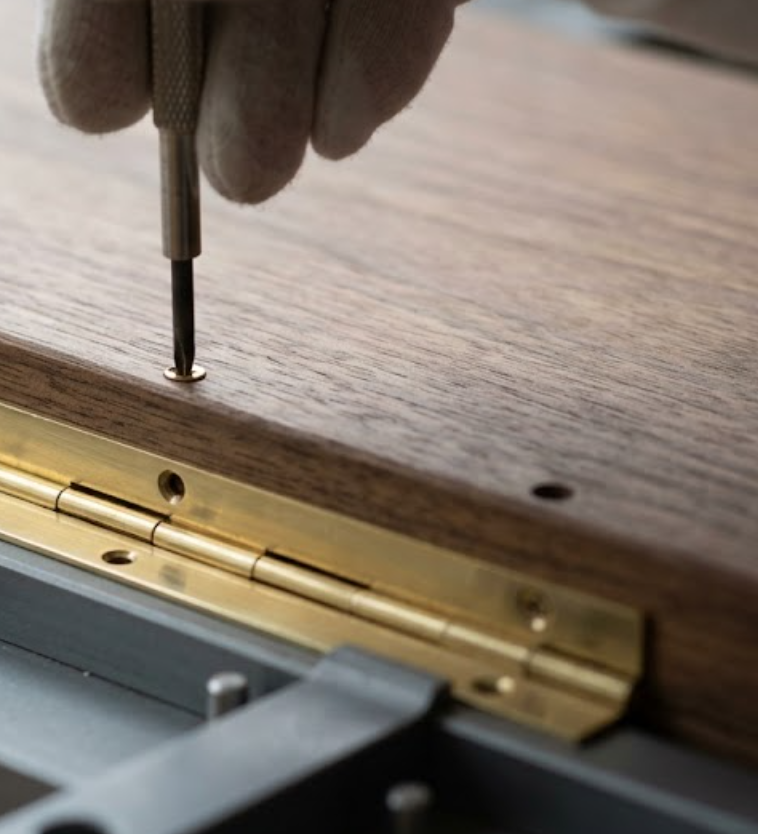
3.1 Butt hinges (surface-mounted)
Use cases: general-purpose storage boxes, gift boxes, small organizers.
- Mounted directly to the back panel and lid, usually visible.
- Suitable for pine, acacia, walnut, bamboo and plywood veneer.
- Cost-effective, easy to install and adjust during assembly.
- Works well for mid-range boxes where the buyer wants visible metal hardware as a design feature.
Factory checkpoints: consistent hinge location jigs, pre-drilling depth control, alignment templates to reduce lid skew, torque control to avoid stripping screws in softer woods like paulownia.
3.2 Concealed or barrel hinges
Use cases: premium gift boxes, jewelry boxes, watch boxes, presentation boxes.
- Installed into drilled holes; no visible leaf from the outside, creating a clean look.
- Requires precise drilling, especially on MDF veneer and plywood veneer to prevent blowout.
- Better suited for projects where structural stability and repeatable positioning matter, and the buyer accepts slightly higher unit cost.
Factory checkpoints: CNC or dedicated drilling fixtures, moisture control to avoid swelling at hinge points, careful sampling to confirm opening angle and friction, special attention during carton drop-test because concealed hinges transfer impact differently.
3.3 Piano hinges (continuous hinges)
Use cases: long or heavy lids, cigar boxes, document cases, board game boxes.
- Runs across most or all of the back edge, distributing stress evenly.
- Improves lid alignment and durability over many opening cycles.
- Can be an advantage for paulownia or softer pine because force is spread across more screws.
Factory checkpoints: straightness and cut accuracy of the hinge, screw spacing and size, consistent gap between lid and base to prevent rubbing after finishing.
3.4 Specialty hinges (soft-close, stop hinges)
Use cases: higher-end boxes where controlled opening angle and smooth motion are part of the brand experience.
- Increase perceived value but add cost and assembly time.
- Require more detailed engineering and pre-production samples to confirm torque with different wood species and finishes.
For most B2B projects, a combination of surface butt hinges or piano hinges is sufficient. Specialty hinges are normally reserved for higher price points or category-leading products.
4. Choosing Magnets and Closures for Function and Safety
Magnets and closures determine how the box behaves in the real world: does the lid stay closed in transit, does it open too easily on shelf, and does the closure match the brand’s perceived quality?
4.1 Magnetic closures: strength and positioning
Magnets are common in modern wooden box projects, especially for lifestyle storage, presentation boxes and e‑commerce packaging that must stay closed through shipping.
- Magnet type: typically round or rectangular neodymium magnets, sometimes ferrite for cost-sensitive projects.
- Magnet strength: matched to lid weight, internal loading and drop-test expectations. Too strong, and users feel resistance; too weak, and lids open in transit.
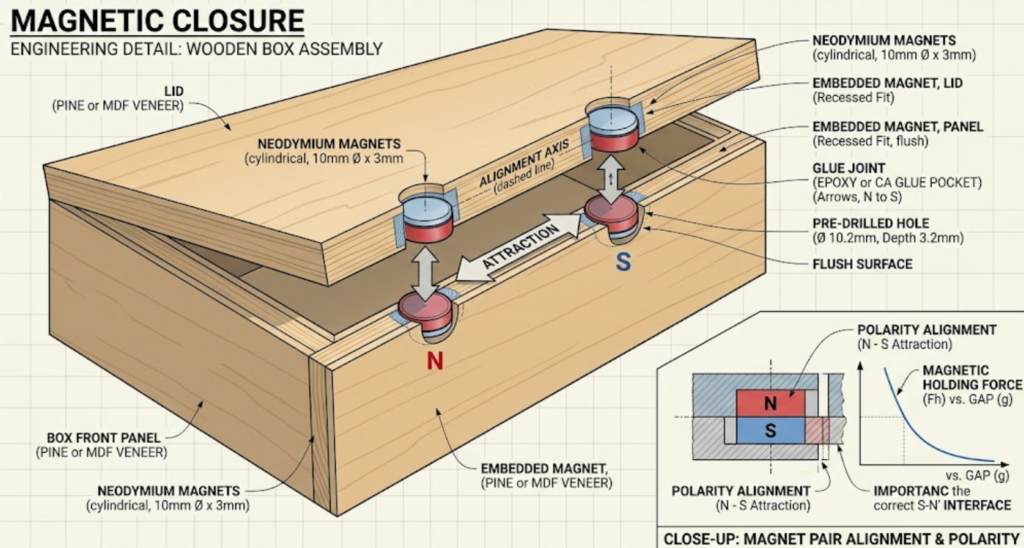
- Installation method: embedded in lid and front panel, with matched poles and precise depth so they sit flush after sanding and finishing.
Factory checkpoints:
- Accurate drilling or routing depth to prevent magnets from protruding after sanding.
- Correct polarity during assembly to avoid rework (polarity is usually controlled by fixtures and process checks).
- Testing after finishing and logo application, because additional coatings and lining materials can alter the perceived closure strength.
4.2 Mechanical closures
Beyond magnets, a variety of mechanical closures can be used:
- Hasp and staple: traditional clasp-style closures, common on rustic pine or paulownia boxes, suited to simple gift sets.
- Toggle or latch closures: good for heavier lids or utility boxes where secure closure is important.
- Hook and eye: simple and low-cost, mostly used for decorative or low-frequency use boxes.
- Ribbon or leather ties: sometimes used to complement magnets for a lifestyle or premium aesthetic.
Mechanical closures may be more forgiving in moisture variation than magnets because they rely less on precise alignment. However, they introduce additional assembly time and potential snag points for textiles or fragile items inside the box.
4.3 Safety considerations for magnets and closures
When selling into EU or US markets, buyers often ask about safety and compliance, especially if the product may be used around children or food-related items.
- Magnet encapsulation: ensure magnets are firmly embedded and secured, especially in boxes that might be accessible to children.
- Nickel and plating: some buyers request specific plating types or nickel-free solutions; this should be clarified early in sampling.
- Sharp edges and pinch points: hinge and latch designs need evaluation after sanding and finishing to avoid sharp corners or pinch hazards.
These points are typically addressed in project-based compliance communication, so your manufacturer can support any required testing or documentation.
5. How Finishing and Logos Affect Hardware Selection
Many B2B buyers focus on color, stain and logo first. However, the finishing process directly impacts hardware choice and installation sequence.
5.1 Surface finishing: stain, paint and clear coats
Chic Homeware regularly works with acacia, pine, paulownia, bamboo, walnut, MDF veneer and plywood veneer under different finishing systems, including stains, paints and clear lacquer.
- Stain finishes: highlight natural grain, especially on acacia, pine and walnut. Hardware color (antique brass, black, silver) should complement the stain tone.
- Paint finishes: often used on MDF veneer or smooth pine for uniform brand colors. Painted edges around hinges and closures must be masked or cleaned to maintain smooth function.
- Clear coats: require careful curing before hardware fitting to avoid imprint marks or adhesion issues from handling.
Production consideration: sequence of finishing and hardware fitting is planned to protect both the coating and the hardware from scratches. For magnets, embedding often happens before final sanding, then surfaces are coated while holes are sealed around the magnet.
5.2 Logo applications and hardware layout
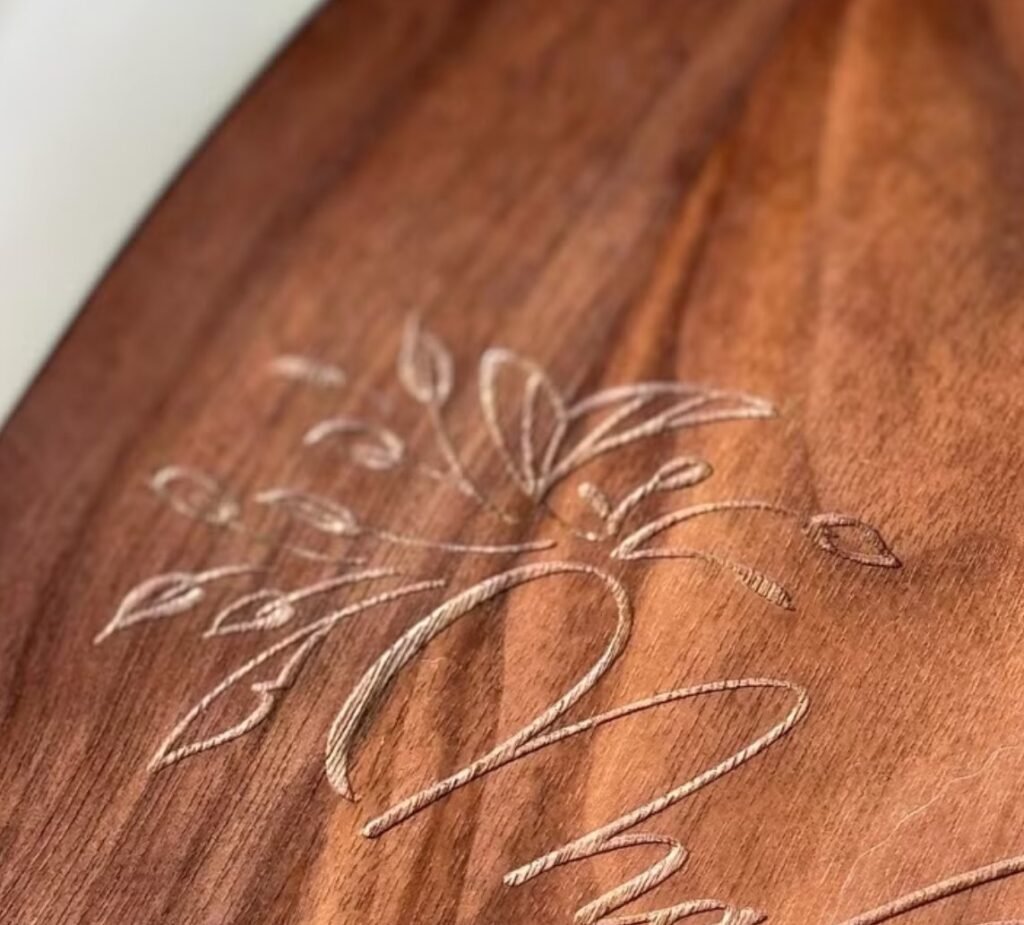
Logo positioning interacts with hinge and closure positions. Common logo processes include laser engraving, silk screen printing, UV printing and hot stamping.
- When placing a logo on the lid front, the closure position should be coordinated so that screws or hardware do not interfere with the logo area.
- On MDF veneer or painted surfaces, logos are usually applied after base coats but before topcoat to balance protection and clarity.
- For premium branding, invisible magnets are often preferred so the logo area remains uninterrupted on the lid front.
During sampling, it is useful to request at least one fully finished prototype with complete hardware, logo and packaging so you can check the visual and tactile consistency as a customer would.
6. Balancing Aesthetics, Cost and MOQ in Hardware Choices
Hardware decisions directly affect tooling, procurement and assembly time, which in turn drive price structure, MOQ and lead time. A practical selection process considers these factors from the beginning.
6.1 Hardware cost tiers
- Entry-level: simple butt hinges, basic hasps, standard magnets. Suitable for volume gift packaging and value-line organizers.
- Mid-range: piano hinges, concealed magnets, upgraded plating colors and slightly heavier hardware. Works for private label lifestyle products and mid-priced Amazon listings.
- Premium: concealed hinges, soft-close or stop hinges, designed latches, customized hardware colors. Best for brand-building hero products.
Across these tiers, the base material (pine vs acacia vs walnut vs MDF veneer) and finishing complexity (hand-stain vs multiple paint layers) will combine with hardware cost to define the final price segment.
6.2 MOQ and hardware standardization
Many importers and Amazon sellers want differentiated designs but need manageable MOQs and stable costs. Using standard hinge and magnet specifications across multiple items can help:
- Use the same hinge type and finish on a series of boxes in different sizes to consolidate purchase volumes.
- Maintain one magnet diameter and strength across a collection, adjusting only the number of magnet pairs if needed.
- Standardize screw types and lengths to simplify assembly and quality control.
This approach allows variation in wood species, finishes and internal compartments, while keeping the hardware supply chain more stable. Chic Homeware can advise on which existing hardware configurations are proven in production and easier to repeat.
7. Hardware, Damage Control and Export Packaging
Hinges, magnets and closures must survive export cartons, container transport and last-mile handling. Even well-built boxes can experience issues if hardware is not considered in export packaging planning.
7.1 Carton drop-test thinking
For projects shipped to EU and US markets, many buyers request carton drop-test thinking during development. Hardware is one of the main stress points.
- Hinges: need sufficient screws and proper pilot holes to prevent loosening when cartons are dropped on edges or corners.
- Magnets: must stay embedded under impact; gluing or press-fit tolerances are checked during sampling.
- Closures and latches: should not puncture internal products or scratch surfaces under compression or vibration.
In testing, boxes are normally checked for alignment drift (lid still closing correctly), magnet hold strength and visible damage to hardware or finish.
7.2 Inner packing and protective solutions
When planning export packaging, hardware elements are considered in inner packing design:
- Positioning foam or corrugated inserts so hinges and closures do not directly contact the outer carton.
- Using tissue paper, foam sleeves or polybags to protect painted or stained surfaces around hardware from rubbing.
- For premium boxes, sometimes shipping with lids slightly open or with protective spacers so closures are not under tension during transit.
Chic Homeware integrates these packaging decisions with the overall structure, ensuring that hardware choices do not unexpectedly increase packing labor or carton size.
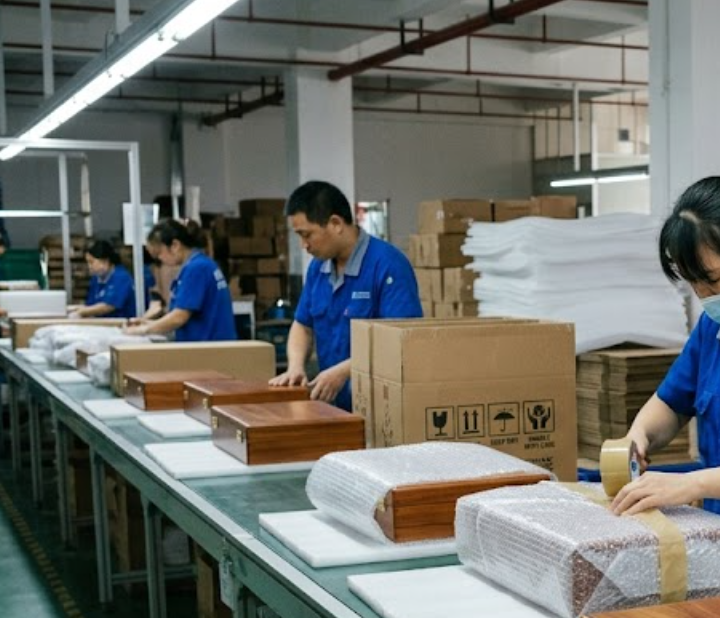
8. OEM/ODM Workflow: From Sampling to Repeat Orders
For B2B buyers, the challenge is not just selecting a hinge or magnet once, but ensuring the choice works across samples, first production and repeat orders. A clear OEM/ODM workflow is essential.
8.1 Sampling: locking in hardware specifications
During sampling, hardware configuration should be treated as a critical specification, together with size, compartments and finishing.
- Confirm hinge type, material, color, screw type and placement in the technical drawings.
- Record magnet size, strength and quantity per box, and clarify if the magnet specification must remain fixed over future orders.
- Check that hardware functions correctly after full finishing and with the intended contents (bottles, jars, textiles, accessories).
It is also helpful to request photos or short videos of the sampling process showing hardware fitting, so you can understand the assembly method and potential variation points.
8.2 Production: moisture, sanding and fitting consistency
In production, several checkpoints protect hardware consistency:
- Moisture control: stabilizes wood movement so hinge alignment and magnet placement remain accurate over time.
- Sanding consistency: ensures that edges and surfaces around hardware are level, so hinges sit flush and magnets maintain contact.
- Hardware fitting: executed according to jigs and standard operating procedures, with regular checks of screw penetration, torque and alignment.
For series orders, a reference “golden sample” is used in QC to compare hinge and closure behavior, ensuring the closure feel is similar across batches.
8.3 Repeat orders: maintaining hardware and supplier stability
In long-term relationships, buyers often expand collections or change finishes. Keeping hardware stable simplifies these changes:
- Using the same hinge and magnet specification on new sizes or related products.
- Confirming any hardware supplier change through updated pre-production samples.
- Maintaining a clear BOM (bill of materials) that labels hardware codes and finishes for future reference.
This approach supports predictable lead times and reduces variability, which is important for Amazon sellers and retail programs that rely on consistent reviews and low return rates.
9. Practical Comparison Table: Hinges, Magnets and Closures
| Hardware Type | Best For | Pros | Considerations |
|---|---|---|---|
| Butt hinges | General boxes in pine, acacia, walnut, plywood veneer | Cost-effective, easy to install and adjust | Visible hardware; requires alignment control |
| Concealed/barrel hinges | Premium gift and jewelry boxes | Clean exterior look, premium feel | Requires precise drilling and tighter QC |
| Piano hinges | Long or heavy lids, document cases | Strong and stable, spreads load | More screws and assembly time |
| Magnets (embedded) | Modern presentation boxes, lifestyle storage | Clean look, adjustable strength | Requires careful positioning and polarity control |
| Hasp/latch closures | Rustic or utility boxes, gift sets | Clear closure feedback, decorative options | Visible hardware, more assembly steps |
10. How Chic Homeware Supports Hardware Decisions in Real Projects
As a Wooden Products Factory in China, Chic Homeware integrates hardware considerations into the full OEM/ODM workflow, from wood species selection and moisture control to export packaging and repeat orders.
For buyers developing full collections, a Custom Wooden Products Manufacturer can help you standardize hinges, magnets and closures across multiple box types, sofa trays, organizers and gift sets. This reduces complexity while keeping the design language consistent.
When projects are focused specifically on storage and presentation, our Custom Wooden Boxes development process aligns hardware specifications with your size, compartment design, logo, color box and mailer carton requirements.
Conclusion: Turn Hardware Decisions into a Competitive Advantage
Choosing hinges, magnets and closures for wooden box projects should not be an afterthought. When approached systematically—starting from use scenario, material, finishing and export requirements—hardware decisions can strengthen the user experience, protect the product in transit and support reliable repeat orders.
By combining practical hardware options with controlled moisture levels, sanding consistency, stable finishing systems and thoughtful export packaging, Chic Homeware helps importers, wholesalers, distributors and online sellers bring wooden box concepts to market with fewer surprises.
If you are planning a new wooden box range or upgrading an existing collection, you can share your drawings, target price, market and compliance needs so we can recommend suitable hinge, magnet and closure configurations at the sampling stage. This early alignment often saves time, avoids re-engineering and makes scaling smoother.
To discuss your next project, hardware options and OEM/ODM possibilities, please get in touch with Chic Homeware’s team for project-based recommendations and sampling.