
FSC wooden product sourcing: What B2B Buyers Usually Ask
FSC-oriented wooden product sourcing is no longer a “nice to have” topic during supplier calls. For many importers, brand owners and Amazon sellers, it is a basic qualification that must be addressed alongside pricing, MOQ and lead time. From our perspective as a factory-oriented OEM/ODM partner, the most productive conversations happen when buyers know what to ask, and suppliers can answer in a clear, practical way.
This article summarizes the questions B2B buyers most often raise about FSC-oriented sourcing when developing custom wooden boxes, organizers, trays, kitchen storage and gift packaging with Chic Homeware. It focuses on real project details: materials, moisture control, customization options, export packing and how FSC-related topics fit into your overall sourcing strategy.
What Does “FSC-Oriented” Actually Mean in Daily Sourcing?
Different buyers use the term “FSC-oriented” in different ways. Some require fully certified FSC product lines; others want to understand whether suppliers can work with FSC materials when needed. In practice, discussions usually fall into three levels:
- Level 1 – Awareness and capability: The supplier understands FSC requirements and can separate FSC and non-FSC material routes in their production and documentation.
- Level 2 – Project-by-project decision: Buyer and supplier jointly decide which SKUs require FSC inputs and which can remain standard, depending on target market, channel and price position.
- Level 3 – System-level planning: Long-term partners align on FSC-oriented sourcing policies for new collections, including material selection, labeling and documentation expectations.
When you discuss “FSC-oriented” sourcing with Chic Homeware, the conversation is less about slogans and more about how to implement practical routes for raw material purchasing, production planning and export documentation that align with your channel requirements in the EU, US or other markets.
Key Buyer Question 1: Which Wood Species Can Be FSC-Oriented?
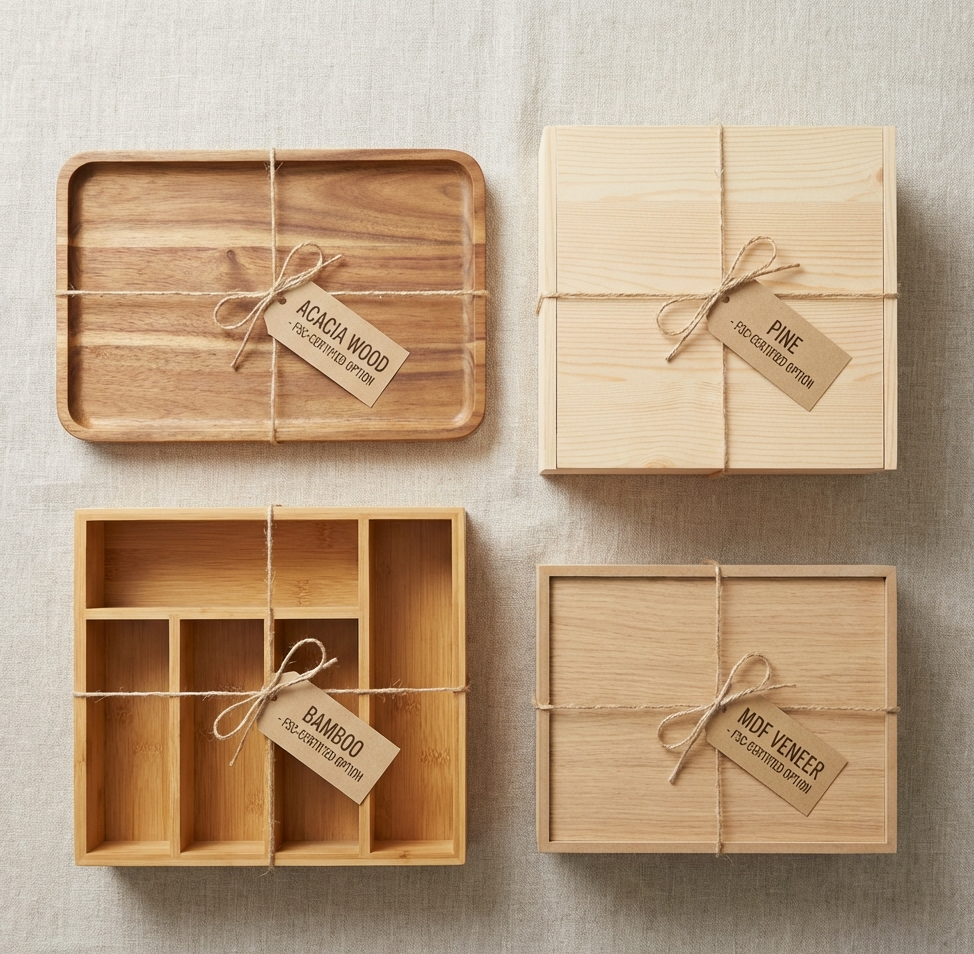
The natural starting point is materials. Buyers want to know whether commonly used species in their projects can be supported via FSC-oriented routes. At Chic Homeware, we regularly discuss the following materials for OEM/ODM wooden products:
- Acacia: Often used for richer, darker-toned organizers, trays and kitchen storage. Works well for mid- to higher-end positioning and can support FSC-oriented sourcing depending on project scope.
- Pine: A cost-effective softwood widely used for gift boxes, storage crates and decorative organizers. Typically offers good flexibility for FSC-oriented material planning.
- Paulownia: Extremely light, making it popular for larger boxes and decorative packaging where weight is a concern. FSC-oriented options may be more project-specific and require early planning.
- Bamboo: Perceived as eco-friendly and modern, frequently requested for kitchen items and premium packaging. Bamboo often aligns naturally with sustainability discussions and FSC-oriented sourcing.
- Walnut: A higher-value species used for premium gift boxes, watch boxes and executive organizers. Due to price and availability, FSC-related decisions are usually taken per project.
- MDF veneer: Engineered core with a veneer surface. Common for painted finishes and precise shapes. FSC-oriented sourcing depends on the MDF core and veneer origins.
- Plywood veneer: Stable, layered construction with veneer on surface. Useful for structural consistency in trays and boxes, also subject to project-based FSC discussions.
In many cases, buyers will mix materials—such as combining pine or MDF cores with acacia or walnut veneer—to balance cost, appearance and FSC considerations. Clear early communication about your target markets and positioning allows us to propose realistic material combinations and indicate where FSC-oriented sourcing is most feasible.
Key Buyer Question 2: How Does FSC-Oriented Sourcing Affect Cost and MOQ?
Most B2B sourcing managers quickly move from materials to commercial impact. Two questions repeat in almost every call:
- “What is the price difference if we choose FSC-oriented material routes?”
- “Will my MOQ increase if we specify FSC-related requirements?”
While exact numbers depend on market condition and product design, there are some general patterns you can expect when working with a Custom Wooden Products Manufacturer like Chic Homeware:
- Material cost impact: FSC-oriented raw material can carry a premium compared with standard sources, especially for certain species or when availability is tight. The impact is typically more noticeable on heavy solid woods (acacia, walnut) than on lighter or engineered materials.
- MOQ alignment: For stable, widely used woods like pine and bamboo, FSC-oriented orders can often align with similar MOQs as standard material. For niche species or custom veneers, we may discuss larger minimums or consolidated purchasing schedules.
- Design-driven optimization: Smart engineering—e.g., using FSC-oriented veneer over cost-efficient cores, adjusting wall thickness, or reducing waste through optimized nesting—can help offset part of the material premium.
During the quotation stage, it helps if you clarify whether FSC-oriented sourcing is a strict requirement for all SKUs, only for certain SKUs, or simply a preference if cost impact is acceptable. This allows the factory to structure quotations accordingly and propose options instead of giving you a flat “yes/no” answer.
Key Buyer Question 3: How Do Production Checkpoints Support FSC-Oriented Quality?
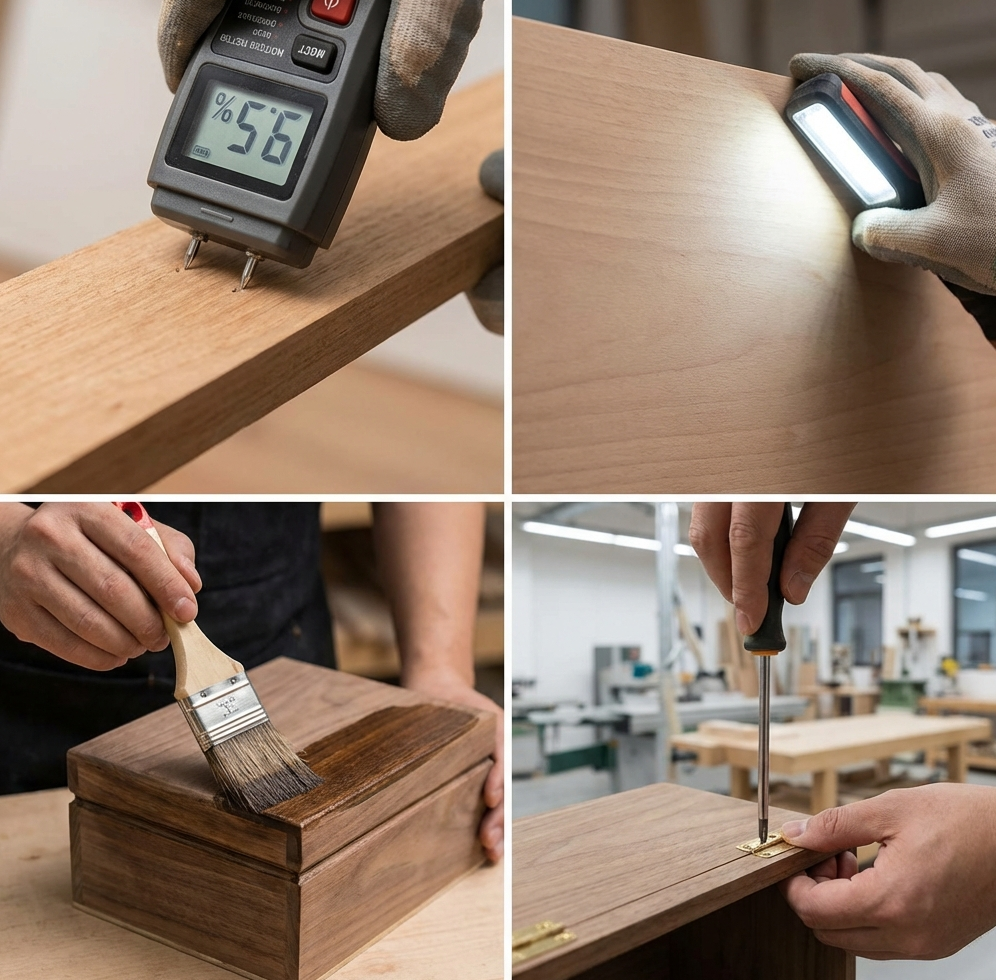
FSC-oriented sourcing is not only about where the wood comes from. Buyers also care about how the finished product performs in real usage and shipping. At Chic Homeware, our factory-side checkpoints are designed to manage both compliance expectations and day-to-day quality issues that affect your brand reviews and repeat orders.
Moisture Control
Moisture content remains one of the top issues for wooden products shipped across climates. Even if the material is FSC-oriented, unstable moisture can still cause warping, cracking or mold during transit or storage.
- Pre-drying and conditioning: We focus on drying schedules suitable for acacia, pine, paulownia and other species to keep moisture within a range appropriate for export.
- Structure + moisture balance: For MDF or plywood veneer constructions, core and veneer are matched to avoid stress that might lead to surface issues even when moisture numbers look acceptable on paper.
Sanding Consistency
Uneven sanding is visible in stain and paint finishes and can be amplified on darker species like walnut or acacia. Buyers frequently ask how we keep finish consistency across large orders.
- Grit sequence and process control: Production lines follow defined grit sequences for different product types to minimize visible sanding marks.
- Spot checks: Sampling from each batch is reviewed before stain or paint, reducing the risk that defects only become visible after finishing.
Stain, Paint and Surface Finish
FSC-oriented sourcing does not automatically guarantee a premium look; finishing processes do. Common questions include color consistency, VOC considerations and batch stability.
- Color matching: We keep master color panels for each project and compare batch samples under consistent lighting conditions.
- Product-function fit: For kitchen storage or trays, buyers may prefer certain finish types for easier cleaning and resistance to oil or moisture.
Logo Process and Hardware Fitting
Brand owners and Amazon sellers are especially sensitive about logo clarity and hardware durability because these factors directly affect product reviews.
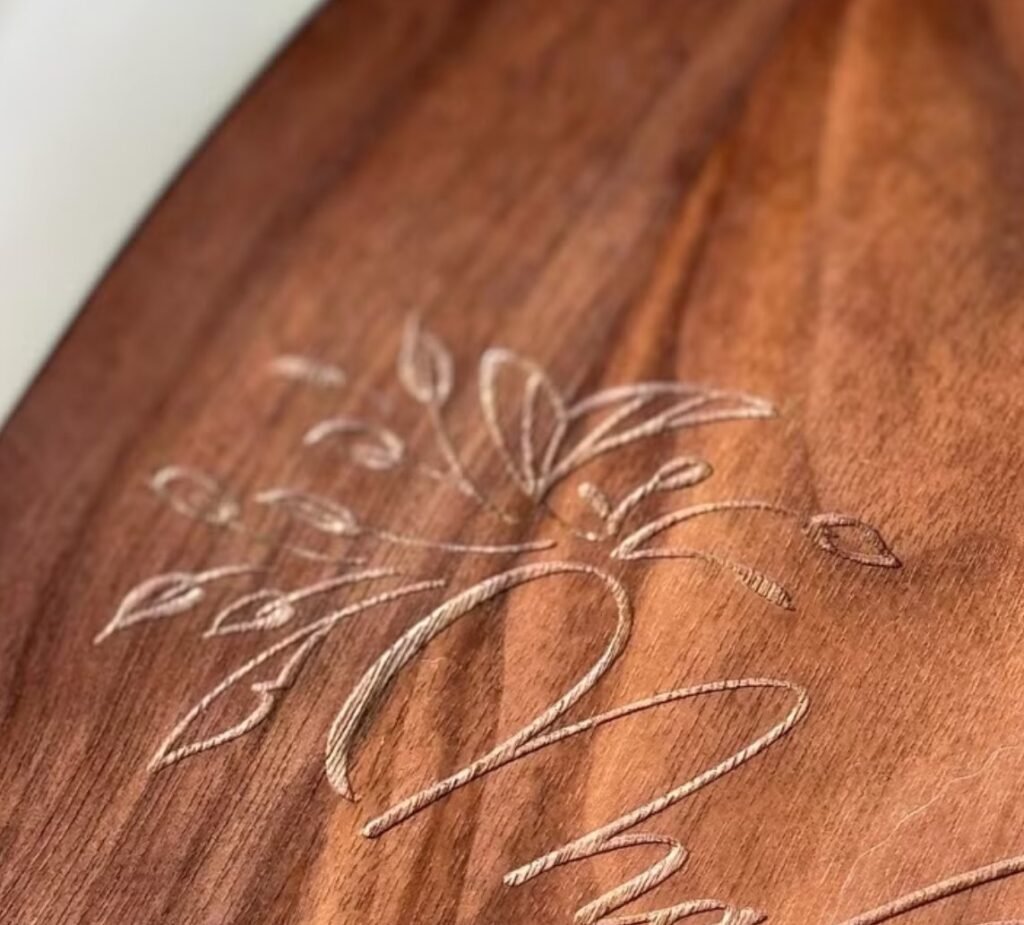
- Logo methods: Common options include laser engraving, silk-screen printing, heat stamping and metal badges. Each has implications for cost and suitability for different materials (e.g., laser on bamboo vs. screen print on painted MDF).
- Hardware: Hinges, magnets, latches and handles must be matched with the wood type and wall thickness to avoid splitting or misalignment. Test-assembly is built into the pre-mass production phase.
When we talk about FSC-oriented sourcing with buyers, we connect it back to these checkpoints. The choice of species and material route affects drying, finishing and hardware selection; handling them together gives you a more stable product and fewer surprises.
Key Buyer Question 4: What Customization Can We Combine with FSC-Oriented Sourcing?
Most B2B buyers are not sourcing off-the-shelf items. They need a practical OEM/ODM workflow that combines FSC-oriented wood sourcing with design, branding and packaging flexibility. Typical customization points include:
- Size and structure: Length, width, height and wall thickness adjustments to fit your product contents, shipping constraints or brand aesthetics.
- Compartments and inserts: Fixed dividers, removable trays, foam or cardboard inserts, and mixed-material interiors (e.g., fabric lining) to organize contents.
- Hinges and magnets: Different hinge types, opening angles, and magnet strengths to achieve the desired user feel and closure stability.
- Logo application: Position, size and method (laser, print, stamping) aligned with the selected wood species and intended finish.
- Outer packaging: Color boxes, mailer cartons and carton marks designed for retail, e-commerce or wholesale supply chains.
During the development stage, we usually start with a drawing or reference sample, confirm target material (e.g., FSC-oriented pine body with acacia veneer lid), and then build a sample that integrates all structural, finish and packaging requirements. Buyers who share their channel needs (e.g., Amazon FBA, specialty retail, direct-to-consumer) early can often avoid costly design changes later.
Key Buyer Question 5: How Are Sampling, Lead Time and Repeat Orders Managed?
Sourcing managers often need internal answers fast: when can we see a sample, how long to ship, and how stable will future orders be? FSC-oriented sourcing adds another layer of planning, but with a factory-oriented workflow, it can be managed in a predictable way.
Sampling
Typical steps for a new project include:
- Briefing: You share dimensions, target wood species (with FSC-related preferences), finish, logo artwork and packaging requirements.
- Engineering review: We confirm technical feasibility, suggest structural optimizations, and flag any material-related risks.
- Sample development: Our team produces a physical sample reflecting agreed materials, hardware and finishing. For FSC-oriented projects, the sample stage is when we confirm material routes and align expectations.
The sample phase is also when MOQ bands and pricing structures are clarified so that category managers and purchasing teams can make informed decisions.
Lead Time
Lead time is influenced by material preparation, finishing complexity and packaging details. FSC-oriented material planning may require earlier lock-in of key parameters, especially for large or multi-SKU programs. To avoid delays:
- Confirm material and finish early, including whether FSC-oriented sourcing is mandatory or flexible.
- Finalize logo and packaging specifications before mass production scheduling.
- Align on inspection and testing strategies, particularly if you are shipping to EU or US markets with specific expectations.
Repeat-Order Consistency
Buyers are rightly concerned that the first shipment looks perfect while later shipments drift in color, finish or structural details. We address this via:
- Master samples and records: Keeping master samples and documented process parameters for moisture, sanding, staining and hardware for each approved SKU.
- Material batch controls: Managing wood selection to minimize color and grain variations beyond what was accepted in the approved sample.
- Packaging consistency: Maintaining the same export packaging structure, carton marks and protective details unless we jointly agree on improvements.
FSC-oriented sourcing can actually support consistency by encouraging more controlled material procurement and batch planning, as long as communication remains open across the life of the product.
Key Buyer Question 6: How Do You Manage Export Packaging and Damage Control?
Damage control is one of the most practical concerns for importers and e-commerce brands. A well-sourced wooden gift box or organizer loses its value if it arrives scratched, cracked or deformed.
Export Packaging Planning
For each project, we discuss export packaging in detail:
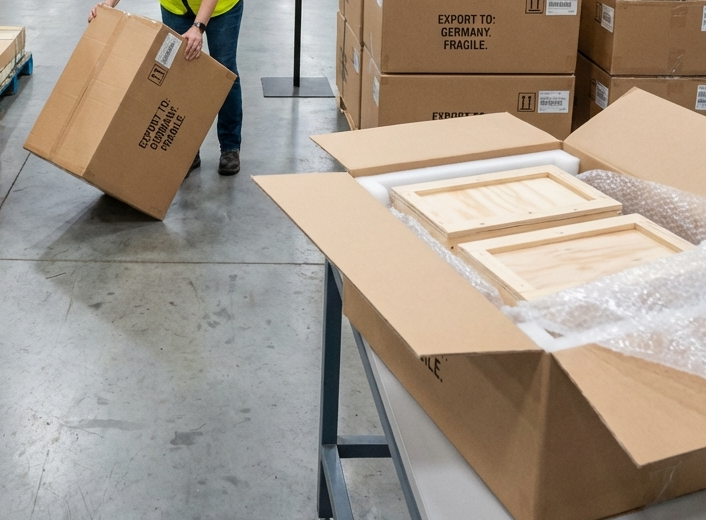
- Individual protection: Polybags, tissue paper, foam corners, bubble wrap or cardboard inserts around the wooden product.
- Inner cartons or color boxes: Depending on whether the item is sold as a retail unit or bulk. Color boxes often need both visual design and structural reinforcement.
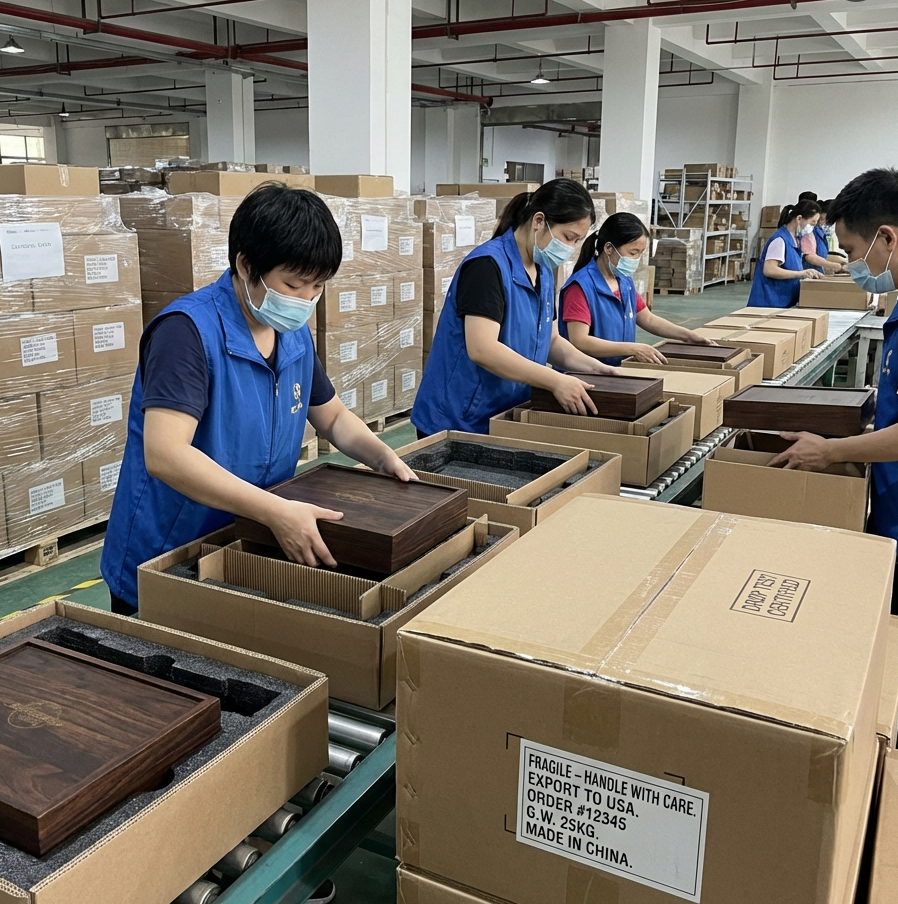
- Outer master cartons: Carton quality, stacking limits and layout (e.g., 4, 6, 8 pcs per master) are designed according to weight, carton drop-test thinking and shipping method.
We analyze the product’s vulnerability (e.g., fragile hinges, protruding hardware, fragile veneer edges) and design protection around these weak points.
Carton Drop-Test Thinking
While formal testing may vary by buyer and standard, we use internal carton drop-test thinking when planning export packaging. The aim is to simulate typical handling shocks during warehouse transfer and courier sorting. This leads to practical decisions such as:
- Adding extra corner and edge reinforcement for heavier acacia or walnut boxes.
- Using molded pulp or foam inserts for premium gift sets to prevent internal movement.
- Adjusting master carton packing orientation so that the product’s strongest side faces likely impact points.
By combining FSC-oriented wooden sourcing with robust export packaging design, you minimize the risk of breakage claims, return rates and negative customer feedback in your target markets.
Key Buyer Question 7: How Does a Factory-Oriented Partner Support Compliance Communication?
B2B buyers serving EU, US and other regulated markets want a partner who can speak in practical compliance terms. This does not mean overpromising; it means being able to support project-based document requests and technical discussions.
At Chic Homeware, project-based compliance communication typically includes:
- Material transparency discussions: Clarifying wood species, engineered cores, veneers, finishes and glue types used for specific SKUs.
- FSC-oriented documentation planning: Agreeing which products require FSC-linked sourcing records and how those records align with your internal or external requirements.
- Risk-based approach: Focusing more documentation effort on high-sensitivity products (e.g., food-contact adjacent items, baby-related storage) and critical sales channels.
For sourcing managers, this practical, project-based approach is often more useful than generic claims. It allows your internal compliance and quality teams to work directly with our factory team, rather than dealing only through trading intermediaries.
Putting It All Together: Planning an FSC-Oriented Wooden Product Program
When you launch or refresh a wooden product line—whether it is custom boxes, organizers, trays, kitchen storage or gift packaging—you can think of the process in six steps:
- Clarify your channels and requirements: Define which SKUs are destined for EU vs. US vs. other markets, and which channels (retail, wholesale, online) will expect FSC-related documentation or labeling.
- Segment SKUs by sourcing level: Decide which items must follow FSC-oriented routes and which can remain flexible based on cost and positioning.
- Select suitable materials: Choose from acacia, pine, paulownia, bamboo, walnut, MDF veneer or plywood veneer, possibly in combinations, balancing appearance, cost and FSC-related feasibility.
- Co-develop structure and finishing: Work with the factory to optimize structure, moisture control, sanding, finish and hardware so that the product performs well in real usage and shipping.
- Engineer export packaging: Incorporate damage control and carton drop-test thinking to protect the FSC-oriented product all the way to the end customer.
- Set up repeatability: Use master samples, process parameters and clear documentation so that future orders stay consistent even as volumes scale.
Choosing a Wooden Products Factory in China that understands both FSC-oriented sourcing and OEM/ODM workflow helps you move through these steps more efficiently, without treating sustainability and quality as separate conversations.
Why Work with Chic Homeware for FSC-Oriented Wooden Product Sourcing?
Chic Homeware operates as a factory-oriented OEM/ODM partner focused on custom wooden boxes, organizers, trays, kitchen storage and gift packaging for importers, wholesalers, distributors, brand owners and Amazon sellers. Our daily work revolves around:
- Flexible material routes: Practical experience with acacia, pine, paulownia, bamboo, walnut, MDF veneer and plywood veneer, including FSC-oriented sourcing discussions where relevant.
- Production optimization: Emphasis on moisture control, sanding consistency, stable stain/paint finishes, reliable logo processes, structural strength and protective export packaging.
- Commercially realistic OEM/ODM flow: Sample development, logo customization, mixed-material proposals, MOQ and price-structure discussions tailored to different markets and channels.
- Project-based communication: Direct, technical dialogue with sourcing, quality and compliance teams to align on requirements for EU, US and other destinations.
If you are planning a new wooden product program or reviewing your current supply base, partnering with a dedicated Custom Wooden Boxes and wooden storage manufacturer allows you to integrate FSC-oriented considerations from the first drawing through to mass production and repeat orders.
Conclusion and Next Steps
B2B buyers usually ask the same core questions about FSC-oriented wooden product sourcing: which materials can support it, how it affects cost and MOQ, what it means for quality and export packaging, and how documentation and repeat orders will be managed. Addressing these questions early and clearly turns FSC-oriented sourcing from a potential risk point into a structured advantage for your brand.
If you are evaluating suppliers for custom wooden boxes, organizers, trays, kitchen storage or gift packaging and want practical, factory-level input on FSC-oriented sourcing, sampling, customization and export packing, we can support you from concept to shipment.
To discuss your upcoming projects, share drawings or request a development quote, please reach out via Contact Chic Homeware. Our team will review your requirements and propose suitable material options, structure designs and packaging solutions aligned with your FSC-oriented sourcing goals and commercial targets.