Williams-Sonomas Holzbretter im Frühjahr: 5,8×-Aufschlag

TL;DR
- ▸Die Holzwand von Williams-Sonoma im Frühjahr ist weiterhin Akazie im Einstieg und Walnuss/Ahorn in der Spitze — getrennt durch die Konstruktion, nicht die Holzart.
- ▸Dasselbe Mittelklasse-Akazienbrett verlässt unseren Werksboden für ≈ 6,90 $ FOB gegenüber einem US-Regalpreis von ≈ 40 $ — etwa 5,8× Aufschlag.
- ▸Die meistkopierte Einzel-SKU auf unserem Angebotsschalter diesen Monat ist das 3-teilige Edge-Grain-Akazienset.
In Zahlen
Aufschlag von Retail zu FOB bei einem Mittelklasse-Akazienbrett
US-Regal ≈ 40 $ · unser FOB ≈ 6,90 $ bei 2.000 Stück
Every spring we pull a major retailer's wooden-board wall apart to see what it's really made of — and what the same thing costs to build. This season it's Williams-Sonoma. The short version: their assortment isn't really sorted by wood, it's sorted by how the board is built. Get that one distinction right and you can put a near-identical board on your own shelf for a fraction of the price.
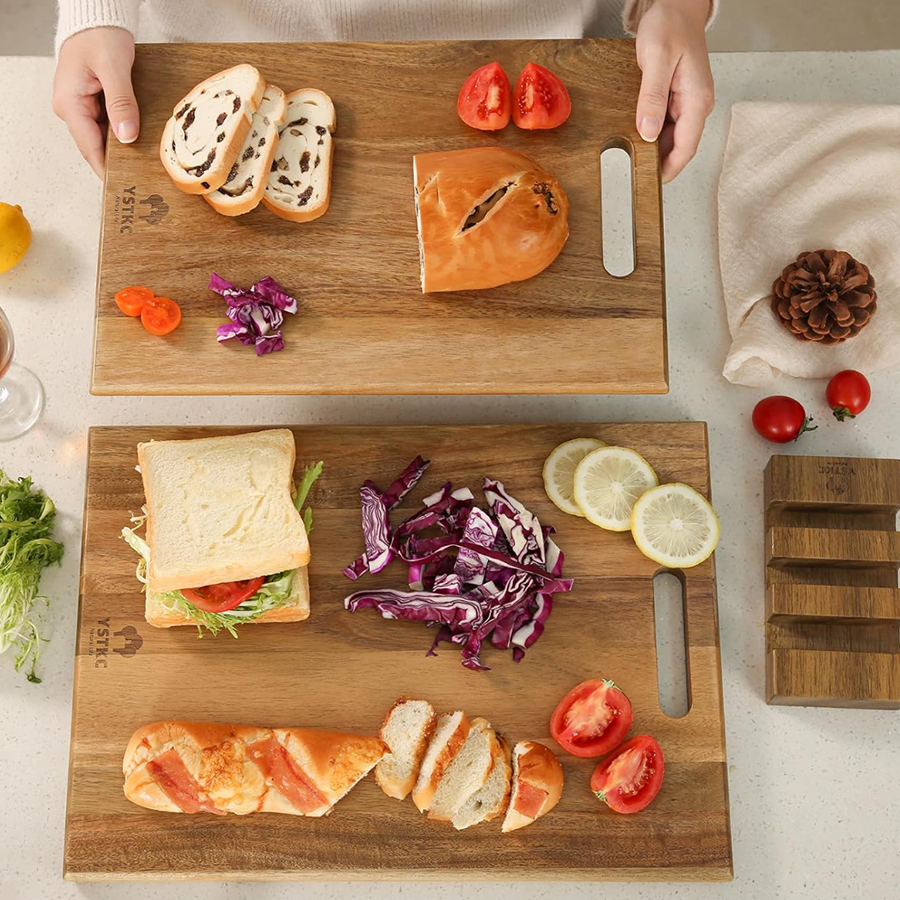
The front of the wall is edge-grain acacia. These are the two- and three-piece sets, the carving boards with a juice well, the board-and-knife gift sets. They're light, warm-toned, and marketed as "sustainably sourced." This is the workhorse tier — the one most shoppers actually buy — and it's the easiest to private-label well. Our floor builds the same construction in FSC acacia, with a laser-engraved logo and a food-grade oil finish, at about $6.90 a set against a roughly $40 US shelf price.
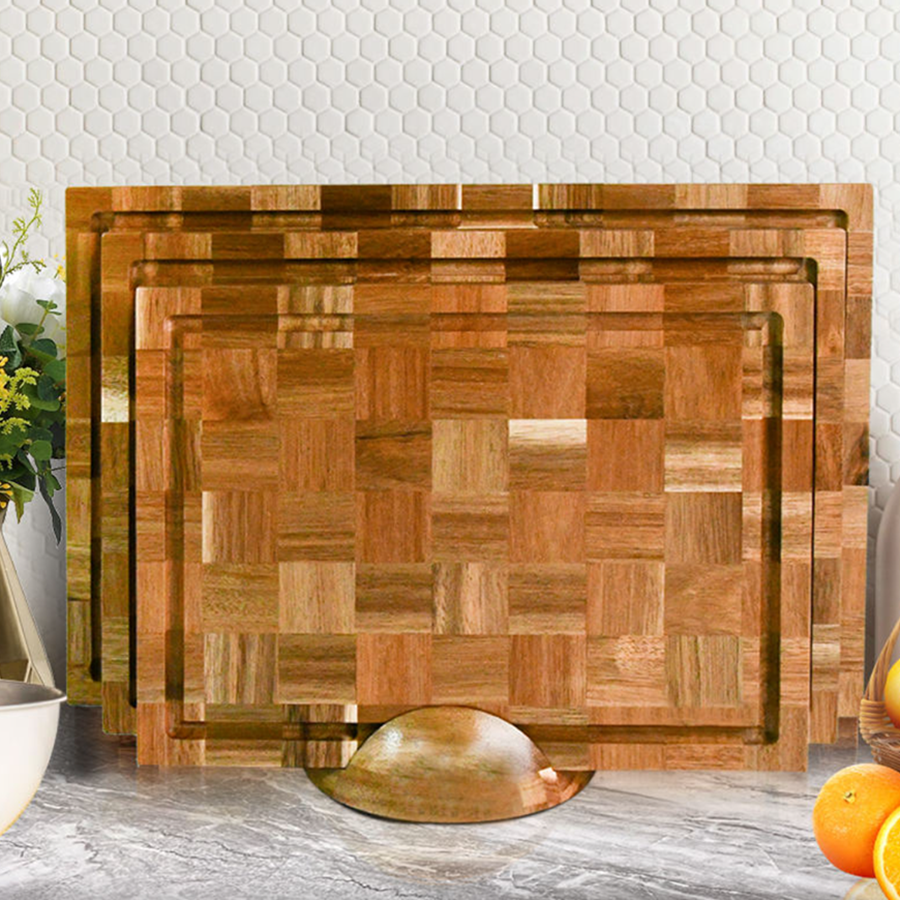
The top of the wall is end-grain. These are the thick butcher blocks with the checkerboard face, little feet underneath, in acacia and walnut. They feel expensive because they're harder to make — more waste, more glue-up labour, a longer drying cycle — and that, not the wood, is why they cost a multiple of the board sitting right next to them.
So the practical takeaway for anyone launching a private-label board line is simple: decide your construction tier before you argue about wood. Edge-grain gets you to shelf cheaper and faster; end-grain buys you a premium feel at a higher cost and longer lead time. Pick the tier first, send exact dimensions, lock your FSC paperwork for EU-bound stock — and the rest is a routine build. The numbers, MOQs and lead times are in the cards below.
Externes Signal
Die Frühjahrswand von WS: Akazie vorne, Walnuss an der Spitze
Das aktuelle Holz-Schneide- und Servier-Sortiment von Williams-Sonoma teilt sich sauber in zwei Konstruktionsstufen. Am zugänglichen Ende stehen Edge-Grain-Akazienstücke — die Zweier- und Dreier-Sets, die Tranchierbretter mit Saftrille, das Open-Kitchen-Brett-und-Messer-Set — wobei Akazie als „nachhaltig bezogen“ vermarktet wird. Am Premium-Ende stehen End-Grain-Hackblöcke aus Akazie und Walnuss sowie gestreifte Ahorn-Walnuss-Bretter. Das Verräterische: Die Konstruktion, nicht die Holzart, bewegt den Preis. Ein End-Grain-Block (dicker Korpus, Füße, Schachbrettfläche) erzielt ein Vielfaches des daneben liegenden Edge-Grain-Bretts.
Aus der Halle
Käufer schicken uns WS-Screenshots — das 3er-Set wird am meisten kopiert
Diesen Monat nahm unser Angebotsschalter 18 OEM-Anfragen entgegen, die sich auf ein Brett im Williams-Sonoma-Stil bezogen; 11 davon waren das Edge-Grain-Akazienset zu dritt. Unser FOB für diese Ausführung liegt bei etwa 6,90 $ pro Set bei 2.000 Stück — FSC-Akazie, lasergravurtes Logo, lebensmittelechtes Öl-Finish — gegenüber etwa 9,40 $ für einen vergleichbar großen End-Grain-Walnussblock. MOQ ist 500, Bemusterung 7–10 Tage, Produktion 25–30 Tage. Die eine Spezifikation, die Zeit kostet, ist das Tranchierbrett mit Saftrille: eine CNC-Rillentasche fügt rund 3 Tage plus einmalige Vorrichtungskosten hinzu.
Was diese Woche zu tun ist
- □Wählen Sie zuerst Ihre Konstruktionsstufe: Edge-Grain (niedrigeres FOB, schneller) oder End-Grain (Premium-Anmutung, ~35 % höheres FOB, längere Lieferzeit).
- □Senden Sie exakte Brettmaße plus Rillen-/Griffdetails — die bestimmen die Rüstzeit, nicht die Holzart.
- □Für eine Eigenmarken-Retail-Linie starten Sie mit dem Akazien-3er-Set: niedrigste MOQ, schnellstes Muster, breiteste Regalwirkung.
- □Sichern Sie FSC-Chain-of-Custody-Dokumente vorab für jedes EU-bestimmte Volumen — die EUDR wird am Hafen durchgesetzt.
Nächste Woche
Vol. 03 schlüsselt die Kostenlücke zwischen End-Grain und Edge-Grain auf — warum die Hackblock-Konstruktion die Rüstkosten fast verdoppelt und wie man sie value-engineert, ohne die Premium-Optik zu verlieren.
Q4-Angebot anfordern →Kurze Fragen
Können Sie ein Williams-Sonoma-Brett wirklich nachbauen?+
Wir bauen dieselben Konstruktionen — Edge-Grain und End-Grain, Akazie und Walnuss — auf derselben Maschinenklasse. Wir dürfen ihr Branding nicht verwenden, aber ein spezifikationsgleiches Äquivalent ist ein routinemäßiger OEM-Auftrag.
Was ist ein realistisches FOB für ein Eigenmarken-Akazien-3er-Set?+
Etwa 6–8 $ pro Set bei 1.000–3.000 Stück, je nach Finish, Gravur und Verpackung. Ein vergleichbarer End-Grain-Walnussblock liegt höher.
Welche MOQ brauche ich zum Start?+
500 Stück für eine einzelne Edge-Grain-SKU. Multi-SKU-Retail-Programme werden am besten ab 1.000 Stück kalkuliert.