
Custom Wooden Watch Box Development: From Material Choice to Gift-Ready Packaging
For importers, distributors and private label brands, a custom wooden watch box is more than a decorative accessory. It is a core packaging asset that must protect high-value timepieces, support brand positioning, survive international logistics and scale into repeat orders without quality drift. Working with a factory that understands both wood craftsmanship and export requirements can significantly reduce development risk and total landed cost.
Chic Homeware focuses on OEM/ODM wooden packaging and storage solutions, including watch boxes and multi-watch organizers. This article walks through the key decisions in custom wooden watch box development—materials, structure, inserts and gift packaging—using a practical, factory-oriented perspective.
1. Defining the Role of Your Custom Wooden Watch Box
Before discussing wood species or inserts, clarify the commercial role of the watch box in your assortment. This drives material selection, structure and cost targets.
1.1 Main roles a watch box can play
- Gift packaging for single watches – compact, refined boxes designed to enhance perceived value at a controlled cost level.
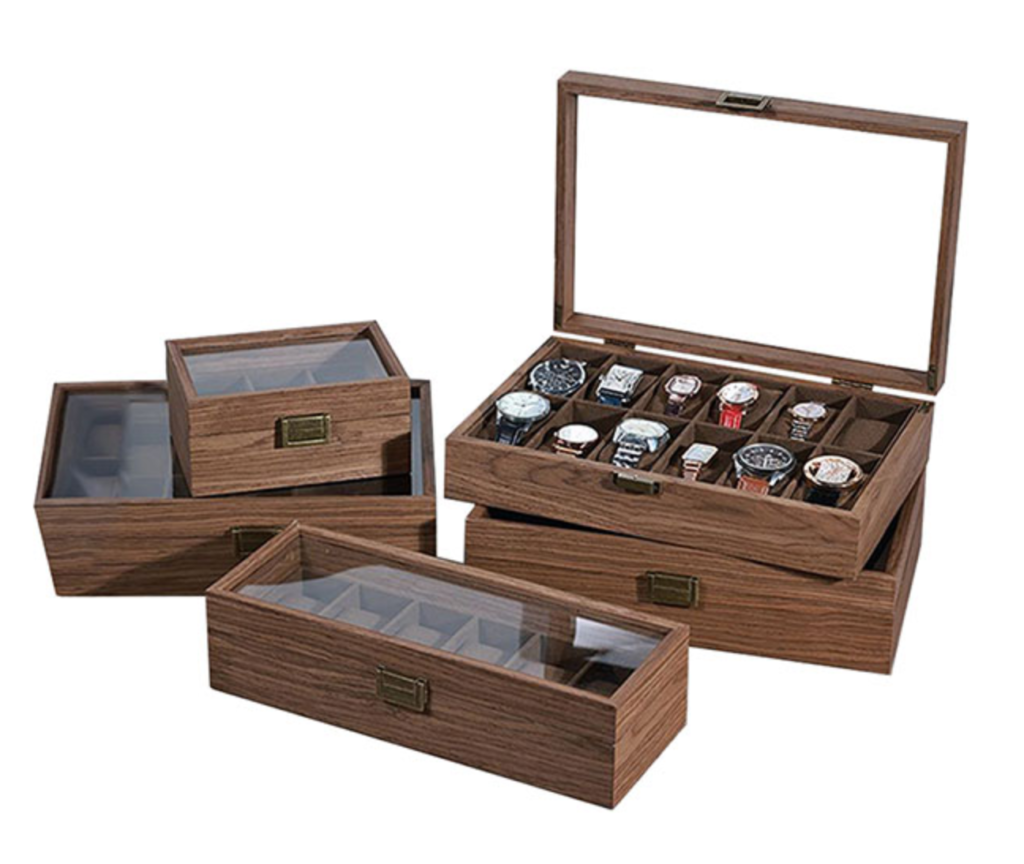
- Collector or organizer boxes – multi-slot cases for 4, 6, 8 or 12 watches, often with glass lids and upgraded interiors.
- Retail display boxes – boxes that double as in-store presentation units, sometimes with removable trays or risers.
- Online brand packaging – packaging optimized for e-commerce, focusing on protection during parcel delivery and unboxing experience.
Each role leads to different expectations for wood species, insert quality, hinges, magnets and packaging complexity. Sharing this upfront with your OEM/ODM partner allows the factory to propose realistic options during sampling instead of over‑ or under‑building the item.
2. Selecting the Right Wood: Material Options and Trade-offs
Material choice is a primary driver of cost, weight, appearance and stability. Chic Homeware works with several common routes for watch box projects: acacia, pine, paulownia, bamboo, walnut, MDF veneer and plywood veneer. Each has its own positioning.
2.1 Acacia: Natural character for mid- to high-end boxes
Acacia offers rich grain, warm tones and good hardness. It suits gift-oriented watch boxes where the wood itself is part of the value story.
- Pros: Attractive grain; good strength; suitable for visible natural or stained finishes.
- Considerations: Slightly higher material cost; requires attentive moisture control and sanding to achieve a smooth, premium surface.
- Best use: Single or multi-watch boxes with clear coatings, oil finishes or semi-transparent stains.
2.2 Pine: Versatile and cost-effective for many markets
Pine is one of the most commonly requested species for watch boxes and wooden gift packaging.
- Pros: Flexible price level; widely available; works well with paints and stains.
- Considerations: Softer surface can dent more easily; grain may show through light paints; resin content needs to be managed during finishing.
- Best use: Mid-range multi-watch boxes, painted boxes, or projects where branding and color are more important than the raw wood look.
2.3 Paulownia: Lightweight for airfreight and parcel-friendly boxes
Paulownia is extremely light, which can significantly reduce shipping weight and make parcel delivery less risky for outer cartons.
- Pros: Very light; easy to machine; suitable for painted or stained surfaces.
- Considerations: Softer and less dense; needs structural reinforcement in hinges and corners; not for ultra-luxury positioning.
- Best use: Entry- to mid-level gift boxes where weight is a major factor, such as online sales shipped individually.
2.4 Bamboo: Sustainable image and modern aesthetic
Bamboo appeals to buyers who position their brand around sustainability and a contemporary look.
- Pros: Eco-focused image; very stable laminated structure; straight, modern grain.
- Considerations: More work in edge treatment and surface preparation; color and grain variations between batches need to be managed.
- Best use: Modern single or multi-watch boxes, especially for brands that communicate natural or eco-conscious themes.
2.5 Walnut and darker hardwood routes
Walnut and dark veneers are often chosen when the box must match premium timepieces or high-end gifting.
- Pros: Deep brown color; luxurious appearance; works well with clear lacquer and minimalistic hardware.
- Considerations: Higher cost; color shade control is important across repeat orders.
- Best use: Premium watch displays, corporate gifting programs and collector boxes with limited but high-margin volume.
2.6 MDF veneer and plywood veneer: Stable, consistent and cost-manageable
MDF veneer and plywood veneer are common choices for watch boxes that need a consistent appearance and stable structure at manageable cost.
- Pros: High dimensional stability; smooth surface; easy to paint or veneer; good for sharp edges and precise fits.
- Considerations: Weight can be higher than paulownia; moisture resistance depends on sealing and packing; wood grain is created by veneer selection.
- Best use: Painted watch boxes, veneer-finished boxes for retail chains, and projects where repeat-order consistency is critical.
For buyers who are still exploring supplier options, reviewing how a partner manages material selection, moisture, and finishing across product lines can be helpful. Chic Homeware outlines this broader capability as a wooden products factory in China supporting different wood species, surface treatments and export packing needs.
3. Moisture Control, Sanding and Surface Finishing
Watch boxes often travel long distances and may be stored for extended periods. Problems like warping lids, sticking drawers or surface cracking usually relate to insufficient moisture control or rushed finishing. Addressing these points during development protects both customer satisfaction and your claim rate.
3.1 Moisture control and panel stability
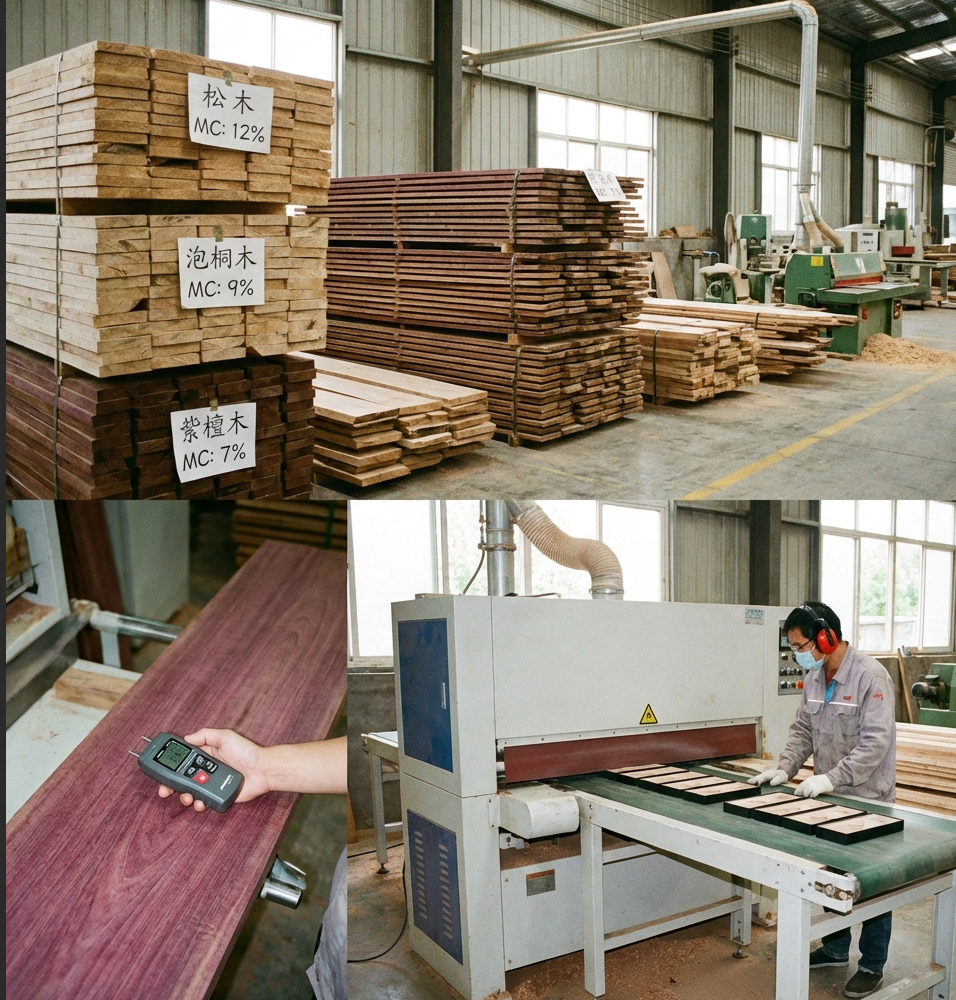
For any custom wooden watch box, the factory should monitor wood moisture content before machining, after major cutting and before finishing. Typical practices include:
- Using kiln-dried material or controlled storage to keep moisture within target range suitable for export markets.
- Allowing time for semi-finished components to stabilize before final assembly, especially lids and larger panels.
- Designing structures that reduce the risk of warping—for example, using engineered panels for large lids instead of solid boards in sensitive species.
3.2 Sanding consistency for premium touch
Watch boxes are handled closely by end users. Any rough edge, inconsistent rounding or sanding scratch is noticeable. A practical sanding strategy includes:
- Multiple sanding steps with suitable grit progression on both flat surfaces and radius edges.
- Extra attention around lid openings, finger pulls, magnet areas and handle positions.
- Random spot checks before finishing to catch raised fibers or filler marks.
3.3 Stain, paint and clear coating choices
The finishing system must match both the material and the brand’s visual direction:
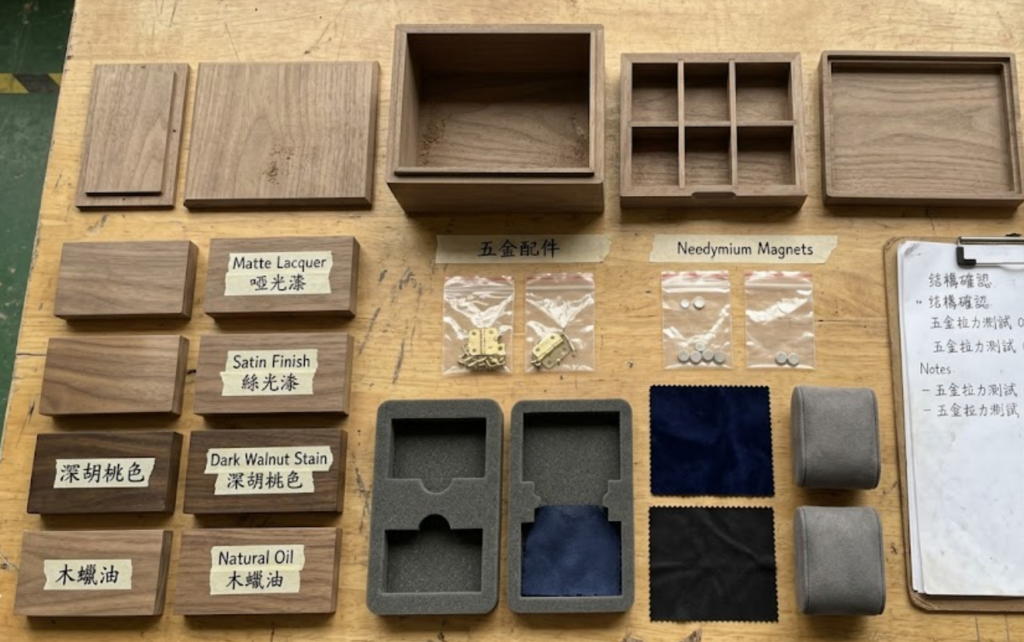
- Transparent stain + clear lacquer – highlights natural grain in acacia, walnut, bamboo and some pines. Good for mid- to high-end watch boxes.
- Opaque paint – suited for MDF or pine when precise brand colors or matte finishes are required.
- Oil or wax finishes – used for a more natural, tactile feel, often combined with eco-leaning brand stories.
During sampling, discuss gloss level, color tolerance, and whether your market needs specific coatings discussions (for example, project-based compliance documentation for EU or US.) This ensures the finishing process is set up correctly before you commit to a larger order.
4. Structural Design: Size, Compartments and Hardware
Inside a watch box, structure is as important as surface appearance. The internal layout must match target watch sizes, strap types and usage scenarios while staying within your budget and logistics framework.
4.1 Box size and capacity planning
Core dimensions depend on the number of watches, whether they are displayed flat or wrapped around pillows, and if extra accessories (tools, straps, warranty cards) are included.
- Single-watch boxes: Typically compact, designed to fit retail shelves or e-commerce mailer cartons efficiently.
- Multi-watch organizers: Common formats include 4, 6, 8 and 12 slots. Larger capacities demand attention to lid weight, hinge strength and internal dividers.
- Drawer or tiered designs: Used when combining watches with straps or jewelry; require thorough structural stability checks.
4.2 Hinges, magnets and hardware fitting
Hardware details strongly influence user experience and perceived quality:
- Hinges: Choices include basic butt hinges, piano hinges and soft-close or lid-stay solutions for heavier lids.
- Magnets: Recessed magnets can provide a clean, handle-free closure. Proper positioning and polarity checks are important for consistent closing force.
- Metal locks and clasps: Often used for collector cases or higher-end pieces; require precise alignment of lid and base.
During development, it is important to align hardware specification with target markets and price levels. The factory should test repeated opening/closing cycles in sampling to ensure screws hold well in the chosen material, especially in soft woods and MDF edges.
4.3 Structural stability and corner strength
Custom wooden watch boxes face both daily use and freight handling. To keep claim rates low, structure design must consider:
- Joint selection (butt joints, finger joints, doweled or mitered corners) according to the wood type and box size.
- Reinforcement for heavy lids, especially if a glass top or mirror is installed.
- Base stability so the box does not wobble on flat surfaces—even minor distortions become obvious in display usage.
5. Inserts and Interior Solutions for Watch Protection
The insert is the functional heart of a watch box. It must hold watches securely, protect surfaces and create a clean, brand-appropriate presentation. At the same time, inserts must be designed for efficient production and assembly.
5.1 Common insert structures
- Fixed compartments with pillows: The classic structure for multi-watch boxes. The wooden or MDF grid defines slots, and removable pillows hold each watch.
- Foam cut-outs: EVA or PU foam precisely cut to watch shape; often covered with fabric or PU leather.
- Removable trays: Inner trays that can be lifted out; useful when the box doubles as a general organizer.
- Hybrid layouts: Half watch slots, half open space for straps, tools or other small accessories.
5.2 Insert materials and coverings
Interior material choices impact both perceived value and cost:
- Fabric linings (linen, velvet, microfiber): Provide a soft touch and adapt well to different styles, from casual to luxury.
- PU or bonded leather: Suitable for premium positioning and easy cleaning; can be stitched or wrapped for different visual effects.
- EVA foam: Offers good protection with a clean cut profile; often used for more modern or technical designs.
Discuss color matching, rub resistance and insert density with your OEM partner during sampling. For dark watches, a lighter interior helps visibility; for light-colored or silver watches, darker interiors create contrast.
5.3 Functional priorities for watch inserts
From a practical standpoint, a watch insert should achieve the following:
- Prevent watches from moving during transit, especially in parcel shipments.
- Ensure no hard edges contact the watch case or crystal.
- Allow easy placement and removal without stressing straps or bracelets.
- Maintain its shape and finish over repeated use.
During sample review, simulate end-user behavior: load the insert with watches, close the lid, shake gently and test removal. This helps identify design adjustments before finalizing tooling or bulk materials.
6. Logo Application and Branding Options
Custom wooden watch boxes are a visible canvas for brand identity. Effective logo application must balance visual impact with process reliability and cost.
6.1 Exterior logo methods
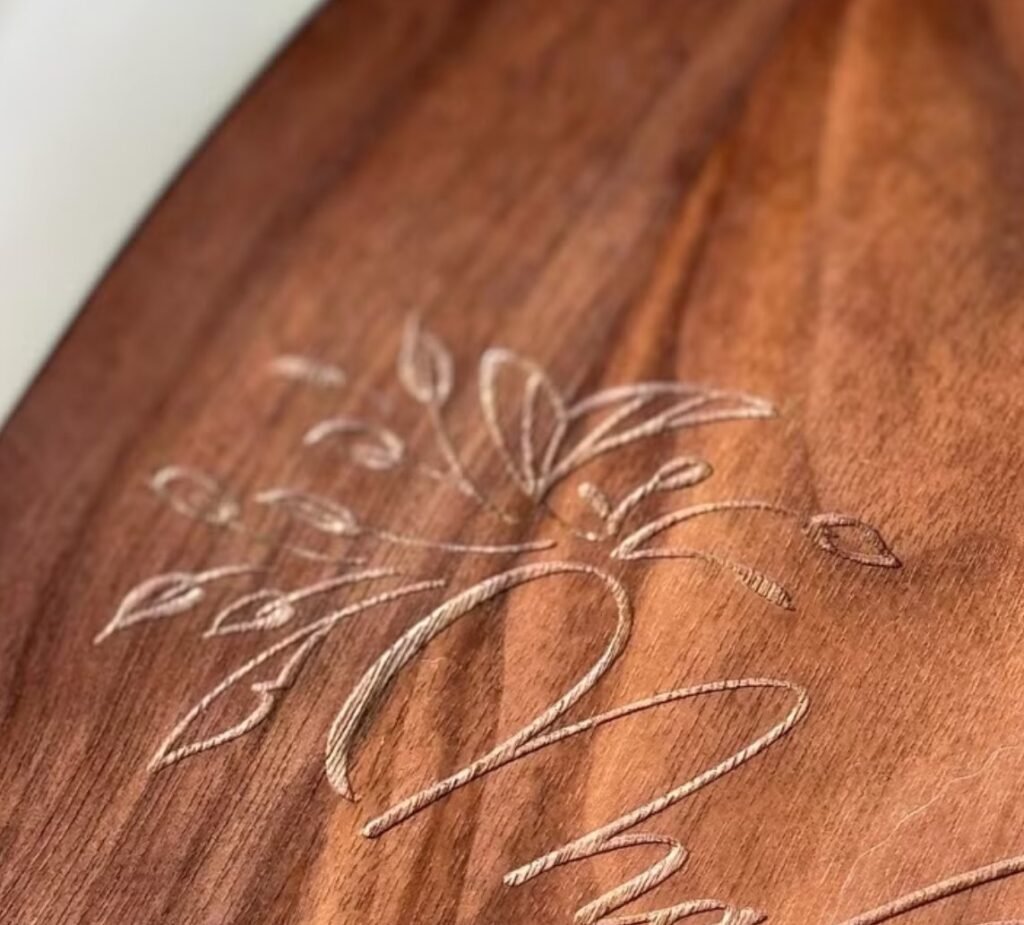
- Laser engraving: Especially effective on acacia, bamboo and walnut. Provides a permanent, subtle mark; cost-effective at scale.
- Silk-screen or pad printing: Suitable for solid colors or basic graphics on painted or clear-coated surfaces.
- Metal badges or plates: Add premium feel; require extra assembly steps and alignment controls.
6.2 Interior logo placements
- Logo on inner lid: Printed, debossed or metal-plate branding on fabric, PU or wood.
- Logo on insert or pillow band: Often used for private label brands to reinforce identity during unboxing.
- Printed or embossed logos on documentation slots: Combine functional card holders with subtle brand touchpoints.
When confirming your logo process, clarify color references, file formats (vector preferred), and acceptable tolerance for alignment and size. Your OEM partner can then define a repeatable operation that keeps branding consistent across orders.
7. Gift Packaging and Export Packaging: Thinking Beyond the Box
Even the best-designed watch box can lead to quality claims if outer packaging is weak. Professional B2B development treats gift packaging and export packaging as integral parts of the product, not afterthoughts.
7.1 Color boxes and retail packaging
For retail and online brands, the wooden watch box is often placed inside a color box or printed sleeve. Key points include:
- Choosing box style (lid and base, book-style, sleeve) that matches your brand and packing line capabilities.
- Defining printing method (offset, spot color, minimalistic logo) and surface finish (matte, gloss, soft touch).
- Designing internal supports (cardboard inserts, foam, molded pulp) so the wooden box doesn’t move or rub against the color box.
7.2 Mailer cartons for e-commerce
For Amazon sellers and D2C brands, a mailer carton may be part of the product packaging. It must balance protection, volumetric weight and cost.
- Appropriate single- or double-wall corrugated board selection based on watch box weight and fragility.
- Internal cushioning (bubble wrap, foam corners, honeycomb paper) that passes practical drop expectations.
- Pre-printing of barcodes, FNSKU labels or shipping marks where required.
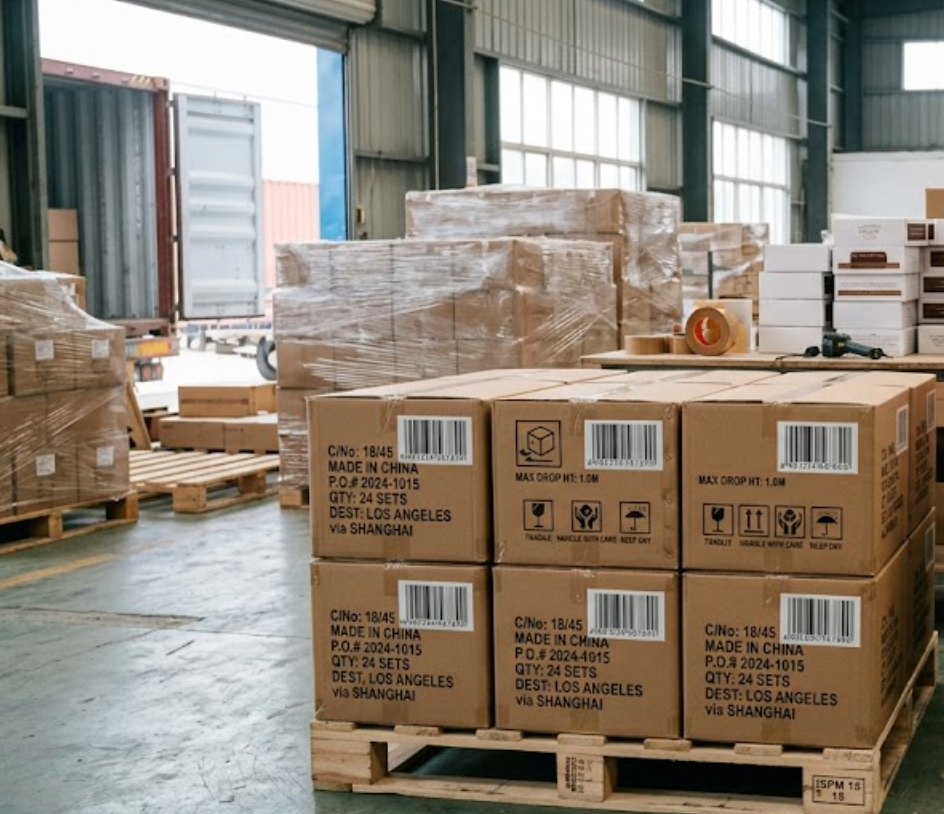
7.3 Carton marks and export carton optimization
On the export side, the master carton program should be defined early to support stable logistics and cost planning:
- Confirm outer carton size, net weight and gross weight to fit palletization and container loading patterns.
- Define carton marks to match warehouse and retail requirements, including item codes, quantity, barcodes and handling symbols.
- Consider carton drop-test guidance for your market; design inner packing to withstand realistic handling stress.
Chic Homeware routinely integrates these considerations into project planning as part of its role as a custom wooden products manufacturer for global buyers.
8. Managing MOQ, Sampling, Lead Time and Price Structure
For sourcing managers and brand owners, commercial predictability is as important as product creativity. Clarifying key parameters at the beginning of a watch box project helps avoid redesigns and delays.
8.1 MOQ and material efficiency
Minimum order quantity for custom wooden watch boxes is influenced by:
- Wood species and panel sizes needed.
- Insert complexity and whether custom tooling is required.
- Finishing method (special colors, custom stains) and logo process.
Sometimes small adjustments to dimensions or insert layout allow better use of standard materials and reduce effective MOQ. Discussing possible shared components with your OEM partner can also help if you plan a series of boxes (for example, 4- and 8-watch versions in the same style).
8.2 Sampling workflow and approval
A structured sampling process typically includes:
- Concept and drawing phase: Agreed dimensions, layout, materials, finishing system and packaging outline.
- Pre-production sample: Nearly final representation of materials, finish, logo and packaging.
- Approval and specification freeze: Once the sample is confirmed, changes are minimized to protect schedule and consistency.
At each stage, document feedback clearly—especially for color tolerance, grain expectation, insert fit and hardware alignment—to ensure the production team and quality team are working from the same reference.
8.3 Lead time and capacity considerations
Lead time for custom watch boxes depends on material, complexity and order volume. Key drivers include:
- Availability of wood species and insert materials.
- Finishing line capacity for multi-layer coatings and drying times.
- Logo process setup (for example, new screens, jigs or tooling).
- Packaging material printing lead times for color boxes or gift sleeves.
For seasonal programs (Q4 gifting, Father’s Day, Black Friday), coordinating forecasts and tentative booking of capacity helps avoid bottlenecks. This is especially important when multiple SKUs share the same finishing or packing lines.
8.4 Price structure transparency
A clear price structure helps buyers evaluate opportunities and manage retail margins. When discussing quotes, it is useful to separate:
- Base wooden box cost (according to species, structure and finish).
- Insert cost (including foam or fabric, pillows, trays).
- Logo cost (per position and process type).
- Gift packaging cost (color box, printed sleeve, manual inserts).
- Export packing cost (inner protectors, master cartons, palletization if needed).
This breakdown makes it easier to adjust specifications if you need to hit a certain FOB target while maintaining the core value features of your watch box.
9. Quality Control and Repeat-Order Consistency
Once a watch box is launched successfully, the main challenge becomes maintaining consistency across repeat orders and new batches. Effective quality control systems ensure that future shipments match approved samples and brand expectations.
9.1 Production checkpoints on the factory floor
For custom wooden watch boxes, critical checkpoints typically include:
- Incoming material inspection: Wood species verification, moisture testing, panel flatness checks.
- Machining and assembly check: Dimensions, squareness, joint quality and hardware positioning.
- Finishing check: Color, gloss, coverage uniformity, and surface feel.
- Logo and insert check: Placement, alignment, firmness of inserts and visual cleanliness.
- Packing check: Correct color box, protective materials, labeling and carton marks.
9.2 Managing color, grain and finishing variability
Wood is a natural material, which means some variation is normal. However, having clear visual standards helps keep this within acceptable limits. For each confirmed watch box, it is useful to:
- Keep an approved master sample at the factory and in your office.
- Define acceptable color variance range using physical reference boards or color codes.
- Align on which surfaces should be most closely controlled (for example, lid front and top surfaces).
9.3 Pre-shipment inspection and communication
Before shipment, many buyers request internal QC reports or third-party inspections. Close communication at this stage can prevent avoidable rework or delays:
- Share your main inspection focus (logo, insert fit, surface finish, packaging) so the factory can prepare.
- Review any small deviations together and decide which are acceptable based on positioning and market feedback.
- Document agreed points so future orders benefit from the learning.
10. Moving from Concept to Long-Term Watch Box Program
Developing a custom wooden watch box is not only a design exercise. It involves aligning material choices, structure, inserts and packaging with business requirements such as MOQ, lead time, price, compliance and long-term brand plans. Working with an OEM/ODM partner who is comfortable with project-based discussions—covering FSC-oriented sourcing, export packing, and EU/US compliance communication—helps reduce risk as your program scales.
Chic Homeware provides a commercially practical workflow for watch box projects: from material suggestions and structure optimization to insert solutions and gift packaging, all backed by factory-level control of woodworking and finishing. You can also leverage broader experience in custom wooden boxes, organizers and gift-ready packaging to build coordinated ranges for your brand.
If you are planning a new timepiece collection, refreshing an existing watch box line, or exploring a private label opportunity, you can share your brief, target markets and timeline for a tailored proposal on materials, inserts and packaging options. To discuss your next custom wooden watch box project, material routes and export packing details, you can reach out directly to the Chic Homeware team.