Williams-Sonoma's Spring Wooden Boards Run a 5.8× Markup

TL;DR
- ▸Williams-Sonoma's spring wooden wall is still acacia at the entry tier and walnut/maple at the premium end — split by construction, not species.
- ▸The same mid-tier acacia board leaves our floor at ≈$6.90 FOB against a ≈$40 US shelf — about a 5.8× markup.
- ▸The single most-cloned SKU on our quote desk this month is the edge-grain acacia 3-piece set.
By the Numbers
retail-to-FOB markup on a mid-tier acacia board
US shelf ≈ $40 · our FOB ≈ $6.90 at 2,000 pcs
Every spring we pull a major retailer's wooden-board wall apart to see what it's really made of — and what the same thing costs to build. This season it's Williams-Sonoma. The short version: their assortment isn't really sorted by wood, it's sorted by how the board is built. Get that one distinction right and you can put a near-identical board on your own shelf for a fraction of the price.
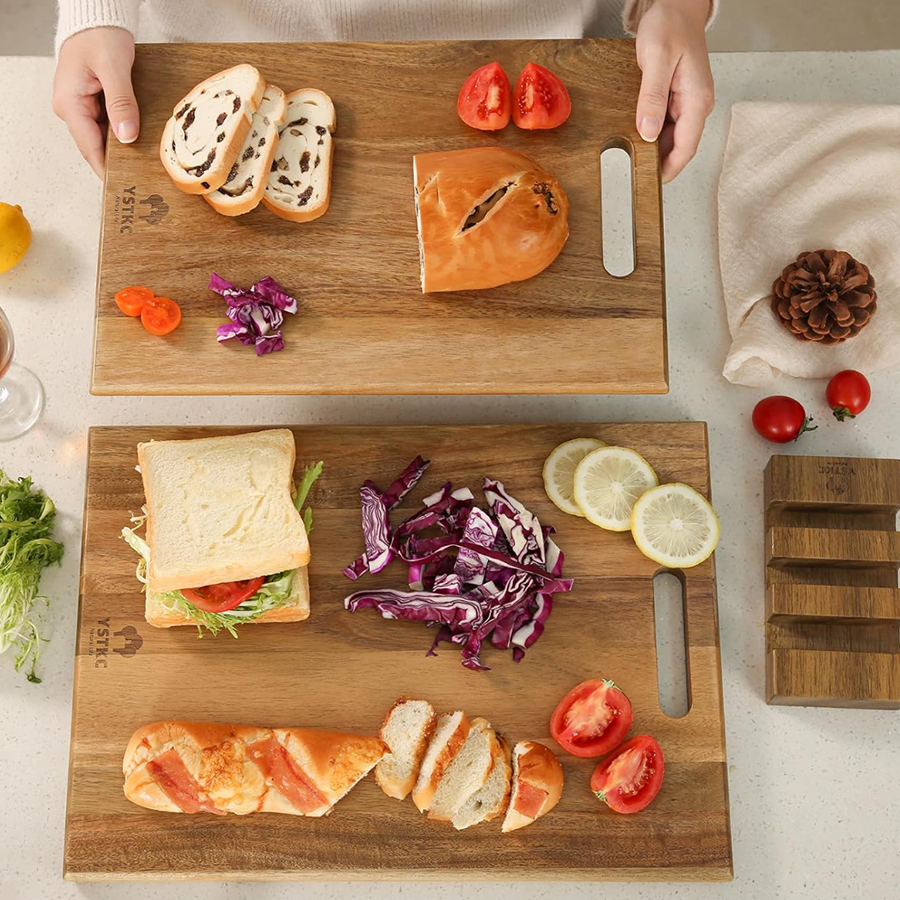
The front of the wall is edge-grain acacia. These are the two- and three-piece sets, the carving boards with a juice well, the board-and-knife gift sets. They're light, warm-toned, and marketed as "sustainably sourced." This is the workhorse tier — the one most shoppers actually buy — and it's the easiest to private-label well. Our floor builds the same construction in FSC acacia, with a laser-engraved logo and a food-grade oil finish, at about $6.90 a set against a roughly $40 US shelf price.
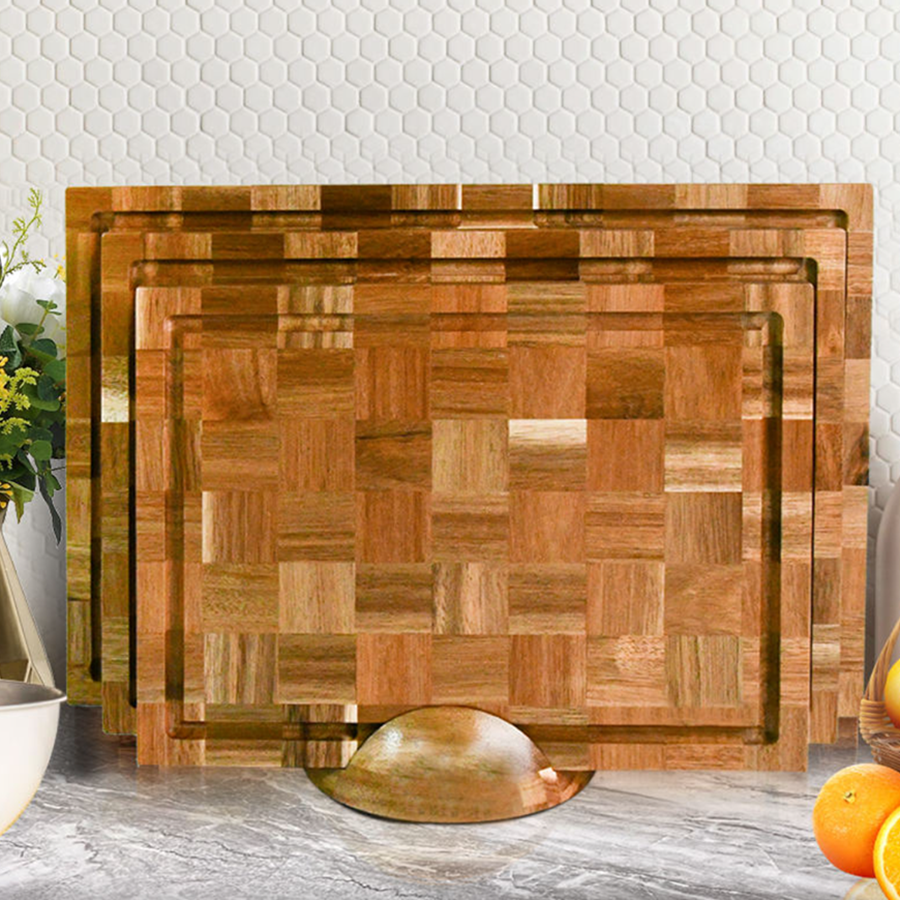
The top of the wall is end-grain. These are the thick butcher blocks with the checkerboard face, little feet underneath, in acacia and walnut. They feel expensive because they're harder to make — more waste, more glue-up labour, a longer drying cycle — and that, not the wood, is why they cost a multiple of the board sitting right next to them.
So the practical takeaway for anyone launching a private-label board line is simple: decide your construction tier before you argue about wood. Edge-grain gets you to shelf cheaper and faster; end-grain buys you a premium feel at a higher cost and longer lead time. Pick the tier first, send exact dimensions, lock your FSC paperwork for EU-bound stock — and the rest is a routine build. The numbers, MOQs and lead times are in the cards below.
Outside Signal
WS's spring wall is acacia at the front, walnut at the top
Williams-Sonoma's current wooden cutting and serving assortment splits cleanly into two construction tiers. At the accessible end sit edge-grain acacia pieces — the sets of two and three, the carving boards with juice wells, the Open Kitchen board-and-knife set — with acacia marketed as "sustainably sourced." At the premium end sit end-grain butcher blocks in acacia and walnut, plus maple-and-walnut striped boards. The tell: construction, not wood species, is what moves the price. An end-grain block (thick body, feet, checkerboard face) commands a multiple of the edge-grain board sitting next to it.
From the Floor
Buyers are sending us WS screenshots — the 3-set is the most-cloned
This month our quote desk took 18 OEM inquiries that referenced a Williams-Sonoma-style board; 11 of them were the edge-grain acacia set of three. Our FOB on that build is about $6.90 per set at 2,000 pcs — FSC acacia, laser-engraved logo, food-grade oil finish — versus about $9.40 for a comparably sized end-grain walnut block. MOQ is 500, sampling 7–10 days, production 25–30 days. The one spec that adds time is the juice-well carving board: a CNC well pocket adds roughly 3 days plus a one-time fixture cost.
What to Do This Week
- □Pick your construction tier first: edge-grain (lower FOB, faster) or end-grain (premium feel, ~35% higher FOB, longer lead).
- □Send exact board dimensions plus well/handle details — those drive tooling time, not the wood species.
- □For a private-label retail line, start with the acacia 3-set: lowest MOQ, fastest sample, broadest shelf appeal.
- □Lock FSC chain-of-custody documents up front for any volume bound for the EU — EUDR is enforcing at port.
Next Week
Vol. 03 will break down the end-grain vs edge-grain cost gap — why butcher-block construction nearly doubles tooling, and how to value-engineer it without losing the premium look.
Get a Q4 quote →Quick Questions
Can you actually match a Williams-Sonoma board?+
We build the same constructions — edge-grain and end-grain, acacia and walnut — on the same class of machinery. We can't use their branding, but a spec-for-spec equivalent is a routine OEM build.
What's a realistic FOB on a private-label acacia 3-set?+
Roughly $6–8 per set at 1,000–3,000 pcs, depending on finish, engraving and packaging. A comparable end-grain walnut block runs higher.
What MOQ do I need to start?+
500 pcs for a single edge-grain SKU. Multi-SKU retail programs are best quoted at 1,000 pcs and up.