
Best wood for custom wooden boxes
When you develop a new line of custom wooden boxes, the first decision that affects cost, durability and brand positioning is the wood species. For importers, wholesalers, distributors and Amazon brands, choosing between acacia, pine and paulownia is not just a design preference. It impacts MOQ, price ladder, defect rate, transit damage and long-term repeat-order stability.
As an OEM/ODM partner, Chic Homeware works daily with acacia, pine, paulownia, bamboo, walnut, MDF veneer and plywood veneer. Over hundreds of projects, we have seen how different species behave during drying, machining, finishing and export packing. This article summarizes those practical lessons to help you choose between acacia, pine and paulownia for your next custom wooden box program.
Key Differences Between Acacia, Pine and Paulownia for Wooden Boxes
Before selecting a material, it helps to understand the basic physical and commercial differences that matter in a factory environment.
| Factor | Acacia | Pine | Paulownia |
|---|---|---|---|
| Density & Weight | Medium-high density, heavier feel | Medium density, moderate weight | Very light, low density |
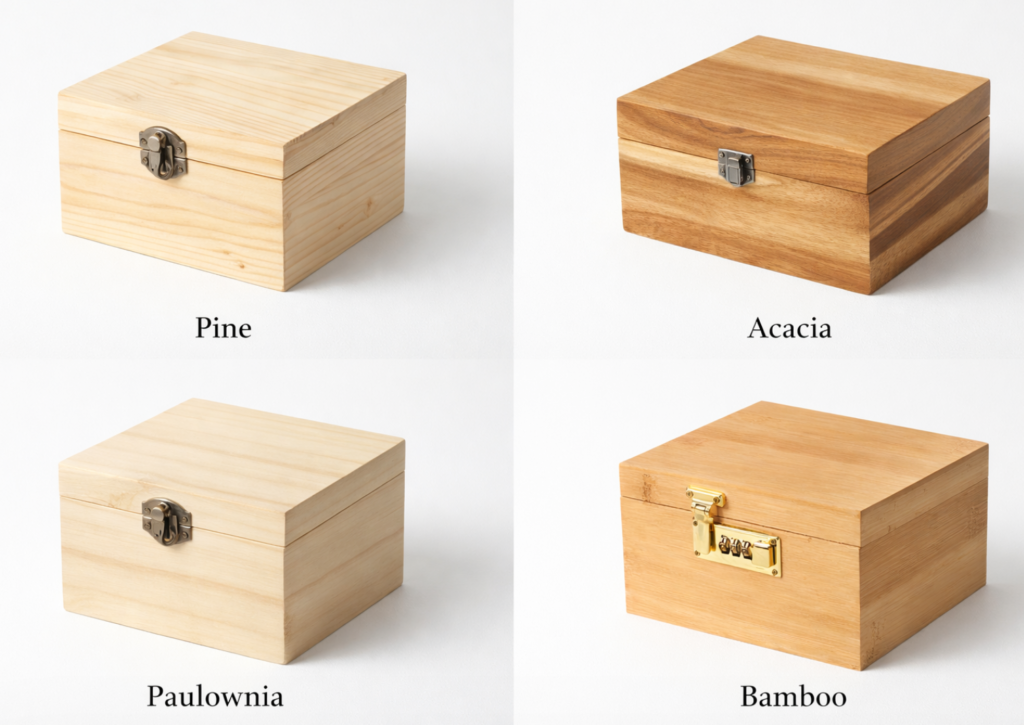
| Visual Character | Rich grain, darker tones, premium look | Visible knots, more rustic and casual | Very light color, subtle grain, clean look |
| Hardness & Durability | Hard and wear-resistant | Softer, more dent-prone | Soft but stable if moisture controlled |
| Price Level (General) | Highest of the three | Mid-range, cost-effective | Generally lower to mid, depends on spec |
| Best Use Cases | Premium gift boxes, kitchen storage, brand-hero items | General packaging, mid-range gift sets, functional storage | Large-size boxes, lightweight packaging, volume programs |
In real projects, the choice is rarely about only one parameter. It is about balancing brand positioning, logistics cost, breakage risk and buyer expectations across your target markets.
Acacia Wood Boxes: Premium Feel and Long-Term Durability
Acacia is a popular choice in premium kitchenware and tableware because of its rich grain and dependable durability. For custom wooden boxes, it is ideal when you want the packaging or storage unit to feel like a permanent part of the product, not a disposable accessory.
Advantages of Acacia for Custom Wooden Boxes
- Premium visual impact: Natural color variations and expressive grain patterns give acacia boxes a high-end, warm appearance, especially under clear oil or low-pigment stain.
- Better resistance to wear: Compared with pine and paulownia, acacia resists dents and scratches more effectively, which is useful for boxes intended for long-term household use or heavy handling.
- Perceived value: Many buyers associate acacia with quality cutting boards, trays and kitchenware. Using the same species for storage boxes or organizer sets adds a consistent premium message to your assortment.
Production Considerations for Acacia Boxes
Because acacia is denser, factory control during production becomes more important than with softer woods.
- Moisture control: Acacia needs careful kiln-drying and equalization. If moisture is not uniform, you may see warping or small cracks around joints after assembly or during long ocean transit. Chic Homeware emphasizes incoming moisture checks and controlled storage before machining.
- Sanding and finishing: The dense grain requires more sanding steps to keep surfaces even, especially on lids and edges that customers touch frequently. For darker stains and food-contact-adjacent items, we typically coordinate with buyers on stain color panels and gloss level before mass production.
- Machining and hardware fitting: When you use concealed hinges, magnets or complex joints, acacia holds screws and hardware firmly. However, tool wear is higher, which slightly affects cost and lead time planning.
When to Choose Acacia Over Pine and Paulownia
- Brand is positioned mid-to-premium and wants to show wood character in gift packaging, tea or coffee sets, barware sets or kitchen storage.
- End customers are likely to keep and reuse the box, making durability and appearance critical.
- Box dimensions are not extremely large, so the heavier weight will not cause shipping cost or drop-test issues.
- You plan to align the box material with existing acacia products such as trays or cutting boards.
If your project fits these conditions, acacia often gives the best quality impression among the three species.
Pine Wood Boxes: Versatile, Cost-Controlled and Customizable
Pine is one of the most flexible species for custom wooden boxes, especially when you balance cost, appearance and machining performance. It suits both decorative packaging and everyday storage where price sensitivity is higher.
Advantages of Pine for Custom Wooden Boxes
- Cost-effective material base: Pine is generally more economical than acacia while offering better strength than paulownia for the same wall thickness.
- Friendly to paint and stain: Pine accepts different stains, paints and washes, allowing you to achieve light Scandinavian looks, darker rustic styles or full-color brand themes.
- Good for structural boxes: For hinged lids, slide lids, finger-joint or dovetail structures, pine machines consistently when the moisture content is controlled. It supports screws, nails and small hardware components reliably.
Production Considerations for Pine Boxes
- Knots and grading: Visible knots are common in pine and can fit rustic or natural design directions. For more refined packaging, we discuss knot grade with buyers during the sampling stage and align on acceptable levels (for example, fewer or smaller knots on visible surfaces).
- Resin and finish: Some pine boards contain resin pockets that may influence paint adhesion and long-term appearance. This is managed through raw material selection, sealing coats and testing during pre-production.
- Surface smoothness: Because pine is softer than acacia, sanding consistency is essential to avoid waves or sanding marks that show through stain or paint. Chic Homeware uses multi-step sanding and checks for cross-grain scratches in QC.
When to Choose Pine Over Acacia and Paulownia
- Projects target a mid-price position where unit cost must stay within a strict range, such as gift sets for retail chains or subscription boxes.
- Design requires colored paint, printing or a brand-specific Pantone finish that would cover natural grain anyway.
- Boxes will carry moderate weight, like cosmetic sets, candles, glassware or small food jars, where you need reasonable strength without the cost of acacia.
- You are planning multiple size variations or a collection system (small, medium, large) and need a stable material for repeat orders.
Pine is often the most balanced choice when you need structural reliability plus a wider price ladder for large-volume programs.
Paulownia Wood Boxes: Lightweight and Logistics-Friendly
Paulownia is significantly lighter than acacia and pine. For international buyers focused on freight efficiency, mail-order packaging or large-format boxes, this low density can translate directly into cost savings and improved drop-test performance when combined with good structural design.
Advantages of Paulownia for Custom Wooden Boxes
- Very light weight: For large boxes, gift chests or storage units, paulownia keeps the overall weight manageable for e-commerce shipping and home handling.
- Clean, pale appearance: The light, nearly white color presents a neutral base for light stains, whitewash finishes or branding that emphasizes minimal aesthetics.
- Stable when properly dried: With proper moisture control and storage, paulownia maintains shape well, which is useful for lid alignment and magnet closure performance.
Production Considerations for Paulownia Boxes
- Soft surface: Because paulownia is soft, it can dent more easily during production, packing or transport. Chic Homeware typically recommends thicker corner structures, internal ribs or protective inserts when using paulownia for export programs.
- Fast machining: The softness allows quick cutting and shaping, which can support shorter machining times on straightforward box designs. However, tooling and clamping must be adjusted to avoid crushing edges.
- Finishing strategy: For some projects, buyers want a slightly richer look than bare paulownia provides. In those cases, we may combine paulownia with veneer panels or choose a stain that adds warmth without hiding the clean grain.
When to Choose Paulownia Over Acacia and Pine
- E-commerce programs where shipping weight, dimensional weight and drop-test performance are critical.
- Large or deep boxes that would become too heavy in acacia or dense pine, particularly for storage, toy boxes, blanket boxes or big gift sets.
- Projects where the interior product is light, such as textile sets, stationery or small accessories, so the box does not need maximum structural strength.
- Concepts that favor a soft, clean, minimalist look over strong grain expression.
When engineered correctly, paulownia offers a practical balance of light weight and adequate strength, especially for high-volume, logistics-sensitive programs.
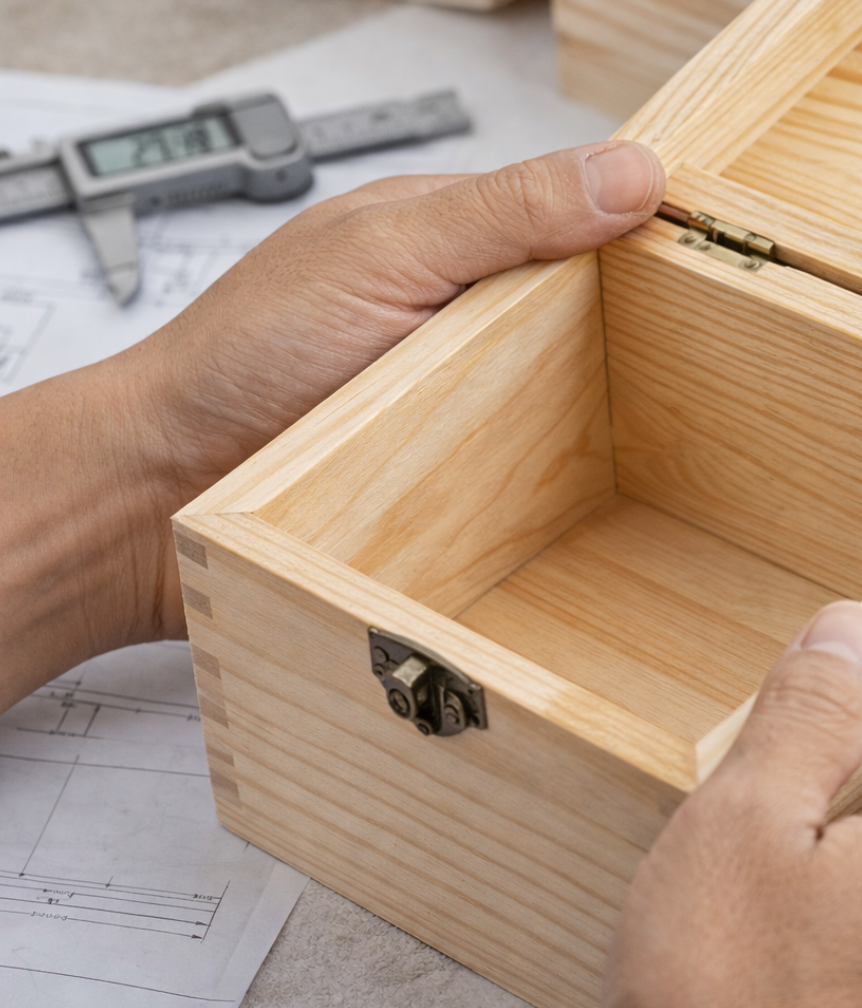
Beyond Species: Moisture, Structure and Finishing Decide Real-World Performance
For B2B buyers, choosing acacia vs pine vs paulownia is only the first layer. The performance of your custom wooden box also depends on moisture management, structural design and finishing methods. This is where partnering with a factory-oriented supplier becomes essential.
Moisture Control and Dimensional Stability
Uncontrolled moisture is one of the most common root causes behind warping, lid misalignment and cracking during or after sea shipment.
- Kiln drying by species: Acacia, pine and paulownia each have different drying curves. We adjust kiln time and stacking methods to avoid internal stress, especially for thicker panels and lid components.
- Equilibrium checks: Before machining, boards are checked to ensure they are close to the target moisture range suited to the destination climate. For example, boxes going to drier regions may need tighter control to reduce post-arrival movement.
- Conditioned storage: After finishing, finished goods are stored in controlled conditions before packing, reducing the risk of sudden moisture changes inside sealed cartons.
Structural Stability, Joints and Hardware
Different woods respond differently to the same structure. For example, a wall thickness that feels solid in acacia can feel too flexible in paulownia. During OEM/ODM development, we typically discuss:
- Wall thickness and reinforcement: Paulownia boxes may use thicker sides or internal supports, while acacia boxes can carry weight with slightly thinner walls. Pine often falls in between.
- Joint styles: Finger joints, dovetail joints, rabbet joints or dowel connections are selected based on the species, wall thickness and price point. The goal is to avoid over-engineering but still pass handling and drop-test expectations.
- Hinges and magnets: For softer woods, we may recommend longer screws, pre-drilling or small metal inserts. For acacia, we consider hardware positioning to avoid splitting in dense areas.
Finishing, Logos and Brand Presentation
The same finish can look very different on acacia, pine and paulownia. Sampling is therefore essential.
- Stain or paint tests: We prepare finish samples on each species to show how color and grain visibility change. Pine may show more grain and knots; paulownia may look more uniform; acacia will highlight its natural patterns.
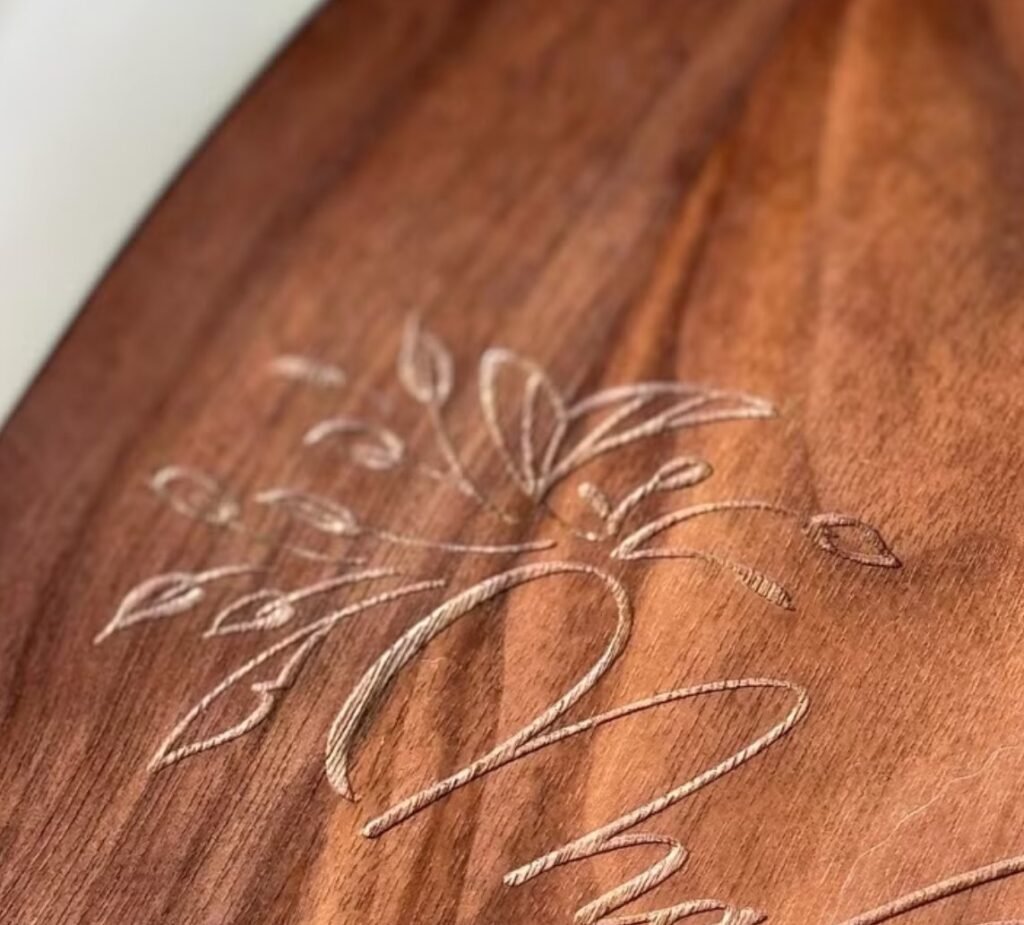
- Logo methods: Depending on your brand style and volume, we can apply laser engraving, silk-screen printing, pad printing, UV printing, hot stamping or metal logos. The choice of species affects how clear and sharp engraving appears and how inks sit on the surface.
- Protective topcoats: For boxes used in kitchens or bathrooms, we align on lacquer or oil systems that balance appearance, odor requirements and compliance expectations for EU and US markets.
FSC-Oriented Sourcing, Compliance and Export Packaging
For many buyers, material choice goes beyond design and cost. Sourcing discussions frequently include FSC orientation, regional regulations and packaging tests.
FSC-Oriented Material Options
When you need FSC-oriented solutions, the discussion typically covers:
- Which species (acacia, pine, paulownia, or other options like bamboo, walnut, MDF veneer or plywood veneer) are available under FSC-oriented supply routes.
- How FSC-oriented sourcing affects MOQ and lead time for each species.
- How to phrase material descriptions and claims correctly in product documentation and packaging.
These details are easiest to align during the project development stage, before final packaging copy and marketing materials are locked.
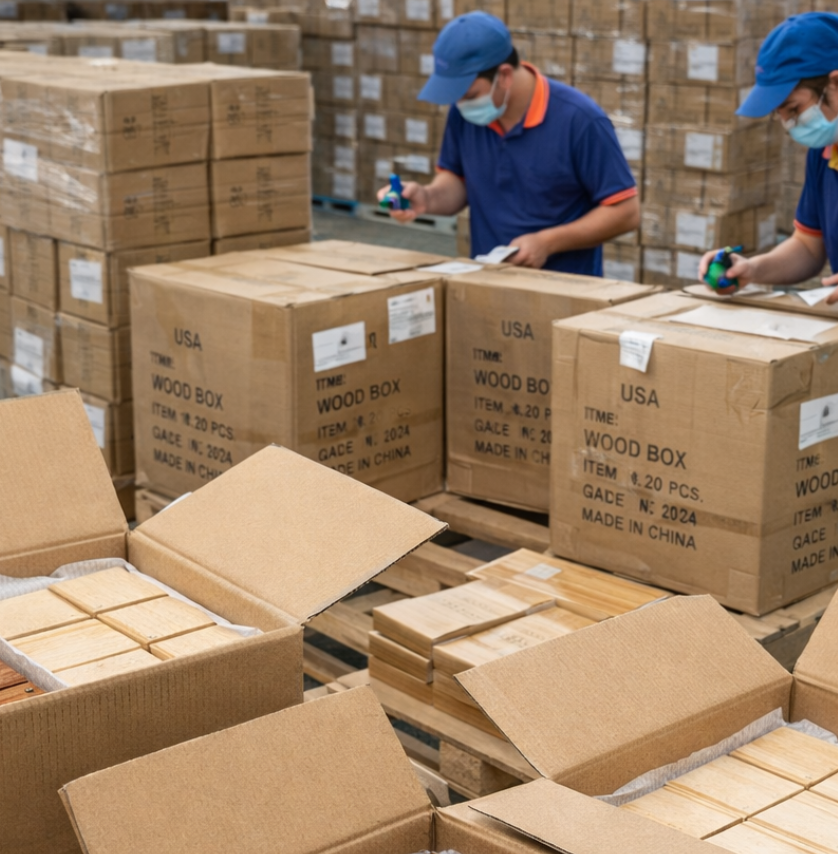
Export Packaging, Drop-Test Thinking and Damage Control
Different woods behave differently under transit stress. A lightweight paulownia box may need more internal support; an acacia box may require special corner protection to avoid chipped edges.
- Carton structure: We review outer carton strength, flute type and packing quantity per carton, based on species, box size and destination channel (container, FCL/LCL, parcel delivery).
- Inner packing: Options include individual polybags, bubble wrap, corner protectors, foam inserts, and custom color boxes. The combination is selected according to your drop-test requirements and target damage rate.
- Carton marks and handling symbols: For Amazon and other e-commerce platforms, we ensure carton marks and labels match platform requirements and your internal warehouse system.
Matching Wood Species to Real B2B Scenarios
Below are some typical project patterns and how acacia, pine and paulownia can be matched to them.
Scenario 1: Premium Gift Packaging for Spirits or Gourmet Food
- Goal: High perceived value, smaller volumes per SKU, brand storytelling via material.
- Recommended species: Acacia for its rich, premium appearance and durability.
- Key checkpoints: Moisture control, precise lid alignment, interior inserts for bottles or jars, laser-engraved or hot-stamped logos.
Scenario 2: Multi-Size Storage Boxes for Retail Chains
- Goal: Competitive retail price, consistent repeat ordering, multiple sizes in coordinated look.
- Recommended species: Pine for its balance of cost, strength and finish flexibility.
- Key checkpoints: Control of knot levels, color consistency across shipments, paint or stain stability, mixed-size packing for optimal container usage.
Scenario 3: Large Organizer Boxes for E-Commerce Delivery
- Goal: Lightweight for shipping, strong enough to pass mail-order handling and basic drop-tests.
- Recommended species: Paulownia with reinforced corners or combined with veneer panels.
- Key checkpoints: Structural design for light but stable walls, protective inner packing, sample-based drop-test trials in pre-production phase.
OEM/ODM Workflow: From Idea to Export-Ready Wooden Boxes
Regardless of whether you choose acacia, pine or paulownia, a disciplined OEM/ODM process helps control cost and risk. As a Custom Wooden Products Manufacturer, Chic Homeware supports buyers through the following typical steps:
- 1. Project briefing: You share target market, price range, box size, structure (hinged lid, slide lid, removable lid), internal configuration and brand positioning.
- 2. Material proposal: We compare acacia, pine, paulownia and other options such as bamboo, walnut or MDF/plywood veneer, showing how each option affects unit cost, appearance and logistics.
- 3. Sampling: Initial samples focus on size, structure and basic finish. We refine details like hardware, magnets, inserts and logo processes according to your feedback.
- 4. Costing and MOQ discussion: Once a final spec is agreed, we provide clear price tiers by quantity and discuss MOQs per species and per finish.
- 5. Pre-production and testing: We prepare pre-production samples to confirm color, logo, packaging and labeling, and help you conduct internal checks such as carton drop tests or trial shipments.
- 6. Mass production and QC: Production includes in-line and final inspections, with particular attention to moisture, finishing consistency and hardware fitting.
- 7. Export packing and documentation: Boxes are packed according to your channel requirements, with agreed carton marks and documentation for smooth customs clearance.
How Chic Homeware Supports Your Custom Wooden Box Portfolio
Many buyers need not just one type of box, but a coordinated portfolio: premium acacia boxes for flagship items, pine boxes for mid-range products, and lightweight paulownia boxes for volume e-commerce listings. Chic Homeware’s factory-oriented supply chain can support mixed-material strategies under one supplier base.
- Flexible material routes: Acacia, pine, paulownia, bamboo, walnut, MDF veneer and plywood veneer can be combined within one program or brand family.
- Consistent finishing systems: We align stains, paints and topcoats so different species still look coordinated on shelf or online.
- Integrated packaging thinking: From color boxes and mailer cartons to master cartons and palletizing, we design packaging to protect each species appropriately while fitting your cost structure.
If you are sourcing from or planning to source from a Wooden Products Factory in China, consolidating your wooden box and organizer programs with one partner can reduce coordination time and improve repeat-order consistency.
Conclusion: Choosing the Right Wood for Your Next Custom Wooden Box Project
Acacia, pine and paulownia each play a clear role in custom wooden boxes:
- Acacia is best for premium, long-lasting boxes where natural grain and perceived value are the priority.
- Pine offers a practical balance of cost, strength and finishing flexibility for mid-range and multi-size programs.
- Paulownia is ideal for large or logistics-sensitive boxes where low weight and clean aesthetics are key.
The right answer for your project depends on your channel, target price, brand position and logistics strategy. A structured OEM/ODM approach and open technical communication at the sampling stage will reduce surprises later in production and shipping.
If you are planning a new wooden box, organizer or gift packaging range and want material guidance, structural suggestions and export-ready packing support, you can explore options on our Custom Wooden Boxes page or reach out with your brief for a tailored proposal.