
Multi compartment wooden tea boxes: What B2B Buyers Must Confirm Before Bulk Orders
Multi-compartment wooden tea boxes are straightforward products on paper, but in real projects they often generate avoidable complaints: warped lids after sea freight, magnets that do not align, dividers that do not fit branded tea bags, color variation between lots, or damaged corners on arrival at the warehouse. For importers, wholesalers, distributors, and private label brands, clearing these issues before confirming a bulk order is critical.
As an OEM/ODM wooden products factory, Chic Homeware focuses on wood species selection, moisture control, finishing, logo application, structure optimization, and export packaging for tea boxes and related organizers. The points below summarize what experienced buyers normally check for multi-compartment wooden tea boxes before issuing a purchase order, and where a factory-oriented supplier can support you.

1. Clarify the Role of Multi-Compartment Wooden Tea Boxes in Your Range
Before you start discussing specifications, it helps to be clear about where the multi-compartment wooden tea box sits in your assortment. This determines the right balance between cost, material choice, and finishing level.
- Retail gift box: Higher emphasis on appearance, smooth finishing, strong branding, and upgraded hardware such as glass windows, soft-close hinges, or metal clasps.
- Hospitality / hotel use: Boxes are opened and closed many times a day, so structural strength, hinge life, and easy cleaning matter more than decorative detailing.
- Corporate gift / promotional project: Branding and perceived value are key. Often paired with other items (mugs, infusers) in a single set, so dimensions and internal layout must fit the total gift concept.
- Ecommerce / Amazon private label: Needs stable quality across repeat orders, low damage rates, packaging optimized for parcel shipping, and consistent photography-level appearance.
- Supermarket / mass retail: Price-sensitive. Simple structures, lighter materials, and efficient packing to hit target landed cost.
When you communicate this positioning to your supplier early, they can propose more suitable structures, hardware options, and materials for your multi-compartment wooden tea boxes.
2. Choose the Right Wood or Veneer for Your Target Market
Material selection is one of the first and most impactful decisions. Chic Homeware works with acacia, pine, paulownia, bamboo, walnut, MDF veneer, and plywood veneer. Each behaves differently during machining, finishing, and shipping. The table below summarizes common choices for multi-compartment wooden tea boxes.
| Material | Look & Feel | Weight | Relative Cost | Typical Use Case |
|---|---|---|---|---|
| Acacia | Warm, rich grain, medium to dark tone; premium appearance | Medium | Medium–High | Gift sets, hotel suites, high-end retail tea boxes |
| Walnut | Dark, elegant, luxury feel; works well with subtle logos | Medium | High | Corporate gifts, premium collections, designer brands |
| Pine | Light color, visible knots if not selected; accepts stain/spray well | Medium | Low–Medium | Mid-range retail, decorative tea boxes, painted finishes |
| Paulownia | Very light color, soft, low density | Very light | Low | Ecommerce projects needing low shipping weight, basic gift packaging |
| Bamboo | Clean, modern, eco-oriented look with vertical or horizontal grain | Medium | Medium | Brands emphasizing sustainability, spa and wellness segments |
| MDF veneer | Flat, stable panels with consistent veneer grain and color | Medium | Medium | Boxes with painted or uniform stained surfaces, logo-focused designs |
| Plywood veneer | Strong, dimensionally stable with real-wood veneer face | Medium | Medium | Structurally demanding boxes, larger sizes, export-heavy projects |
For buyers planning a series of tea, coffee, and condiment organizers, it is usually more efficient to work with a single custom wooden products manufacturer who can keep wood tones and finishes coordinated across the range.
In early discussions, request reference photos or existing samples in each wood option. This helps you judge whether the natural grain, weight, and overall feel match your brand’s positioning and target retail price.
3. Design Details That Affect Function in Multi-Compartment Wooden Tea Boxes
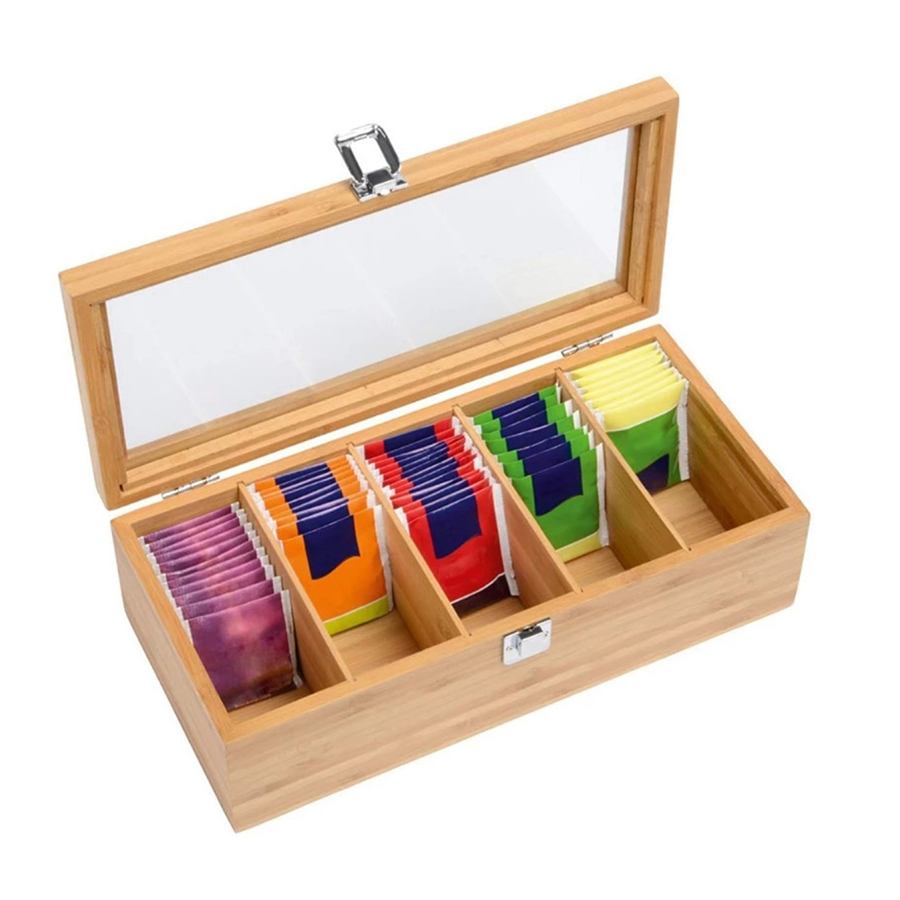
When tea boxes move from concept to production, many problems come from small design details that were not defined clearly. For multi-compartment layouts, make sure you align the following with your supplier:
3.1 Size and Compartment Layout
- Tea bag standard size: Flat tea bags typically fall within a similar range, but envelope thickness and width differ between brands. Ask your supplier to confirm internal compartment width and height against your actual tea SKUs.
- Number of compartments: The most common configurations are 4, 6, 8, 9, and 12 compartments. More compartments mean thinner dividers; you should discuss minimum divider thickness to avoid warping or breakage.
- Removable vs fixed dividers: Removable grids add flexibility but can rattle if not well fitted. Fixed dividers are more stable and suitable for busy hospitality environments.
- Depth of compartment: Too shallow, and packets tumble out when the lid opens; too deep, and the display is not visually appealing. This is especially important for retail presentation boxes.
3.2 Lid Type and Visibility
- Solid wood lid: Gives a classic, understated look and better protects contents from light. More suitable for premium or gift settings.
- Glass or acrylic window: Helpful for retail and hotel use where the customer should see the tea range immediately. Requires careful handling and stronger packaging.
- Opening angle and hinge choice: Standard butt hinges, piano hinges, and soft-close hinges each have different cost and durability profiles. The opening angle should match how and where the box is used (countertop, drawer, trolley).
3.3 Magnets, Clasps, and Hardware
- Magnets: Magnetic closures look clean but require precise drilling and positioning. Magnet strength must be balanced so that the lid stays closed during shipping but opens smoothly on the counter.
- Metal clasps: Visible metal hardware stresses the need for consistent plating color, screw alignment, and rust resistance, particularly for humid climates.
- Screws vs nails vs glue: Discuss how hinges and clasps are fixed. Screws give better long-term stability and allow re-tightening if needed, but they require higher precision in drilling and assembly.
3.4 Inserts and Mixed Materials
- Foam or cardboard inserts: Sometimes used for loose tea tins or glass jars inside the wooden box. The insert material must match your brand’s sustainability and compliance expectations.
- Metal or leather elements: Small metal plates, leather pulls, or fabric linings can lift the perceived value. They also add cost and assembly steps, so the impact on MOQ and lead time should be discussed.
At sampling stage, it is important to test real products in the sample box: fill each compartment to typical capacity, close and shake the box lightly, and see whether everything remains in place without rattling or mixing.
4. Production Checkpoints That Protect Your Bulk Order
Once the design is set, stable production quality becomes the main concern. For multi-compartment wooden tea boxes, certain production checkpoints make a clear difference in the final result, especially after long-distance shipping.
4.1 Moisture Control and Warping
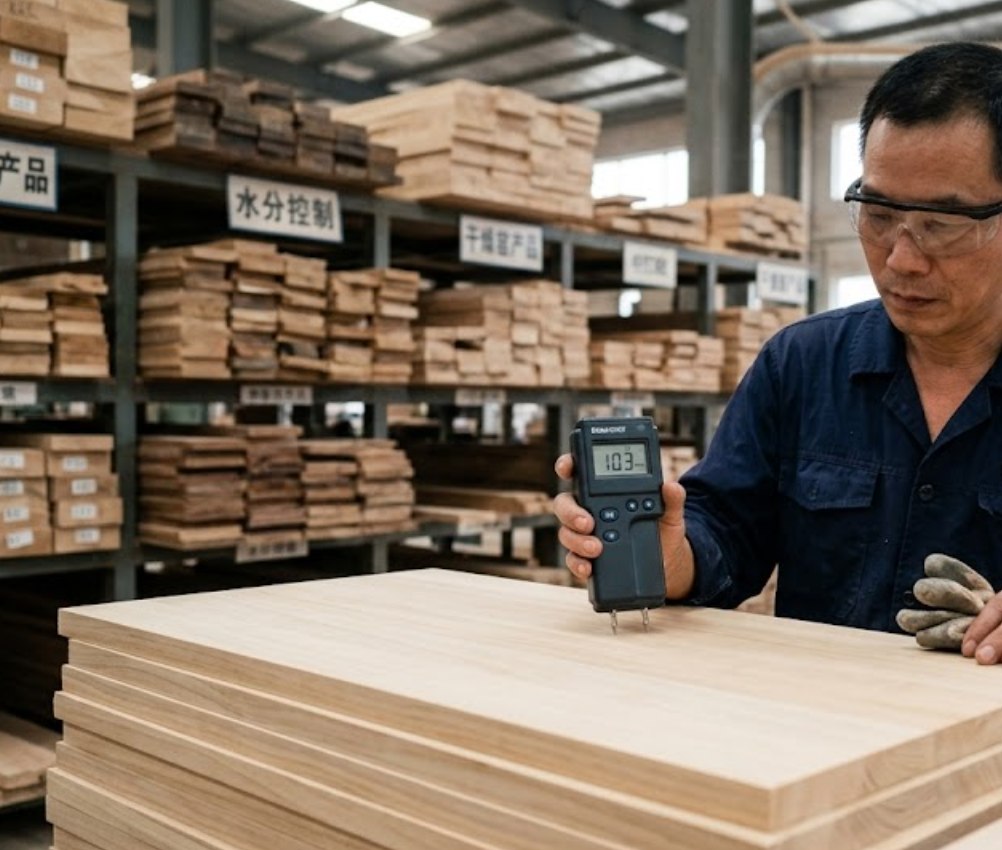
- Moisture content of wood: If the material is not properly dried, panels may warp or crack after arrival in drier climates. Discuss target moisture range with your supplier and how they measure it.
- Panel thickness and construction: Thicker lids and side panels are more stable. If you need very thin walls, plywood or MDF veneer can provide better dimensional stability than solid wood.
- Seasoning and storage: Ask where cut parts are stored before assembly and finishing. Controlled storage reduces the chance of moisture imbalance between components.
4.2 Sanding Consistency and Edge Treatment
- Touch-points: Lid edges, hand grips, and compartment dividers should be free from splinters. Multi-step sanding (machine plus hand sanding on corners) is typically required.
- Sharp edges vs rounded edges: Rounded edges are safer for frequent handling and reduce chipping during transport, but require more work and may affect cost.
4.3 Stain, Paint, and Clear Coating
- Color consistency: Natural wood varies by piece. Your supplier should use controlled staining and batch management so that each order remains visually consistent within an agreed tolerance.
- Finishing system: Different markets prefer different finishing approaches (clear lacquer, water-based coatings, matte vs gloss). Clarify your expectations and ask for finish samples.
- Odor and drying: Tea is sensitive to odor. Coatings must be fully cured before packing so that no chemical smell transfers to the box interior.
4.4 Logo Application and Branding
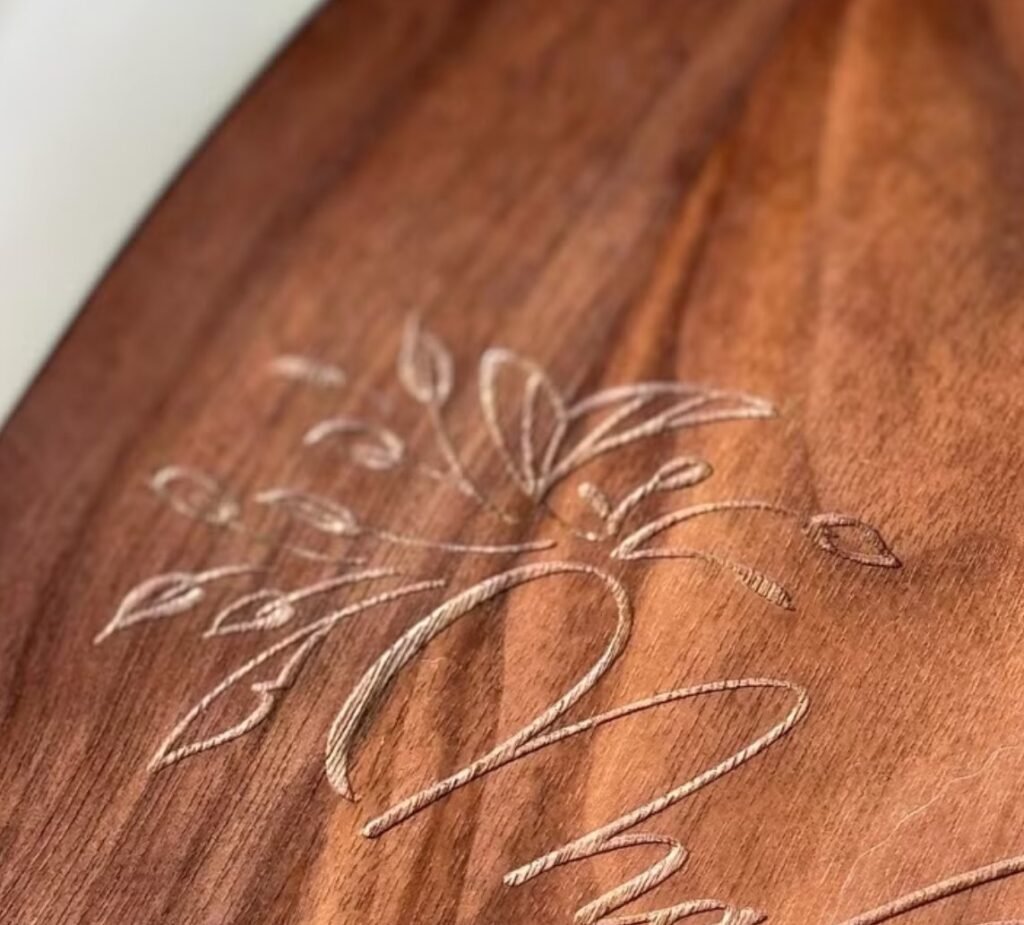
- Laser engraving: Sharp and durable, works well on most woods. The final color depends on the wood species; request a logo sample on the actual material.
- Silk-screen or pad printing: Suitable for solid logos and Pantone-oriented brand colors. Requires smoother surfaces and careful color matching.
- Metal or leather badges: Higher-end look with extra assembly steps; confirm positioning jigs and adhesive/screw methods in advance.
4.5 Structural Stability and Fit
- Lid alignment: The lid should open and close smoothly without scraping the body. Hinges must be aligned and evenly spaced.
- Divider bonding: Dividers should be firmly fixed without visible glue overflow. Poor bonding leads to breakage during shipping or in use.
- Base flatness: Boxes should sit flat on the table without rocking. This is a simple but important QC point.
Many experienced buyers request pre-shipment inspection focused on these points. Clear QC criteria in the PI and purchase contract help both sides work toward the same expectations.
5. Export Packaging and Damage Control for Wooden Tea Boxes
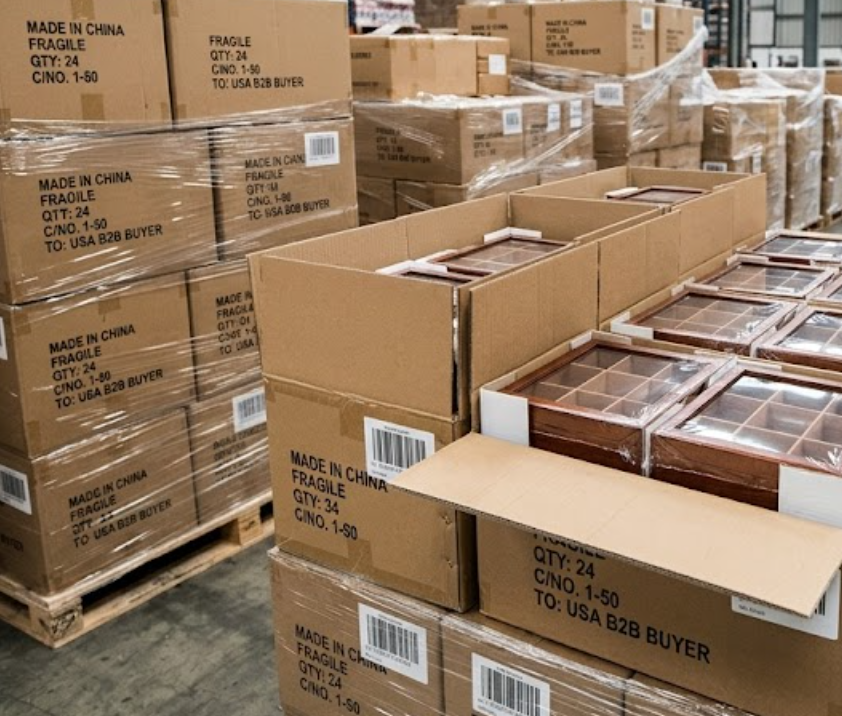
Multi-compartment wooden tea boxes often include glass or fragile joints, and they are expected to arrive in visually perfect condition for retail or gifting. Export packaging is therefore a key part of the project, not just an afterthought.
- Individual protection: Polybags or tissue wrapping, corner protectors, foam sheets, and inner sleeves can all reduce scratching and minor dents.
- Inner box design: Color boxes and mailer cartons need to hold the product firmly without excessive void space. For ecommerce projects, mailer cartons are often sized to survive parcel shipping without an extra outer box.
- Master carton planning: Discuss carton strength (single wall vs double wall), inner layout (individual boxes vs 2-pack/4-pack sets), and carton orientation to reduce pressure on lids and windows.
- Drop-test thinking: Even if a formal test is not required, your supplier should think in terms of typical drop heights and directions when designing the pack.
- Carton marks and labels: Confirm barcode positions, FNSKU labels for Amazon, fragile marks, and orientation arrows at sampling stage.
For buyers coordinating multiple SKUs from the same origin, working with a single custom wooden boxes partner simplifies export carton planning, palletization, and container loading strategies.
6. MOQ, Sampling, Lead Time, and Price Structure
Tea box projects often involve several variants (different colors, logos, or compartment layouts). Aligning commercial terms early avoids surprises when you are already committed to a launch date.
6.1 Sampling
- Structure sample: Usually produced first to confirm dimensions, internal layout, and hardware. At this stage, finishing may be basic.
- Pre-production sample: Matches final material, color, logo, and packaging. This is the reference for mass production.
- Sampling time: Depending on complexity and current workload, sampling often takes around 10–20 days. Clarify how many revisions are included.
6.2 MOQ (Minimum Order Quantity)
- Material and process impact: MOQs tend to be lower for simpler pine or paulownia boxes and higher for mixed-material, heavy finishing, or hardware-intensive designs.
- Per-color or per-design MOQ: Confirm whether the MOQ applies per total order or per color/logo combination. This influences how many SKUs you can launch in one shipment.
- Project-based discussion: For long-term programs, it may be possible to start with a lower initial quantity and grow in later orders, especially when tooling or jigs are already in place.
6.3 Lead Time and Capacity Planning
- Standard production time: For many multi-compartment wooden tea boxes, production might require several weeks after sample approval, depending on order volume and finishing type.
- Seasonal peaks: Gift-giving seasons and year-end often create capacity pressure. Provide forecasts and book production slots early when possible.
- Buffer for shipping: Sea freight schedules, customs clearance, and inland transport can add significant time. Build safety margin into your project timeline.
6.4 Price Structure and Cost Drivers
- Material consumption: Larger boxes and thicker panels increase material usage and cost. Multi-layer dividers and glass windows also add to the bill of materials.
- Labor-intensive steps: Hand sanding, complex staining, logo inlays, and mixed materials all increase labor time.
- Hardware and packaging upgrades: Higher-quality hinges, magnets, and color boxes add both cost and perceived value. Decide which upgrades truly matter for your customer.
- Order volume: Higher quantities allow more efficient batching and purchasing of raw material and hardware, which is reflected in the unit price.
7. Compliance, Sustainability, and Market Requirements
Most multi-compartment wooden tea boxes house individually packaged tea bags, so the box is not usually in direct food contact. Still, importers and brand owners should align with suppliers on compliance expectations.
- Wood sourcing and certification: Discuss FSC-oriented sourcing if your market or retailer requests it. While full certification requires specific paperwork and chain-of-custody management, early communication gives the factory time to align.
- Coating compliance: For EU and US buyers, low-VOC and compliant coatings are often preferred. Ask about previous experience with similar markets and available test reports.
- Packaging and waste: Many brands want to reduce unnecessary plastic. Explore options for paper-based protection, recyclable inserts, and minimized packaging while still protecting the goods.
- Labeling obligations: Country-of-origin marks, recycling marks, and importer information should be planned into the design of both the product and the packaging.
Working closely with a factory that understands export markets, such as a dedicated wooden products facility in China, makes project-based compliance discussions more straightforward for both sides.
8. Practical Checklist Before You Confirm a Bulk Order
Before issuing the purchase order for multi-compartment wooden tea boxes, a structured checklist helps reduce risk. At a minimum, confirm the following points in writing or on your final approved sample:
- Material: Wood species or veneer type, thickness, and any mixed materials (glass, acrylic, metal, leather, fabric).
- Dimensions: External size and internal compartment dimensions; confirm they fit your specific tea products.
- Structure: Number of compartments, fixed or removable dividers, lid construction, type of hinges and closure (magnets or clasps).
- Finishing: Stain or paint color reference, sheen level (matte, satin, gloss), and whether interior is coated or left natural.
- Logo and branding: Process (laser, print, badge), size, position, and color specification.
- Inserts: Any foam, cardboard, or other inserts, including material, color, and layout.
- Packaging: Individual box type (color box, mailer, shrink), master carton quantity and layout, carton marks, and labeling.
- Quality standards: Tolerance for color variation, wood knots, small defects, and clear acceptance criteria for lid alignment, magnet strength, and surface smoothness.
- Compliance and documents: Required certificates, test reports, and any retailer-specific forms.
- Commercial terms: Unit price, tooling or sample charges, payment terms, lead time, INCOTERMS, and conditions for reorders or design changes.
Conclusion: Turn Multi-Compartment Wooden Tea Boxes into a Reliable Product Line
Multi-compartment wooden tea boxes can be a profitable and brand-building product when they are designed and produced with the realities of export logistics, retail presentation, and repeat ordering in mind. The key is to translate your brand and market requirements into specific, factory-ready instructions around materials, structure, finishing, branding, packaging, and quality control.
Chic Homeware operates as an OEM/ODM partner focused on custom wooden boxes, organizers, trays, kitchen storage, and gift packaging. With flexible material routes, moisture-controlled production, and export-oriented packaging practices, we support importers, wholesalers, distributors, and private label brands in building sustainable, repeatable programs for multi-compartment wooden tea boxes and related products.
If you are planning a new project or want to optimize an existing range, you can share your drawings, inspiration photos, or target prices for a practical review from our factory side. To start a detailed discussion about specifications, sampling, and export packing for your next tea box program, please contact Chic Homeware.