
How to Source decorative wooden boxes wholesale
Decorative wooden boxes look simple on a retail shelf, but for importers and brand owners, the reality is different: margin pressure, inconsistent quality and avoidable damage costs can quietly erode profit on every shipment. If you manage wooden box sourcing for wholesale, gifting, home décor or e‑commerce, protecting your B2B margin is not just about getting a lower unit price. It is about structuring the entire project correctly from the factory floor to the export carton.
As an OEM/ODM partner for custom wooden boxes and packaging, Chic Homeware works daily with importers, distributors and Amazon sellers who need decorative appeal and commercial discipline. This article shares a practical, factory-oriented view of how to source decorative wooden boxes without sacrificing B2B margin.
1. Start With the Right Sourcing Mindset: Margin Is a System, Not a Number
For many sourcing teams, the first instinct is to negotiate the lowest possible FOB price. But in decorative wooden boxes, unit price is only one component of your actual landed cost. Margin is influenced by several interlocking factors:
- Material selection and yield
- Moisture control and defect rate over time
- Finishing process and rework ratio
- Logo and hardware choices
- Export packaging and damage rate
- Process repeatability for future orders
If you pressure the price without optimizing these elements, you may gain a small saving in negotiations but lose more through claims, returns and unstable quality. The goal is to co-build a structure where your supplier can run the product efficiently while you control your landed cost and risk.
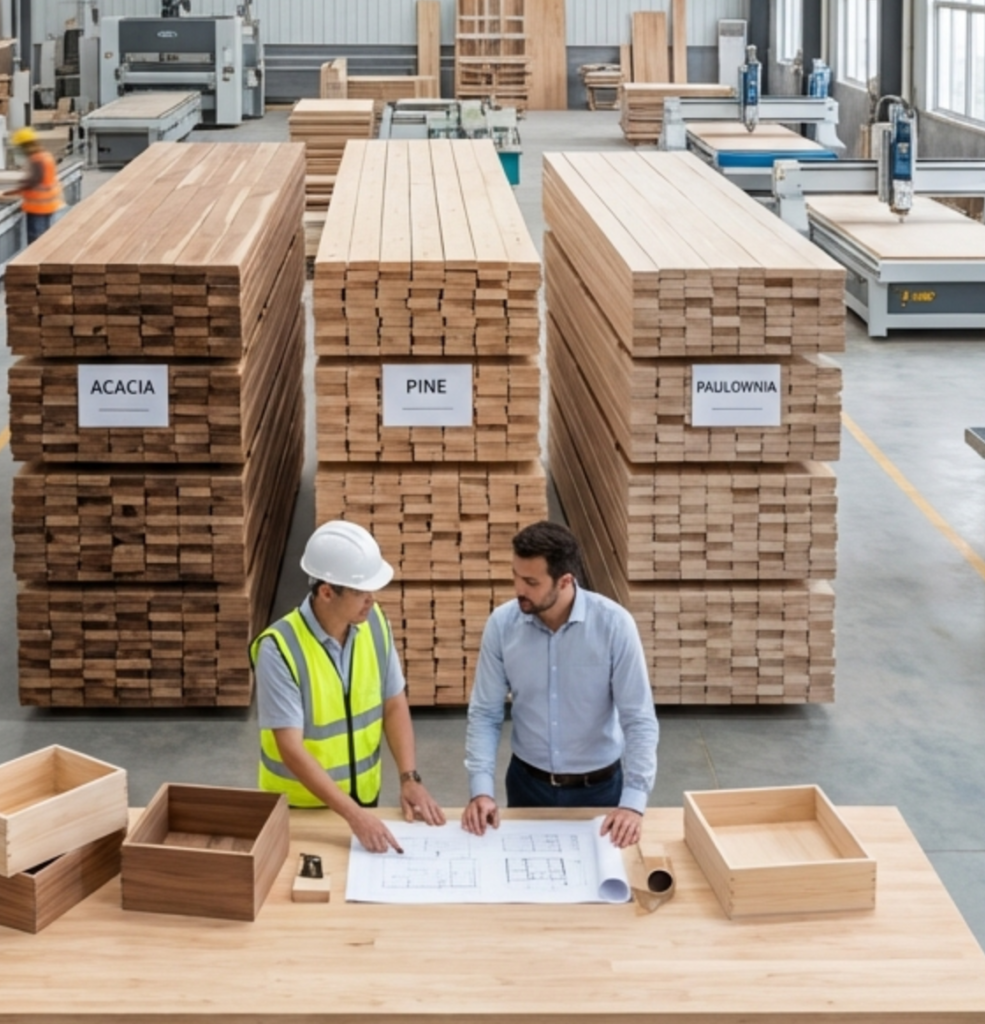
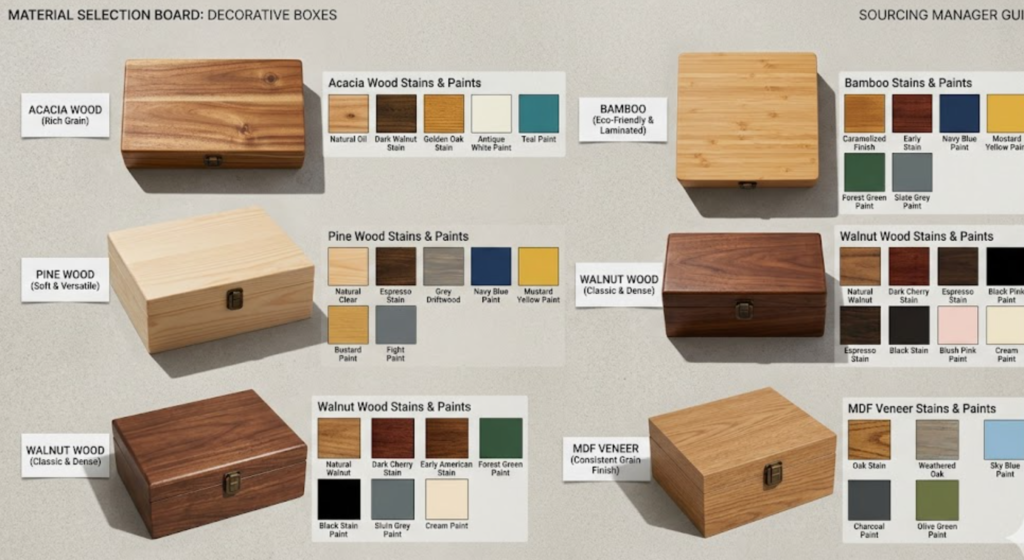
2. Choosing the Right Wood Material Mix for Margin and Market Positioning
Decorative wooden boxes can be built from multiple wood species and substrates, each with different cost, appearance and performance characteristics. Instead of asking only for “solid wood”, it is more margin-friendly to discuss the target look, weight, retail positioning and logistics reality with your factory.
2.1 Comparing Common Materials for Decorative Wooden Boxes
| Material | Key Advantages | Typical Use Cases | Margin Considerations |
|---|---|---|---|
| Acacia | Rich grain, premium appearance, good hardness | Gift boxes, premium home décor, branded packaging | Higher material cost; often used on visible panels only to control pricing |
| Walnut | Dark luxury tone, fine grain, high perceived value | High-end gifting, jewelry, limited editions | Premium pricing; suitable for small SKUs or mixed with veneers to protect margin |
| Pine | Stable supply, cost-effective, accepts stain well | Mass-market décor boxes, storage, crates | Good balance of cost and look; can be optimized with intelligent grading |
| Paulownia | Very light weight, pale color, easy to work | Gift packaging, nesting sets, larger boxes | Reduces shipping weight and freight cost; needs careful moisture control |
| Bamboo | Modern, sustainability perception, durable | Kitchen boxes, tea boxes, organizers | Mid to high price; good for brands with eco narratives |
| MDF veneer | Flat, smooth, stable, supports precise edges | Painted boxes, uniform color projects, branding | Cost-efficient; ideal where paint covers the substrate and wood grain is not required |
| Plywood veneer | Strong, dimensionally stable, visible layers | Modern/Scandi style boxes, storage, trays | Good structural value; works well in flat-pack or thin profile designs |
2.2 Hybrid Material Strategies to Protect Margin
One of the most effective ways to protect B2B margin is by using a hybrid structure instead of solid premium wood everywhere. Examples:
- Use acacia or walnut veneer on MDF for lids and visible faces, with pine or MDF for non-visible surfaces.
- Combine paulownia for body panels (reducing weight) with a pine or bamboo frame for edges and structure.
- Apply a stained finish on pine to mimic higher-end species while keeping raw material cost lower.
When you involve your OEM/ODM partner early, the factory can propose combinations that meet your design intent while maintaining workable yield and processing time on the production line.
3. Control Moisture and Structure Before Discussing Finish
Beautiful finishing cannot compensate for poor moisture and structural control. For decorative wooden boxes, moisture is one of the biggest hidden threats to your margin because it influences warping, cracking, lid misalignment and hardware failure weeks or months after shipment.
3.1 Moisture Control: The Quiet Protector of Your Repeat Orders
A factory-oriented approach to moisture includes:
- Material pre-drying and storage: Discuss targeted moisture content ranges depending on your destination market’s climate.
- Process sequencing: Critical machining and assembly steps scheduled after wood has reached a stable condition.
- Sampling with moisture checks: Include moisture readings as part of sample confirmation for new projects.
When moisture is stable, your risk of customer complaints, return requests and negative reviews drops significantly, directly protecting your margin on every reorder.
3.2 Structural Optimization: Design for Production, Not Only for Photography
Decorative boxes are often designed from a marketing or visual perspective. To keep your B2B margin healthy, involve your Custom Wooden Products Manufacturer early to optimize:
- Panel thickness: Slight adjustments can reduce weight and material cost while maintaining strength.
- Joinery choices: Miters, finger joints, dowels or simple butt joints each have different labor and defect implications.
- Base and lid tolerance: Precise tolerances prevent lid jamming or looseness that can appear after transit.
- Hardware placement reinforcement: Extra thickness or inserts at hinge or magnet zones to prevent splitting.
In many cases, a small structural refinement at the drawing stage avoids rework and claim costs later. This is especially important for projects with magnets, glass lids, inserts or multiple compartments.
4. Finishing, Sanding and Logos: Where Aesthetics Meet Cost
Decorative boxes are purchased with the eyes and hands, so surface quality directly affects your sell-through. However, finishing is also a major cost driver in the factory. The objective is not to demand the “best possible” finish in abstract terms, but the right finish for your price point and brand.
4.1 Sanding Consistency and Finish Levels
Discuss with your supplier what sanding and finishing level is necessary for your market:
- Entry-level décor: Functional sanding, uniform stain or paint, minor grain and color variation acceptable.
- Mid-tier gift packaging: Finer sanding, more controlled stain absorption, better panel matching.
- Premium gifting: Very smooth surfaces, multi-step sanding, hand touch-ups around edges and corners.
Each level adds time and cost. By aligning expectations clearly in the sample stage, you avoid misunderstandings where your pricing is based on one finish level but expectations are set at another.
4.2 Stain, Paint or Clear Coat: Making an Informed Choice
Your finish choice should consider both aesthetics and cost:
- Clear coat: Works well when using acacia, walnut or nicely graded pine where the grain is a selling point.
- Stain: Adds character and can standardize the look of mixed wood grades, useful in mass-market ranges.
- Paint: Hides substrate variation and allows vibrant colors, ideal with MDF or smooth plywood veneers.
Paint typically requires more surface preparation and quality control to avoid orange peel, dust contamination and pinholes. Build this into your pricing and lead time planning.
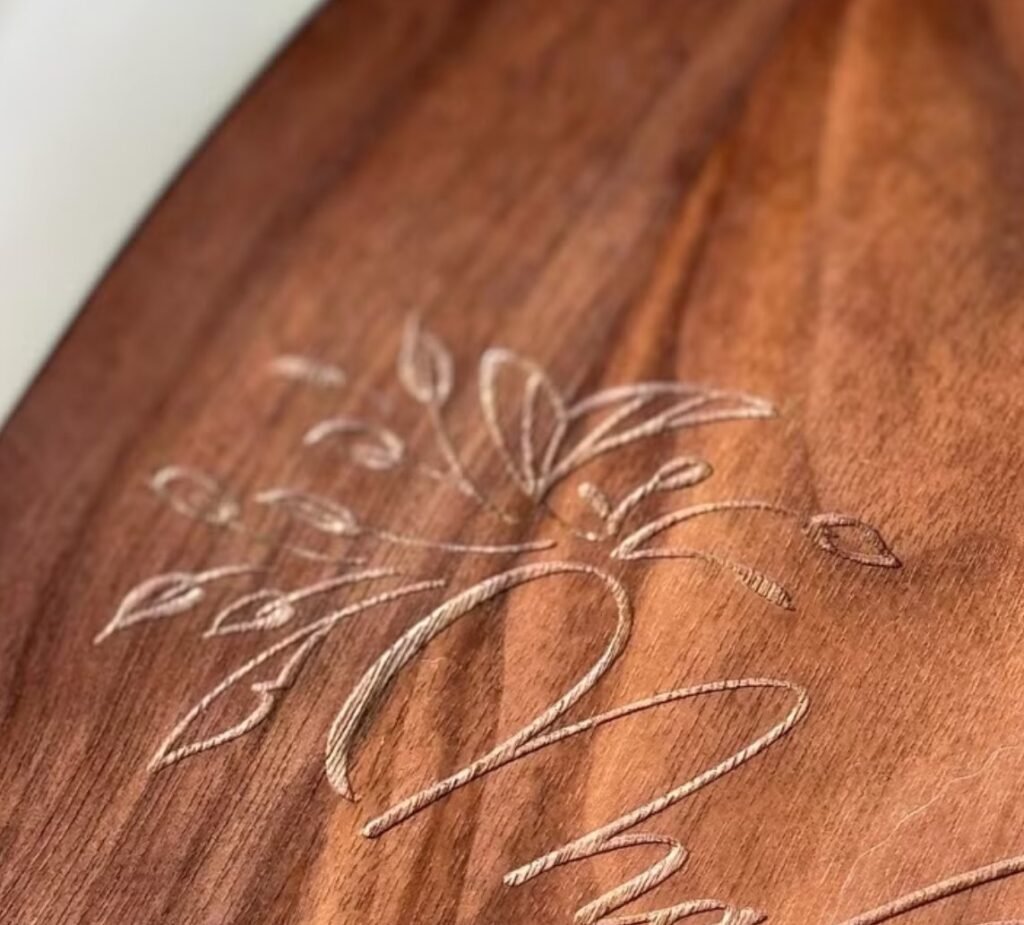
4.3 Choosing the Right Logo Process for Your Margin
Logo application is a small but impactful part of decorative wooden box sourcing. Typical options include:
- Laser engraving: Clean, precise, cost-effective in volume; best on solid wood or darker stained surfaces.
- Screen printing: Good for solid logos or simple artwork, especially on painted boxes.
- UV printing: For multi-color or gradient designs, often used in higher-value projects.
- Metal or leather badges: Premium look but adds component and assembly cost.
From a margin perspective, laser engraving usually offers the best balance of flexibility and cost, especially across multiple SKUs. For seasonal or promotional ranges, screen printing can be efficient if the artwork is shared across sizes and box types.
5. Customization That Adds Value Instead of Just Adding Cost
Decorative wooden boxes attract customization requests around size, internal layout and hardware. Not all customization adds margin; some only increases BOM and complexity. The key is to prioritize features that are noticeable to your customer and manageable for your factory.
5.1 Dimensions, Compartments and Inserts
When defining sizes and internal layouts, consider:
- Standardizing base dimensions across a range so that different lids, compartments or inserts can be combined on the same production line.
- Using simple dividers or removable inserts rather than fixed complex partitions that require extra tooling and QC.
- Planning compatible SKU nesting to reduce shipping volume and warehouse space.
For gift packaging, discuss paperboard or EVA inserts that can be shared across multiple wooden box SKUs with minor cut-out adjustments.
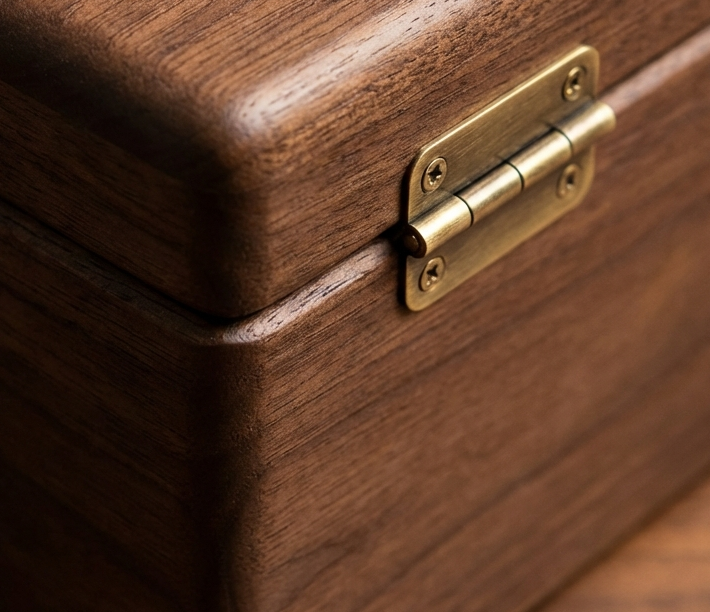
5.2 Hinges, Magnets and Hardware
Hardware choices strongly impact perceived quality but also influence assembly time and defect rates. To protect B2B margins:
- Select hardware models that are already used in the factory’s existing projects to avoid long sourcing lead times.
- Use standard hinge sizes and finishes where possible; custom-plated finishes can complicate replenishment.
- For magnets, ensure the factory designs appropriate recesses and uses correct polarity controls to avoid mis-assembly.
Agree on hardware samples during product development and keep them as a reference for future orders to maintain consistency.
5.3 Color Boxes, Mailer Cartons and Carton Marks
Packaging is often where cost creeps in unnoticed. A structured discussion with your OEM/ODM partner should include:
- Color box vs. simple mailer: For e‑commerce, a sturdy plain mailer with a printed logo may be more margin-friendly than a full-color box.
- Unified mailer sizes across a series to simplify packing and reduce carton SKUs.
- Carton mark standardization so your forwarder and 3PL can handle goods efficiently without mistakes.
Using export-oriented thinking from the start makes it easier to meet drop-shipping, FBA and retail warehouse requirements without multiple rework stages.
6. MOQ, Sampling and Lead Time: Negotiating Without Overstretching the Factory
Experienced buyers know that pushing too hard on MOQ or lead time can backfire. The objective is to find a configuration that keeps the production line stable and your inventory manageable.
6.1 MOQ Discussion With a Factory-Oriented View
When you discuss MOQ for decorative wooden boxes, consider:
- Material preparation: Many wood processes require minimum batch sizes for cutting and drying to remain efficient.
- Color and finish changeovers: Each stain or paint color shift involves cleaning and setup time.
- Hardware procurement: Suppliers often have their own MOQs that influence your project.
A practical approach is to negotiate MOQs per material and finish group rather than per SKU. For example, one batch for all dark-stained pine boxes in your range, even if there are multiple sizes.
6.2 Sampling Strategy to Protect Margin
Use sampling to validate key margin-related factors, not only appearance:
- Confirm moisture and structural stability by observing samples after several weeks in the destination climate.
- Test the inner packaging and export carton through informal drop or vibration tests.
- Verify logo, color and finish under your own photography and lighting setup.
For larger programs, a pilot shipment or pre-production sample batch can provide additional confidence before a full rollout, especially when multiple SKUs are involved.
6.3 Lead Time and Production Planning
Lead time for decorative wooden boxes depends heavily on material, finishing complexity and packaging. To avoid rush charges and quality shortcuts, share your sales calendar and launch windows early with your factory. This allows:
- Better raw material reservation for specific wood species.
- Efficient line scheduling for your finish and hardware combinations.
- More predictable export packing and booking of containers.
In many cases, a structured forecast can achieve more favorable pricing than one-time aggressive negotiations because it improves the manufacturer’s planning efficiency.
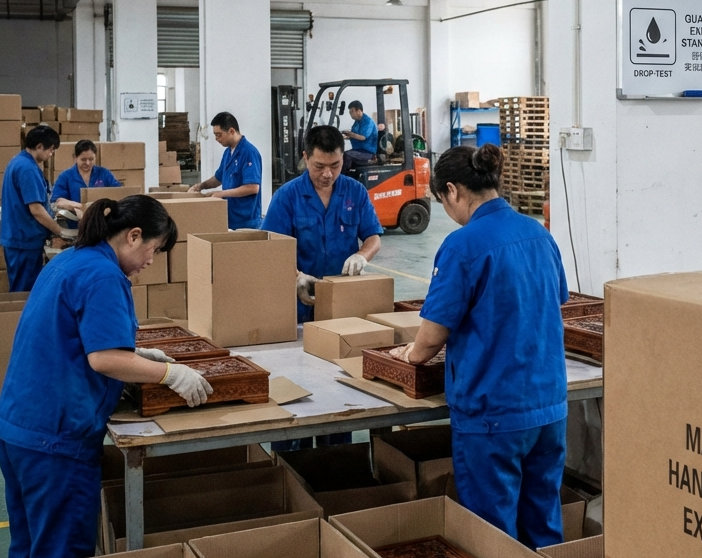
7. Export Packaging, Damage Control and Drop-Test Thinking
Every damaged decorative wooden box is more than one lost unit; it is shipping, handling and potentially negative feedback or claim settlements. A small investment in export packaging can materially improve your B2B margin.
7.1 Align Packaging Requirements With Your Channel
Different sales channels require different packaging strategies:
- Retail: Focus on appearance and shelf impact but ensure adequate internal protection to limit store handling damage.
- Wholesale: Stronger outer cartons, simpler internal packaging, clear carton marks for fast stock movement.
- Amazon/FBA and e‑commerce: Mailer cartons and insert protection must survive individual parcel handling and drops.
Discuss these requirements directly with your manufacturer during the project setup, not at the final confirmation stage.
7.2 Carton Drop-Test Thinking
Working with factories who understand drop-test thinking (for example, planning for edge and corner drops) is critical. Practical steps include:
- Protecting corners and edges of boxes with additional buffering (EPE, corrugated inserts or honeycomb).
- Avoiding excess empty space inside cartons that allows products to move during transit.
- Specifying carton strength, sealing tape and strapping in line with your shipping route.
For many decorative box projects, optimizing packaging reduces damage rates enough to offset a slight increase in packing cost, resulting in better net margin.
7.3 Repeat-Order Consistency
Protecting margin also means avoiding surprises on repeat orders. Document and standardize:
- Packing method (polybag, tissue wrap, insert type, desiccant usage).
- Carton size and loading pattern (number of pieces per carton, orientation, pallet pattern if any).
- Labeling and carton marks with version control so updates are traceable.
When these details are clear, each reorder becomes more predictable, reducing the time your team spends on clarifications and post-shipment discussions.
8. Compliance, FSC-Oriented Sourcing and Documentation
Many EU and US buyers need decorative wooden boxes that align with specific market or retailer requirements. Non-compliance can lead to delays, re-labeling costs or even rejected shipments, all of which reduce margin.
8.1 FSC-Oriented Sourcing Discussions
If your market requires FSC-oriented sourcing, involve your factory early so they can:
- Confirm which wood species and components can be provided with relevant paperwork.
- Plan material segregation to keep certified and non-certified materials properly traced.
- Align documentation timing with your shipment schedule and audits.
For decorative boxes using multiple materials (e.g., acacia frames with MDF or plywood), clarity on which parts carry certification will help avoid misunderstandings in your downstream marketing and compliance communication.
8.2 Project-Based Compliance Communication
Beyond certification, discuss any project-specific compliance expectations early:
- Coatings and their alignment with destination standards for VOC and heavy metals.
- Labeling requirements such as country of origin, material description or warning labels for specific markets.
- Retailer-specific guidelines if you supply to large chains that have their own packaging or testing protocols.
Chic Homeware is experienced in working with EU and US buyers on project-based compliance conversations so that testing and documentation are integrated into the production plan instead of becoming last-minute obstacles.
9. Building a Margin-Friendly Partnership With a Factory-Oriented Supplier
The most sustainable way to protect B2B margin is not to switch suppliers frequently but to build a structured collaboration with a factory that understands your channels, timelines and quality expectations. When you work directly with a Wooden Products Factory in China that manages wood selection, moisture control, finishing, logo application and export packing under one roof, it becomes much easier to stabilize cost and quality over time.
9.1 OEM/ODM Workflow That Supports Importers and Brand Owners
An effective OEM/ODM workflow for decorative wooden boxes typically covers:
- Concept and brief: Sharing style direction, target retail price and channel specifics.
- Material and structure proposal: Factory suggests species, thickness, structure and finish based on cost and feasibility.
- Sample development: Including logo options, hardware selection and packaging mock-ups.
- Costing and MOQ alignment: Transparent pricing structure considering mixed materials and finish levels.
- Production and QC checkpoints: Monitoring moisture, structure, finish and packaging according to agreed standards.
By handling these stages in a coordinated way, you minimize miscommunication and speed up go-to-market while keeping your cost base under control.
10. Conclusion: Decorative Wooden Boxes That Protect Your Margin
Sourcing decorative wooden boxes without sacrificing B2B margin is less about one-time price negotiation and more about systematic control: choosing the right wood mix, optimizing structure, aligning finish expectations, managing packaging and planning MOQs and lead times with the factory’s reality in mind.
Chic Homeware supports importers, wholesalers, private label brands and Amazon sellers with a factory-oriented approach to Custom Wooden Boxes in acacia, pine, paulownia, bamboo, walnut, MDF veneer and plywood veneer. From sample development and logo customization to export packing and project-based compliance communication, our team focuses on practical details that directly impact your margin and long-term repeatability.
If you are planning a new decorative wooden box range or optimizing an existing program, you can share your drawings, inspiration images or target retail positioning with our team. Together we can design a material and production route that meets your aesthetic goals while protecting your profit on every shipment.
Ready to review a project or request sampling? Reach out to the Chic Homeware team to discuss your next decorative wooden box collection.