
Wooden Table Caddies for Restaurants, Cafes and Hospitality Buyers
For restaurant, café and hospitality buyers, wooden table caddies are more than décor. They are work tools that must survive daily handling, simplify table resets, carry branding, and arrive from the factory with consistent quality from shipment to shipment. As an OEM/ODM manufacturer and export partner, Chic Homeware focuses on the structural details, finishing processes and packaging thinking that make table caddies reliable for commercial use, not just attractive in photos.
This article walks through material choices, structural design, finishing options, branding methods and export considerations for wooden table caddies, drawing on our experience supplying importers, wholesalers, distributors and private label brands worldwide.
Why Wooden Table Caddies Work Well in Hospitality Environments
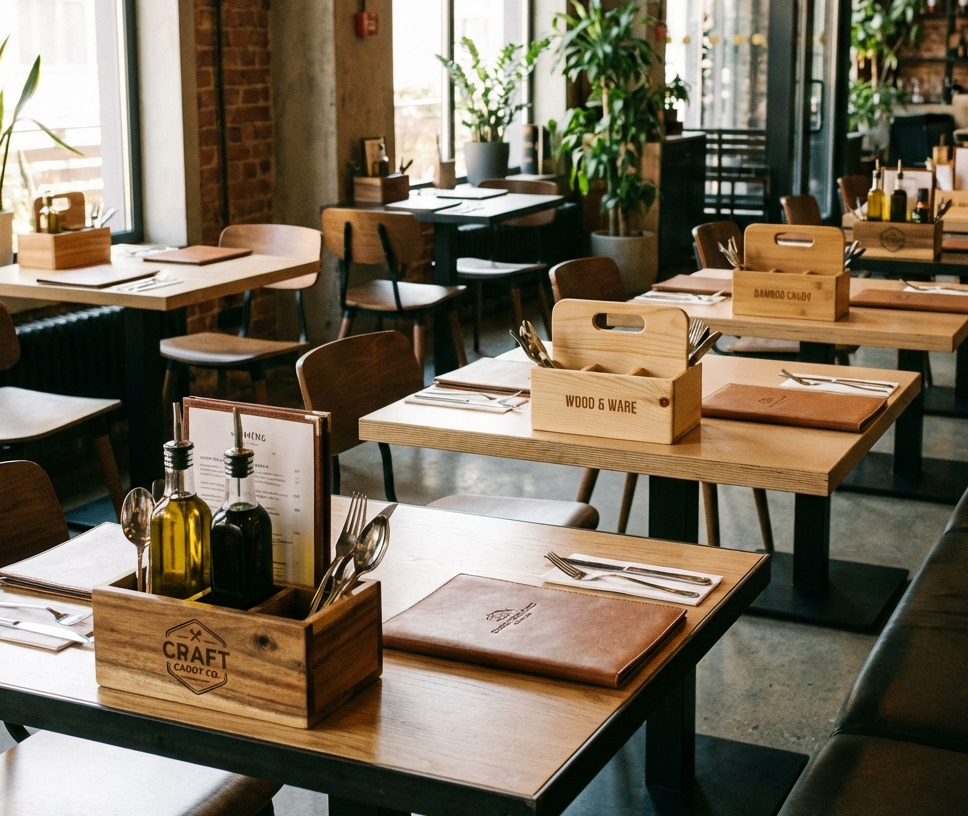
Compared with plastic or metal organizers, wooden table caddies give foodservice venues a warmer feel and can be tuned to match different brand concepts—from rustic bistros to modern casual chains. For B2B buyers, the main advantages are practical:
- Versatile branding surface: Wood accepts engraving, printing and color finishes, supporting both subtle and high-contrast branding.
- Configurable layout: Compartments can be tailored to specific menus—sauce bottles, napkins, menus, cutlery, POS table talkers and more.
- Comfortable handling: Rounded edges, integrated handles and optimized weight make staff work faster and safer during peak hours.
- Perceived value: Solid-feeling wooden caddies elevate guest perception of the venue and the brands inside them.
- Long-term cost-effectiveness: When moisture control, joinery and finishing are well managed, wooden caddies offer a good ratio between upfront cost and service life.
However, to achieve these benefits at scale, the factory must control moisture, joinery, surface treatment and export packaging from the start. That is where an OEM/ODM approach becomes essential.
Key Use Scenarios for Wooden Table Caddies
Hospitality buyers usually come to us with a clear use scenario. Defining this early helps determine material, structure and finish.
- QSR and fast-casual chains: High turnover, frequent cleaning, and need for light, stackable caddies. Often focused on napkins, sauces and takeaway menu leaflets.
- Full-service restaurants: Mixed functionality—condiments, cutlery, table numbers, and sometimes wine or cocktail list inserts. Aesthetic alignment with tabletop and furniture is important.
- Cafés and bakeries: Compact footprints for small tables, with spaces for sugar sachets, stirrers, menus and loyalty cards.
- Hotels and room service: More premium look, often with veneer finishes, darker stains and discreet branding.
- Bar and pub concepts: Robust structures, good grip when wet, and finishes that can tolerate frequent wiping and exposure to moisture around the bar.
Clarifying these usage details upfront turns into concrete guidance on wood species, thickness, handles, dividers and coating type.
Choosing the Right Wood for Table Caddies
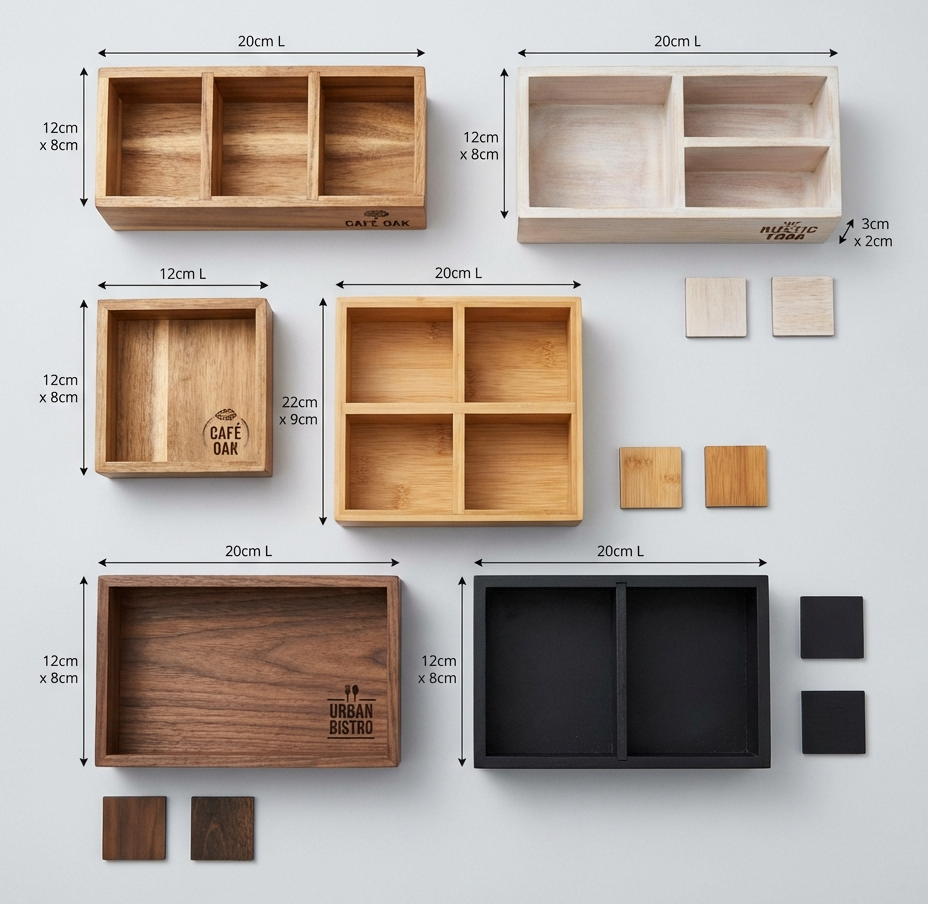
Chic Homeware works with multiple materials, including acacia, pine, paulownia, bamboo, walnut, MDF veneer and plywood veneer. Each has different implications for cost, weight, durability and visual effect.
Acacia: Durable and Premium-Looking
Best for: Mid-to-high-end restaurants, hotel F&B, long-term chain concepts.
Acacia is a dense hardwood with a natural, rich grain and good resistance to wear. In table caddies, it delivers:
- Higher impact resistance: Less prone to denting from daily handling.
- Premium appearance: Works well with clear or slightly tinted stain to highlight the grain.
- Moderate weight: Feels substantial, which many brands prefer for perceived value.
We often recommend acacia when chain buyers want a unified global look combined with longevity and are comfortable with a moderate price point.
Pine: Cost-Effective and Flexible
Best for: Volume projects, value-focused chains, promotional roll-outs.
Pine is widely used for table caddies due to its balance of cost and workability. When managed correctly, it offers:
- Good price-to-size ratio: Suitable for larger caddies without a big cost jump.
- Easy staining and painting: Accepts color very well for brand-specific schemes.
- Light-to-medium weight: Staff-friendly for larger tray-style caddies.
Pine requires careful moisture control and sanding to prevent warping and visible grain raising, especially for painted finishes. Our production flow includes moisture checking and controlled drying to keep movement under control.
Paulownia: Ultra-Lightweight Performance
Best for: Large-format caddies, high-volume venues, and situations where staff carry multiple caddies at once.
Paulownia is significantly lighter than most woods, making it suitable for oversized or multi-compartment caddies that still need to be easily carried. Key considerations:
- Weight reduction: Helps reduce fatigue for staff handling caddies all day.
- Fast machining: Keeps production efficient for big roll-outs.
- Requires structural optimization: Thickness and joinery must be checked to avoid flexing or damage under load.
For paulownia projects, we usually adjust wall thickness and include reinforced joints or base elements to maintain stability.
Bamboo: Eco-Oriented and Modern
Best for: Brands emphasizing sustainability and a contemporary look.
Bamboo panels provide a modern, clean appearance and align well with eco-oriented brand messaging. Typical advantages:
- Renewable material image: Often preferred during sustainability discussions.
- Stable structure: Engineered bamboo panels help minimize warping.
- Distinctive edge pattern: The laminated bamboo grain gives a recognizable modern style.
Bamboo also allows precise CNC cutting for consistent compartment layouts, supporting large rollout projects for chains or distributors.
Walnut, MDF Veneer and Plywood Veneer: Design-Driven Options
Walnut: Used where a darker, luxury appearance is required. Typically combined with clear matt finishes and more subtle branding, often for hotel F&B or upscale bars.
MDF veneer: A stable engineered core with a real-wood veneer surface. Useful for complex shapes and painted finishes where flatness is critical. Often chosen for projects requiring tight dimensional tolerances.
Plywood veneer: Offers strength with visible layered edges if desired, or fully veneered surfaces for a cleaner look. This is practical for caddies that must withstand heavy use and occasional impacts.
Structural Design and Compartment Planning
For hospitality buyers, the functionality of a table caddy is defined by its compartments, handle design, and base stability. A well-planned structure can reduce table-reset time and minimize mess.
Compartment Layout
When we start an OEM/ODM table caddy project, we typically request information such as bottle sizes, napkin dimensions, cutlery volume per table and menu card height. From there we propose layouts:
- Condiment-focused caddies: Deeper, narrower compartments sized to sauce bottles or shakers.
- Napkin and cutlery caddies: Wider sections with dividers to separate knives, forks, spoons and napkins.
- Multi-function caddies: Modular compartments for menus, POS tent cards and condiments in one unit.
For chain clients, we often create detailed compartment drawings showing inner dimensions and proposed clearances for rapid approval.
Handles and Portability
Handle design directly affects usability and breakage risk:
- Center arch handle: Common for classic wooden table caddies. We review thickness and joinery to avoid snapping under load.
- Side cut-out handles: Good for low-profile caddies, easier to stack and transport.
- Routered grip edges: Minimalist solution for modern designs, with less risk of protruding parts breaking.
During sampling, we test handle comfort and strength, and we recommend changes if we foresee stress points under real use conditions.
Structural Stability and Base Design
In busy restaurants, table caddies are frequently moved, bumped and stacked. Structural optimization includes:
- Reinforced corners and joints: Using dovetail, finger joint, or glue-and-pin methods, depending on cost and material.
- Base thickness: Prevents twisting or bowing when the caddy is fully loaded.
- Anti-slip options: Felt pads, silicone dots or textured bases on request, important for polished tabletops.
We review these details with buyers during the OEM drawing confirmation stage to align cost and performance expectations.
Surface Finishing: Durability and Brand Alignment
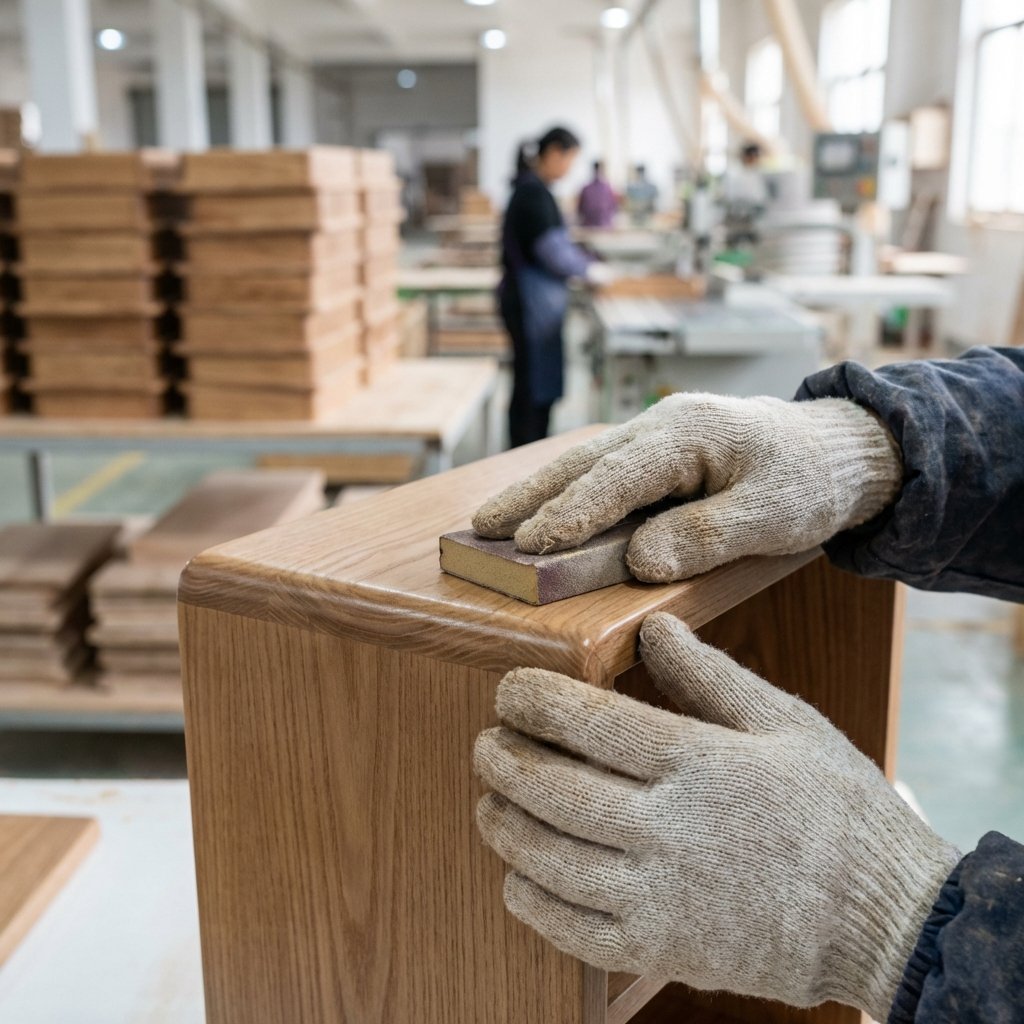
The finishing process is where visual presentation, cleanability and durability come together. Our production checkpoints prioritize sanding consistency, stain or paint application and clear topcoat performance.
Sanding Consistency
In a hospitality environment, uneven sanding shows up quickly as rough corners and visible defects under lighting. Chic Homeware implements:
- Multi-stage sanding: From coarse to fine grits to control surface smoothness.
- Edge rounding: Slight round-over for safer handling and reduced chipping.
- Random inspection: Quality checks on both inner compartments and outer surfaces, not just the visible front.
Stain and Paint Options
We support clear, stained, and painted finishes depending on the brand’s visual direction:
- Natural clear coats: Highlight the wood grain (popular for acacia, walnut and bamboo).
- Classic stain tones: Light oak, walnut, espresso tones to match existing furniture.
- Solid color paints: Brand-specific colors, often used for chain concepts and promotional campaigns.
When buyers specify a color code, we develop reference panels for approval, then match in production with small tolerances. We can discuss gloss level (matt, satin or gloss) during sampling.
Protective Coatings and Cleanability
Table caddies must tolerate frequent wiping and contact with sauces and beverages. We usually recommend:
- Food-contact-adjacent thinking: While the caddy is not a plate, we consider proximity to food and select coatings accordingly.
- Water-resistant topcoats: To reduce staining and swelling when exposed to moisture.
- Easy-wipe surfaces: Finishes that work with standard restaurant cleaning practices.
During project-based compliance discussions for EU and US buyers, we can share coating information and support documentation as required by the buyer’s compliance team.
Logo Application and Branding Options
Branding is a core requirement for most B2B table caddy projects. Chic Homeware offers several logo processes, each suited to different budgets and visual targets.
Common Logo Methods
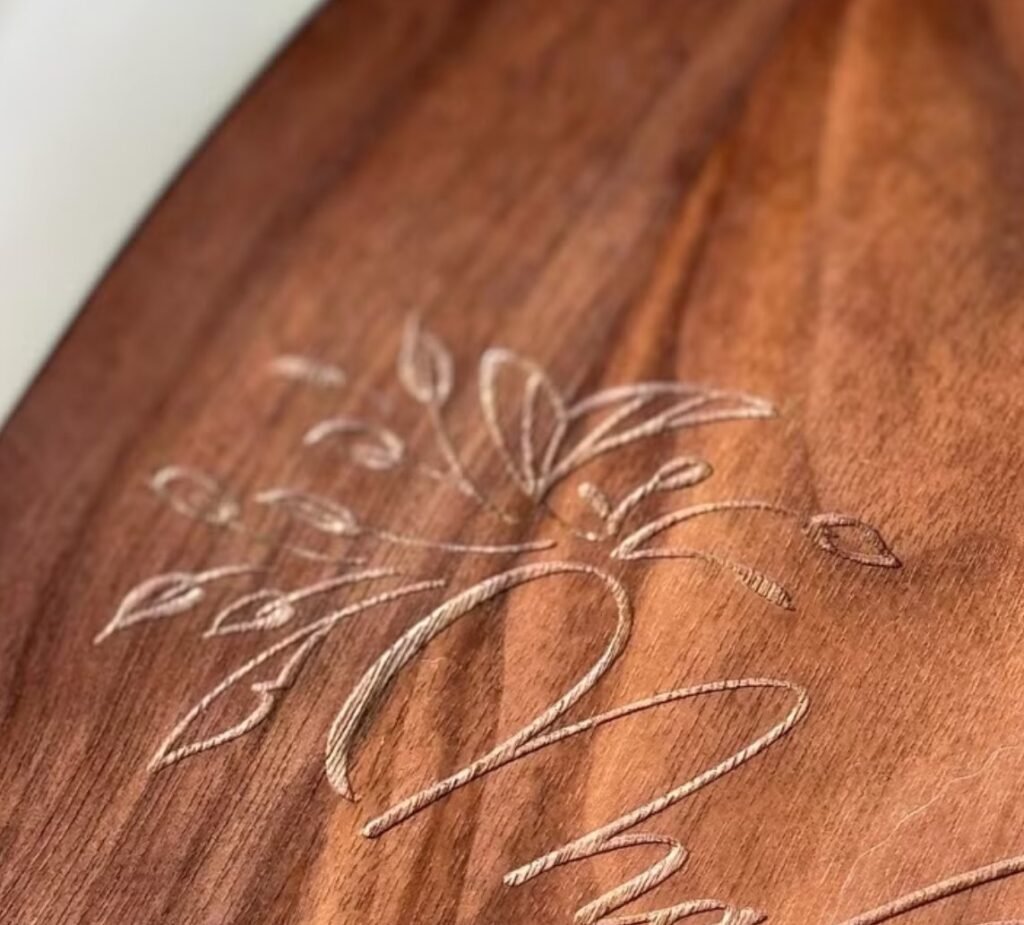
- Laser engraving: Clean and durable, ideal for natural and stained finishes. Works especially well on acacia and bamboo. No additional color, but strong contrast on lighter woods.
- Silk-screen printing: Cost-effective for simple logos and one to two colors. Requires flat or gently curved surfaces.
- UV printing: Allows multi-color logos and gradients. Suitable for brand-specific artwork and promotional designs.
- Metal or acrylic badges: Mixed-material option for premium ranges, attached with adhesive or small screws/rivets.
Logo Positioning
Typical positions on wooden table caddies include:
- Front panel, centered or aligned left/right.
- Handle top or side, for vertical logos.
- Interior base, for more subtle branding.
- Bottom side, often for traceability codes, barcodes or batch info.
We provide digital renderings on request, so buyers can preview branding placement before sampling. During OEM development, we also align the logo scale to the caddy size to avoid visual imbalance.
OEM/ODM Workflow for Hospitality Table Caddies
Chic Homeware works as a Custom Wooden Products Manufacturer, so our process is built around practical OEM/ODM steps rather than fixed catalog items.
1. Project Brief and Feasibility
We start with a basic project brief from the buyer, including:
- Target markets (EU, US, other).
- Concept sketches, reference photos or competitor samples.
- Expected annual volume and initial order quantity.
- Preferred materials (e.g., acacia vs pine vs bamboo).
- Branding requirements and packaging expectations.
From there we propose a structure, material route and approximate price range to align expectations early.
2. Sampling and Structural Optimization
After confirming basic specifications and budget direction, we create samples. In this stage we focus on:
- Checking actual fit of bottles, napkins and accessories (based on sizes provided).
- Evaluating weight, handle comfort and base stability.
- Fine-tuning stain/paint colors and logo execution.
For buyers who already work with us on other categories (such as boxes and trays), we coordinate sampling to optimize freight and timing.
3. MOQ and Price Structure
MOQs for table caddies depend on material, complexity and branding method. In general:
- Simple pine or paulownia caddies with standard finishes support lower MOQs.
- Bamboo, acacia, walnut and veneer projects may require higher MOQs due to material preparation and finishing setups.
- Multi-color printing or special hardware increases set-up cost, so we typically recommend higher quantities per design.
We work with importers, wholesalers and Amazon sellers to find commercially realistic order quantities, often suggesting shared components (same body with different logos) to spread costs.
4. Production, QC and Repeat-Order Consistency
Once the sample is approved, we formalize specifications and QC points, including:
- Wood species and grade.
- Moisture content target before assembly.
- Finished dimensions and tolerances.
- Color/finish references.
- Logo artwork and color codes.
We then integrate these into QC checklists so that repeat orders can be controlled against the same standards. This helps distributors and chain buyers maintain consistency across multiple shipments and locations.
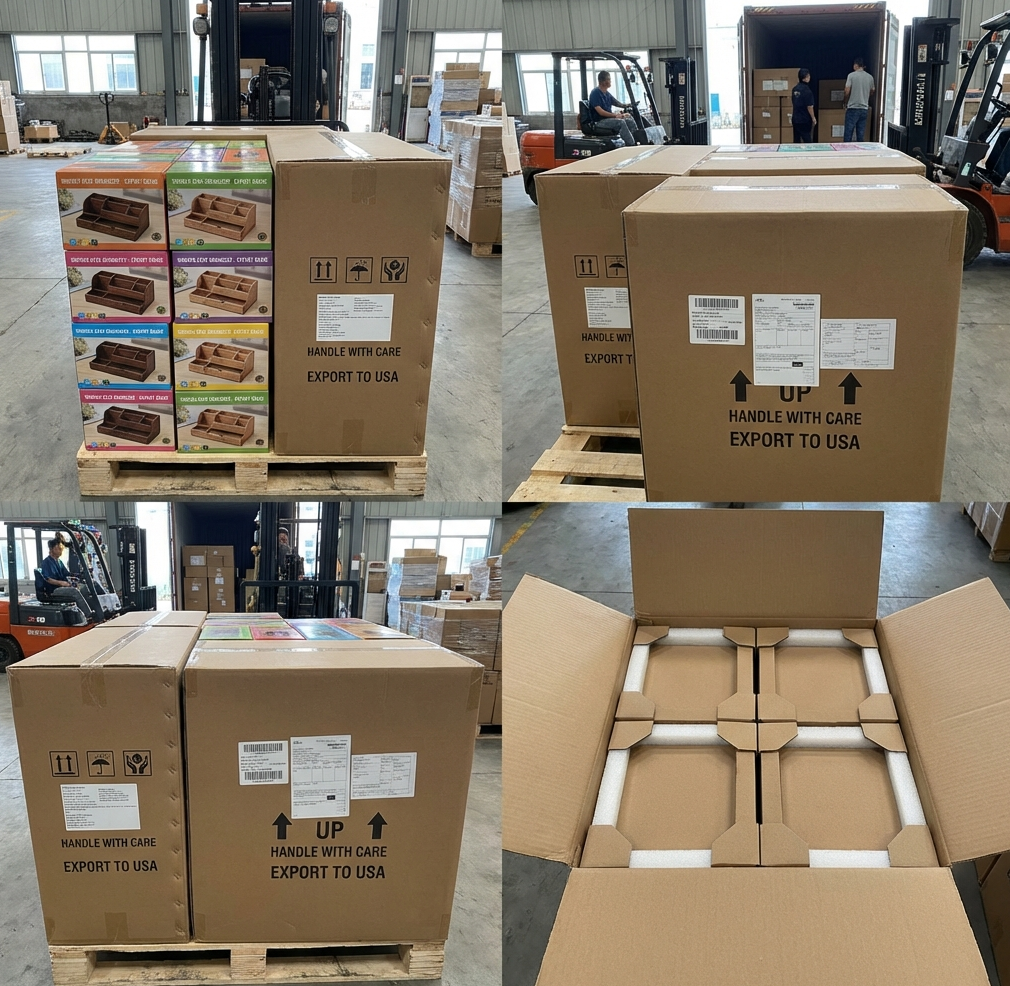
Export Packaging, Damage Control and Carton Thinking
For wooden table caddies, damage during transit is a common concern, especially for buyers selling via e-commerce or distributing to multiple warehousing hubs. Chic Homeware’s factory-oriented approach includes export packaging planning from the beginning.
Primary and Secondary Packaging Options
Depending on the sales channel and price point, we offer:
- Bulk packing: Multiple caddies per export carton, separated by paper/cardboard or foam, suitable for direct B2B distribution to restaurants.
- Individual color boxes: For retail or Amazon sellers who require branded boxes with barcodes and product information.
- Mailer cartons: E-commerce-ready packaging designed to pass basic drop-test scenarios when shipped as single units.
We discuss carton mark requirements early to avoid rework: item codes, quantity, gross weight, net weight, country of origin, and any buyer-specific labeling.
Carton Drop-Test Thinking
Even if formal lab testing is not required, we design packaging with drop-test thinking in mind:
- Placing caddies in the carton so impact points are reinforced.
- Using edge and corner protection when weight or value is high.
- Controlling void space to prevent internal movement during transit.
Buyers planning to sell through online marketplaces or ship directly to restaurants benefit from this practical approach, as it reduces breakages and returns.
Compliance, FSC-Oriented Sourcing and Documentation
Many EU and US buyers now include sustainability and compliance requirements in their sourcing criteria. While every project is different, we support:
- FSC-oriented sourcing discussions: Exploring options for FSC-related material routes when required by the buyer’s program.
- Project-based compliance communication: Sharing relevant technical information with the buyer’s compliance team, including coating details and material descriptions.
- Traceability thinking: Internal batch and production date records that help with quality tracking over time.
We recommend raising any compliance or documentation needs in the initial project brief so they can be built into costing and planning.
Comparing Wooden Table Caddies with Alternative Materials
Hospitality buyers often compare wooden caddies with plastic or metal alternatives. Each material has its place, but wood offers a distinctive balance:
- Versus plastic: Wood provides higher perceived value and a more natural look, though plastic may win on extreme moisture resistance. Wood is usually preferred for mid- to high-end venues and for brands prioritizing sustainability messaging.
- Versus metal: Wood is warmer to the touch, quieter when handled, and easier to customize with logos and colors. Metal caddies can be strong, but may show dents and scratches more visibly.
- Versus disposable solutions: Wooden caddies support long-term cost savings when spread over months or years of use, and help reduce waste.
For many of our clients, the decision ends up being a mix: wooden table caddies for front-of-house tables, combined with metal or plastic back-of-house organization where aesthetics are less critical.
Why Work with a Factory-Oriented Partner for Table Caddies
Chic Homeware operates as a Wooden Products Factory in China with a focus on wooden boxes, organizers, trays, kitchen storage and gift packaging. Wooden table caddies sit naturally within this expertise. For B2B buyers, the benefits include:
- Material flexibility: Ability to shift between acacia, pine, paulownia, bamboo, walnut, MDF veneer and plywood veneer based on budget and brand requirements.
- Shared know-how: Lessons learned from boxes, cutlery organizers and trays applied directly to table caddy projects.
- OEM/ODM capability: Support from idea stage through sampling, logo development and export packing.
- Scale handling: Experience with both smaller private-label orders and large chain roll-outs.
Because we manage moisture control, surface finishing, logo application and export packaging in-house or with stable partners, buyers gain a predictable, repeatable supply base for table caddies and related wooden items.
Practical Next Steps for Importers and Hospitality Buyers
If you are planning to develop or refresh wooden table caddies for restaurants, cafés or other hospitality concepts, we suggest the following steps:
- Prepare a simple specification sheet with dimensions, contents (bottles, napkins, cutlery, menus), target material and color direction.
- Clarify which sales channels you will use (direct to restaurants, retail, e-commerce) and what packaging level is required.
- Decide on essential branding elements—logo style, placement and colors—and what can be flexible.
- Outline your expected volume, launch date and target markets to frame MOQ, lead time and compliance discussions.
With this information, our team can provide practical suggestions on material choice, structure, finishing and packaging to build a commercially workable solution for your brand or distribution network.
Conclusion: Build Reliable, Brand-Ready Wooden Table Caddies with Chic Homeware
Well-designed wooden table caddies help hospitality venues keep tables organized, improve staff efficiency and strengthen brand presentation. To perform in real restaurant and café environments, they must be designed and produced with attention to wood selection, moisture control, structure, finishing and export packaging—not just aesthetics.
As an OEM/ODM partner focused on wooden boxes, organizers, trays and related products, Chic Homeware is positioned to support importers, wholesalers, distributors, private label brands and Amazon sellers with practical, project-based solutions. Whether you need a simple pine caddy for a volume QSR rollout or a premium acacia or walnut design for an upscale concept, we can help translate your brief into a production-ready item.
To discuss your wooden table caddy project, share specifications or arrange sampling, please Contact Chic Homeware. Our team can walk through material options, OEM details, logo applications, MOQ expectations and export packaging options tailored to your business model.