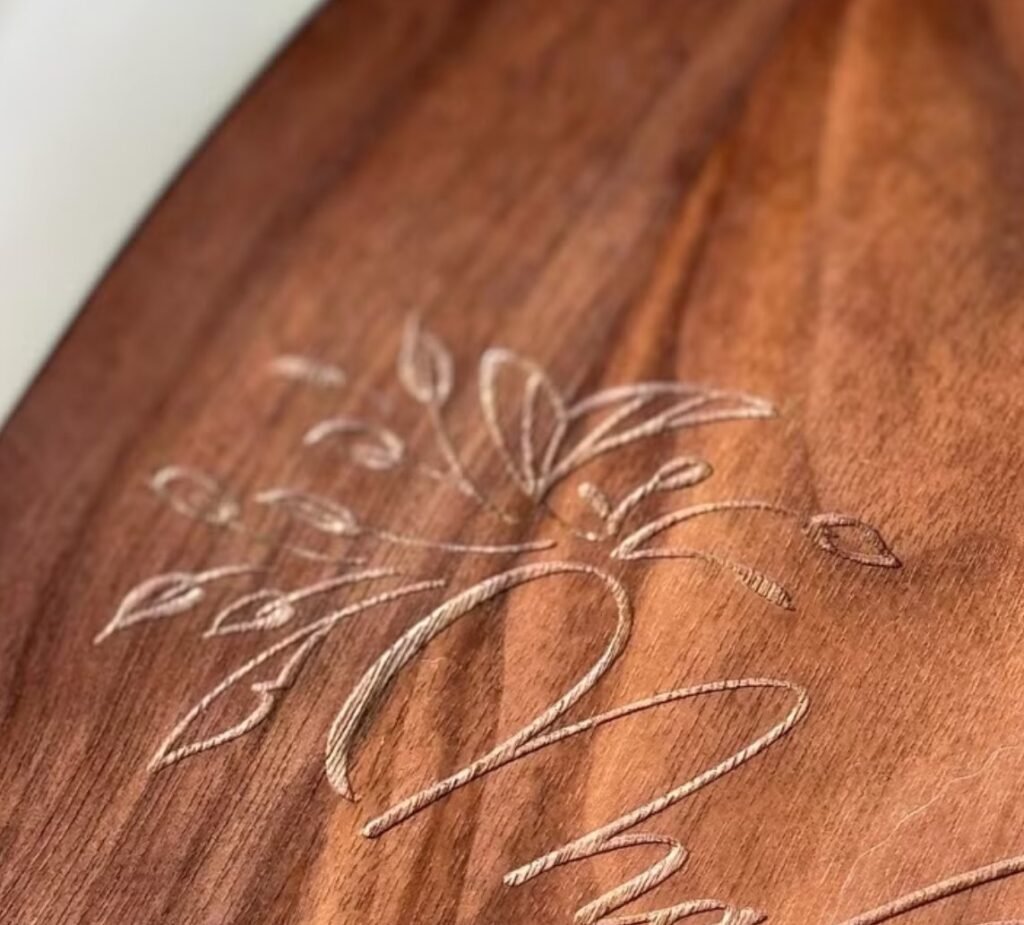

Wooden Box Factory Inquiry Guide for OEM ODM Buyers
For sourcing managers and brand owners, speed to confirmation is often as critical as price. In wooden box projects, some inquiries move quickly from first email to workable quotation, while others stall in long clarification threads. Understanding what inquiries convert faster for wooden box factories helps you structure your RFQs so you get sharper pricing, clearer timelines and more reliable commitments from the start.
As an OEM/ODM manufacturer, Chic Homeware sees daily how the structure and quality of an inquiry directly affects sampling speed, cost visibility and production risk. This article breaks down which inquiry types move fastest, what information wooden box factories actually need, and how importers, wholesalers and Amazon sellers can engineer their RFQs for quick, practical responses.
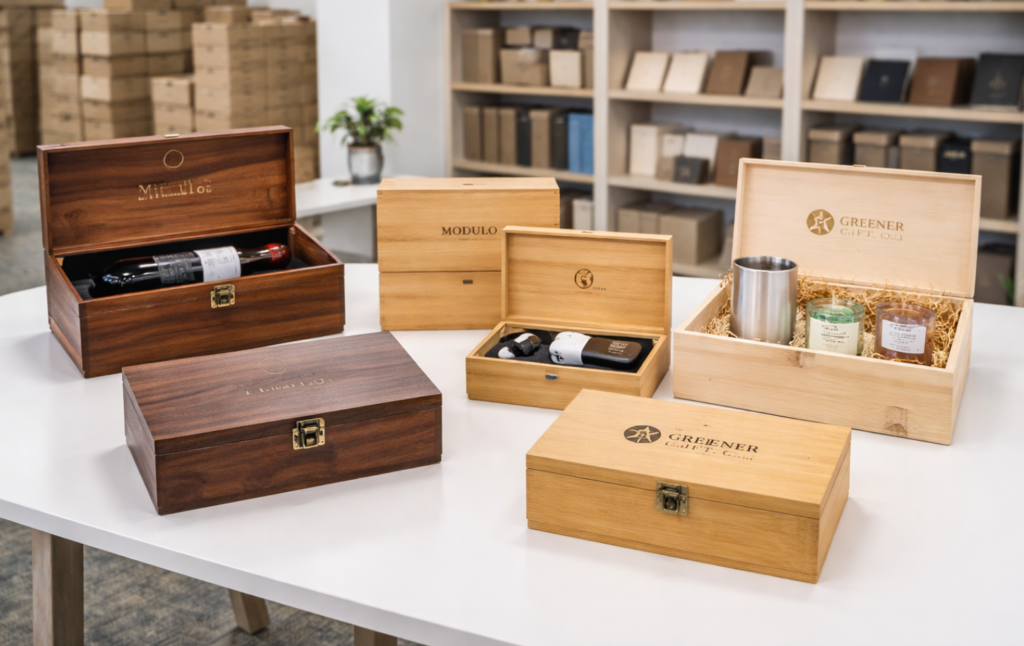
1. Why Some Wooden Box Inquiries Convert Faster Than Others
From a factory perspective, a “fast converting” inquiry has three features:
- Technical clarity – the buyer’s requirements are specific enough that engineering, costing and material routing are obvious.
- Commercial visibility – target quantity, timeline and price expectations are realistic for the structure and finish required.
- Risk transparency – compliance, packaging and quality expectations are open from the start, not added late in the process.
When these three areas are clear, a wooden box factory can move straight into material selection discussions, structure optimization and export packing planning, instead of repeatedly guessing what the buyer “might” want.
Vague inquiries, by contrast, create hidden risk in moisture control planning, surface finishing, logo application and carton design. That risk has to be priced in, or the factory must slow down to ask more questions. Either way, conversion speed drops.
2. Inquiry Types That Typically Convert Fastest
Different inquiry formats naturally move at different speeds. For wooden box factories, some patterns are consistently efficient.
2.1 Repeat or Line-Extension Inquiries
The fastest converting inquiries are usually:
- Reorders with minor adjustments (logo update, color change, insert revision)
- Line extensions based on an existing approved box size or structure
In these cases, the factory already understands wood species behavior, moisture targets, stain consistency and carton strength for that structure. Quote and sample lead time are mainly influenced by:
- New surface finishing (different stain, paint or printing color)
- Alternate hardware (hinges, magnets, clasps)
- Different insert layout or material (foam, EVA, cardboard, molded pulp)
Providing the previous order number, photos of the existing item and a short list of what’s changing allows a wooden box factory to respond quickly with revised pricing and lead time.
2.2 Inquiries Based on a Clear Reference Sample or Link
Even for new projects, inquiries convert faster when the buyer provides a clear reference:
- Physical sample sent to the factory for reverse engineering
- High-resolution photos with scale or dimensions shown
- Online listing link plus your required modifications
When a wooden box factory can see the structure, they can quickly assess:
- Appropriate wood species (acacia, pine, paulownia, bamboo, walnut, MDF veneer or plywood veneer)
- Standard hardware configurations and fitting processes
- Likely sanding and finishing requirements
- Reasonable carton dimensions and packing method
This reduces back-and-forth about basic design details and allows immediate focus on optimization, MOQ and export packaging planning.
2.3 Inquiries for Standard Structures with Custom Branding
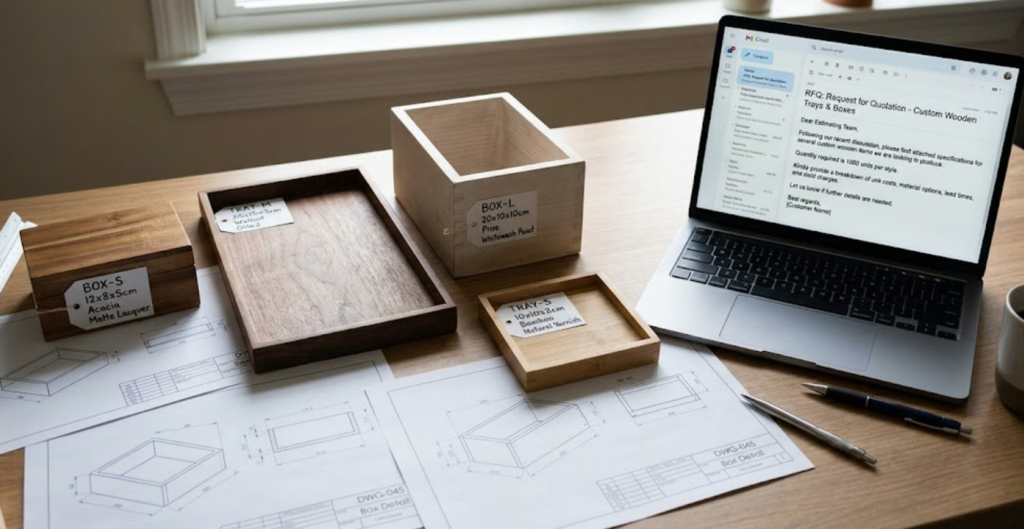
Another category that converts quickly: inquiries that use a standard wooden box structure with custom logo and packaging. For example:
- Classic hinged lid box with your branding on lid
- Sliding lid box with branded sleeve and color box
- Simple open storage box or tray with laser logo and mailer carton
When structure stays standard, the factory can lean on existing production jigs, known moisture control behavior, and tested hardware fitting. Most of the conversation focuses on:
- Logo process (laser, screen print, UV, heat stamp)
- Color or stain options and finishing schedule
- Color box design, mailer carton dimension and carton mark layout
If you are open to standard structures with custom branding, you can often confirm projects faster and with better price efficiency. Chic Homeware’s Custom Wooden Boxes catalog is a typical starting point for this type of inquiry.
2.4 Inquiries with a Clear Commercial Framework
Factories respond faster when they see a realistic commercial framework around the project, even if technical details are still flexible. A high-converting inquiry will typically state:
- Annual volume or project forecast – for example, “First order 1,200 pcs, then quarterly orders if quality is stable.”
- Target launch date and requested delivery window
- Port, incoterms and shipment pattern – such as FOB Xiamen, mixed containers, or LCL trial shipment.
This signals to a wooden box factory that it is worth investing engineering time in structure optimization and export packaging solutions right away, instead of treating the inquiry as a price check only.
3. Inquiry Structures That Slow Down Factory Responses
Understanding what slows down responses helps you avoid bottlenecks before they appear.
3.1 “One-Line” or Extremely Vague Inquiries
Inquiries like “Need wooden box, what’s your best price?” force the factory to guess everything: size, wood species, finishing, logo, hardware, target market and even carton concept. Any quote given will be either:
- Too generic and not actually usable for your project, or
- Loaded with safety margins to cover unknown risk.
This typically leads to multiple rounds of clarification, adding days before you see a relevant quotation. Structuring your RFQ properly avoids this delay.
3.2 Complex Custom Structures with No Reference
Highly custom structures can be produced, but the inquiry process is slower if you provide no reference sample or drawing. Examples:
- Multi-layer boxes with internal moving parts
- Combination of wood plus metal frames or glass panels with complex fit tolerances
- Mixed sets of different box sizes nesting into one unit
Without clear drawings, dimensions and tolerance expectations, a wooden box factory must first invest engineering time to interpret your concept. When details such as lid alignment, hinge positioning, magnet strength or heavy inserts are unclear, sampling and costing cannot be accurately planned.
3.3 Hidden Compliance or Packaging Requirements
Another delay occurs when compliance or packaging expectations are only mentioned late in the process, for example:
- Requiring FSC-certified material after sampling has started
- Adding strict drop-test requirements after cartons are designed
- Requesting special lab tests or certifications just before mass production
Most wooden box factories, including Chic Homeware, can support FSC-oriented sourcing discussions, carton drop-test thinking and project-based compliance work. But if these needs are not communicated in the initial inquiry, timelines and cost structures will shift later, often requiring revised quotations and updated sampling.
4. Key Information That Makes Wooden Box Inquiries Convert Faster
To help your inquiries move quickly, structure them around a clear set of technical and commercial points. Below is a practical checklist aligned with how factory teams actually review projects.
4.1 Basic Product Definition
- Category: gift box, wine box, tea box, cosmetic box, organizer, storage box, tray set, etc.
- Target market: EU, US, UK, specific platform (e.g., Amazon, retail chain) if relevant.
- Intended use: food contact (packed or direct contact), bathroom, kitchen countertop, closet, decorative, etc.
This helps the factory quickly filter suitable materials and finishing systems, and consider humidity and surface performance requirements.
4.2 Dimensions and Structure
Even approximate dimensions speed up the quotation process:
- Internal and external size (L x W x H, in mm or inches)
- Wall thickness or at least expected strength/feel
- Structure type: hinged lid, sliding lid, removable lid, drawer style, open-top, nesting set, etc.
Structural stability and hardware fitting depend heavily on these parameters. For example, thin-walled paulownia behaves differently from solid acacia when adding heavy hinges or strong magnets.
4.3 Material Preferences and Flexibility
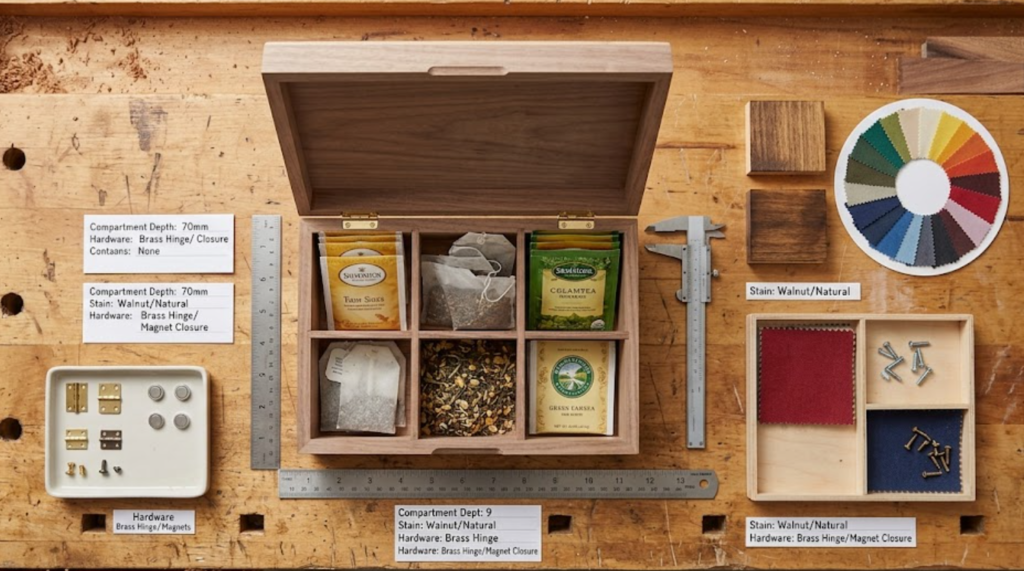
Clarity around material often determines how quickly the factory can route your project into the right production line. Common options include:
- Acacia – heavier, richer grain, often for premium kitchen boxes and trays.
- Pine – lighter weight, cost-efficient, suitable for painted boxes and rustic gift packaging.
- Paulownia – very light, suitable for larger decorative boxes or packaging where weight is a concern.
- Bamboo – eco-oriented look, good for kitchen and bathroom storage.
- Walnut – upscale, dark tone; often used as veneer or solid for premium branding boxes.
- MDF veneer – dimensional stability and smooth surfaces for uniform paint or veneer finishes.
- Plywood veneer – strong, lighter than solid hardwood, good for larger boxes and retail packaging.
To speed up the process, you can phrase your material requirement like this:
- “Preferred: acacia or walnut look, open to veneer options if more cost-effective.”
- “Need lightweight box; suggest paulownia or pine based on your experience.”
Factories can then use their own wood supply routes and processing capabilities to recommend the most practical combination for your project.
4.4 Surface Finishing and Color Expectations
Moisture control and finishing are key cost and risk drivers. When you specify them clearly, inquiries convert faster because the factory can immediately map finishing steps and time.
- Finish type: clear lacquer, natural oil, stain color, full paint, or raw sanding-only.
- Color reference: Pantone, RAL or a reference product photo.
- Gloss level: matte, semi-matte, semi-gloss, high gloss.
- Special effects: white-wash, distressed, wire-brushed, burnt effect, etc.
Mention whether the product will be exposed to bathroom humidity, kitchen splashes or only dry storage. This guides moisture control planning and topcoat selection.
4.5 Logo and Branding Details
Logo application directly influences tooling, sampling time and per-unit cost. Common options for wooden boxes include:
- Laser engraving
- Screen printing
- UV printing
- Hot stamping / foil stamping
To enable quick costing, provide:
- Logo artwork (vector file or high-res image)
- Dimensions and placement (e.g., centered on lid, side panel, inside lid)
- Single-color or multi-color requirements
Factories can then quote both logo setup cost and per-unit logo charge accurately in the first quotation.
4.6 Hardware, Inserts and Compartments
Hardware fitting and internal structure can add significant time if not clear from the beginning. Helpful details include:
- Hinges: type (butterfly, piano, simple hinge), color (black, gold, silver, bronze).
- Magnets: quantity and holding strength expectations (firm closure, or light magnetic assist).
- Clasp/lock: type and finish if needed.
- Compartments: number of compartments and whether dividers are fixed or removable.
- Inserts: foam, EVA, cardboard, molded pulp, fabric lining, or wooden inserts.
For projects where you are flexible, you can request suggestions, such as “recommend a standard magnetic closure used for similar cosmetic boxes” to allow the factory to propose efficient solutions from their existing hardware library.
5. Export Packaging, Drop-Test Thinking and Damage Control
In B2B wooden box projects, export packaging is not an afterthought; it is part of the product. Inquiries that address packing upfront convert faster and more reliably.
5.1 Individual Packaging Options
Clarify what you need for unit-level packaging:
- Plain brown mailer carton with protective inner wrap
- Printed color box (sleeve, tuck-end, or lift-off style)
- Shrink wrap or protective bag
- Corner protectors, foam, or paper-based protection inside the box
Factories then align internal packaging with your brand positioning and shipping method (e.g., direct to consumer vs. bulk to warehouse).
5.2 Master Carton Design
For importers and Amazon sellers, carton design directly affects damage rates and freight cost. To speed up planning, provide:
- Preferred units per master carton
- Maximum carton weight (often 18–20 kg for manual handling)
- Any required carton size limits (e.g., for Amazon FBA or retailer requirements)
- Carton mark content and barcode placement
A factory with carton drop-test experience can then design a packing solution that balances protection with freight efficiency. Chic Homeware’s role as a Custom Wooden Products Manufacturer includes this type of collaborative packaging engineering.
5.3 Damage Control Considerations
To manage risk and minimize claims, discuss:
- Whether boxes will be shipped e-commerce (single unit per parcel) or palletized bulk
- Any history of damage with similar products in your supply chain
- Minimum acceptable cosmetic variation (small color or grain differences) vs. critical defects
When your damage tolerance and distribution method are clear, a wooden box factory can adjust protective packaging, moisture targets and inspection focus accordingly, without multiple rounds of trial shipments.
6. Commercial Details That Speed Up Decision-Making
Even with clear technical information, inquiries may stall if the commercial framework is unclear. Adding a few simple data points accelerates internal decision-making on both sides.
6.1 MOQ and Volume Outlook
Most wooden box factories can flex MOQs when they see a realistic growth path. Indicating tiers such as:
- Trial order: 300–500 pcs
- First standard order: 1,000–2,000 pcs
- Projected annual volume: based on your channel
helps the factory configure tooling decisions, wood purchasing plans and process setup. They can then offer more strategic pricing options rather than a single static quote.
6.2 Sampling Plan
Be explicit about what you need at the sampling stage:
- Number of samples and whether they must be pre-production quality
- Whether color and logo must be final or can be confirmed later
- If you need multiple color options in one round
Factories can only give realistic sample lead times and costs when they know whether sampling is purely structural or also color and branding critical. This moves you faster toward a production-grade sample that your internal team can sign off.
6.3 Lead Time Expectations
Lead time questions are more productive when anchored in your launch plan. Rather than simply asking “What is lead time?”, you can share:
- Your required arrival date in destination port or warehouse
- Your flexibility on shipment split (e.g., partial earlier shipment plus balance later)
- Your readiness to approve samples quickly once received
Factories can then reverse-plan sampling, production and packing windows, and suggest realistic schedules or alternative solutions if your deadline is tight.
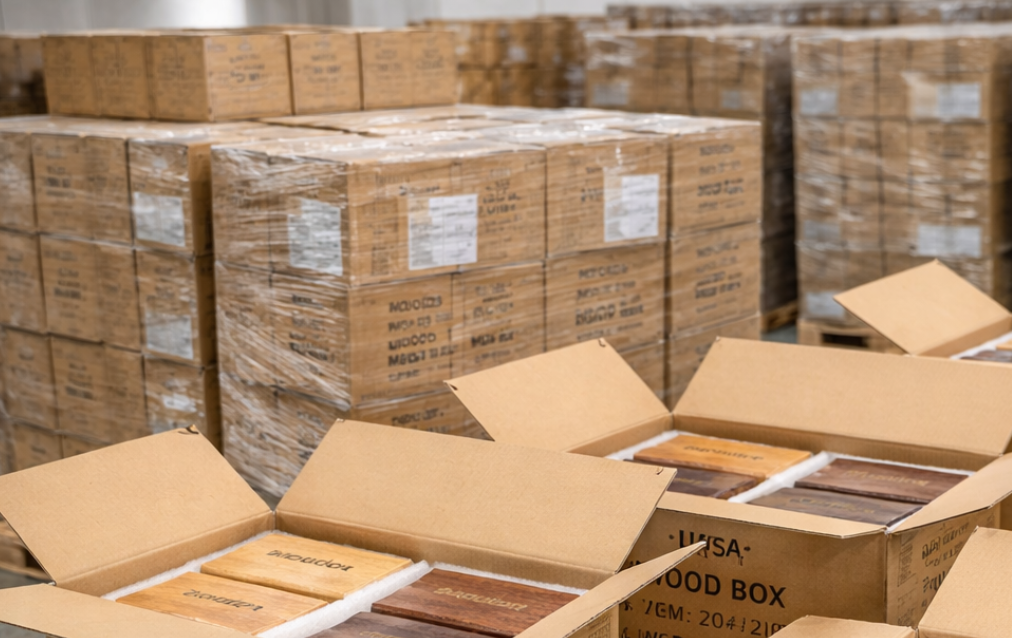
7. Example of a Fast-Converting Wooden Box Inquiry
Below is an example structure that typically results in a quick, practical response from a wooden box factory.
7.1 Example RFQ Outline
- Product: Wooden tea storage box with 8 compartments, hinged lid, for EU retail.
- Material: Prefer acacia or similar medium-tone hardwood; open to veneer on MDF if more stable and cost-effective.
- Size: Outside approx. 300 x 200 x 95 mm; internal compartments sized for standard tea sachets.
- Finish: Medium brown stain with matte clear coat; similar to attached reference photo. Indoor use only.
- Logo: Single-color laser engraving centered on lid, artwork attached (vector file).
- Hardware: 2 small hinges at back, antique bronze color; no front clasp.
- Packaging: Each box in a simple printed color box suitable for retail, then 6 units per master carton. Max carton weight 16 kg. Carton marks per our template (to be shared).
- Compliance: Target EU general consumer product requirements; no direct food contact. Please propose FSC-oriented sourcing option if available, as a separate quotation line.
- Quantity: Trial order 500 pcs, first standard order 2,000 pcs if quality and sell-through are good.
- Timeline: Need production-ready samples within 3–4 weeks after confirming artwork, mass production lead time target 45–60 days after sample approval.
- Port/incoterms: FOB Xiamen preferred.
An inquiry with this level of detail allows a factory to quickly discuss wood species options, moisture control strategy, finishing schedule, logo method, carton strength and realistic MOQs, often leading to a workable quotation within a short time frame.
8. How a Factory-Oriented Partner Supports Faster Conversions
A responsive OEM/ODM partner reduces friction at each stage of the inquiry. As a Wooden Products Factory in China, Chic Homeware focuses on:
- Wood species routing: Matching acacia, pine, paulownia, bamboo, walnut, MDF veneer or plywood veneer to your structure, price and branding level.
- Production checkpoints: Moisture control, sanding consistency, stain or paint finish, logo application, hardware fitting, structural stability and export packaging are treated as project milestones.
- OEM/ODM workflow: Sample development, logo customization, mixed material suggestions (e.g., wood plus metal or glass), MOQ discussions and packaging options aligned with your channel (retail, wholesale, Amazon, subscription box, etc.).
- Project communication: FSC-oriented sourcing discussions, carton drop-test thinking, and compliance communication handled as part of the early conversation, not an afterthought.
This factory-oriented approach means that when your inquiry is structured well, both sides move faster toward a stable product specification, clear price structure and repeat-order consistency.
9. Conclusion: Design Your Inquiry for Speed and Clarity
What inquiries convert faster for wooden box factories? The ones that:
- Define clear product usage, structure and preferred materials
- Share realistic size, finishing and logo requirements
- Address inserts, hardware and packaging early
- Openly state MOQ, sampling expectations and timeline
- Highlight any FSC or compliance needs at the beginning
By treating your RFQ as a technical brief rather than a simple price request, you help factory teams route your project into the right wood, finishing, and packaging processes from day one. That results in sharper quotations, faster sampling, and a more reliable path to repeat orders.
If you are planning new wooden box, organizer, tray or gift packaging projects, you can share your brief and reference materials with Chic Homeware’s team for a practical evaluation of materials, structure and export packing options. To start a focused discussion around your next OEM/ODM wooden box project, please reach out via Contact Chic Homeware.