
How to Source Custom Wooden Knife Holders for Retail and Private Label
For importers, wholesalers, private label brands and Amazon sellers, custom wooden knife holders are a high-value category that sits at the intersection of kitchenware, storage and gift packaging. Done well, they upgrade a knife set, lift perceived value and create a strong unboxing experience. Done poorly, they trigger quality complaints, safety concerns and expensive returns.
This guide walks through how to source custom wooden knife holders for retail and private label programs, based on a factory-oriented OEM/ODM workflow. It covers material selection, structural design, surface finishing, logo options, packaging, and the B2B details that matter: MOQ, sampling, lead time, price structure, and repeat-order consistency.
1. Clarify Your Business Model and Product Positioning
Before discussing materials or dimensions with a manufacturer, define how your wooden knife holder will live in your assortment and on your customer’s countertop. This positioning will drive technical decisions and cost structure.
1.1 Know which channel you are designing for
- Retail chains and distributors: Often need stable, repeatable SKUs with fixed packaging sizes and strict carton specs. Usually focus on a balance of price and finish quality, with clear yearly volume forecasts.
- Amazon and e-commerce sellers: Need packaging optimized for parcel shipping and minimal damage, strong visual appeal, and clear lifestyle positioning in images. Smaller batch testing and more frequent design refreshes are common.
- Private label for knife brands: The knife holder must match existing knife lines in color, style and perceived quality. Tolerance, alignment and surface finish must be consistent across repeat orders.
1.2 Decide the role of the knife holder in your offer
- Core product: A standalone wooden knife block or magnetic holder as the main item. Requires strong design identity, higher finish level, more robust packaging and a wider range of customization.
- Value-add accessory: Included with a knife set to increase perceived value. Design can be simpler, but it must protect blades properly and look coherent with the knives.
- Gift packaging + storage: A wooden knife holder that also works as a presentation or gift box. Here, the cross-over with custom wooden boxes becomes important.
2. Select the Right Wood Material for Your Knife Holders
Material choice is one of the first technical decisions when sourcing custom wooden knife holders. It impacts cost, appearance, durability, and how the product responds to moisture in the kitchen environment.
2.1 Common materials and when to use them
| Material | Key Features | Best Use Cases |
|---|---|---|
| Acacia | Hard, durable, with rich grain and warm brown tones. Good resistance to wear. | Mid- to high-end knife blocks and magnetic racks for retail and private label gift sets. |
| Walnut | Dark, premium look; fine grain; elevates perceived value. | Premium collections, chef-focused brands and high-ticket sets. |
| Bamboo | Stable, renewably sourced, modern look; often requested for sustainability positioning. | Eco-positioned ranges, contemporary kitchen lines, mass retail with value and sustainability messaging. |
| Pine | Lighter weight, softer wood, cost-effective with visible grain. | Entry-level or price-sensitive ranges, promotional items and basic blocks. |
| Paulownia | Very lightweight, pale color, takes stain and paint well. | Wall-mounted holders, knife drawer organizers, and projects where reduced shipping weight is important. |
| MDF veneer | Smooth surface, consistent density, veneer can mimic various woods. | Modern designs with painted or stained finishes, where uniform appearance is more important than solid wood grain. |
| Plywood veneer | Dimensional stability, good strength-to-weight ratio, layered core. | Slim-profile blocks, wall racks and constructions requiring structural stability with thinner panels. |
2.2 Balancing cost, look and performance
When discussing materials with a custom wooden products manufacturer, focus on the trade-offs:
- Cost vs. finish: Acacia and walnut usually cost more than pine or paulownia, but require less color correction to achieve a premium look.
- Weight vs. stability: Heavier woods feel more substantial on the countertop but increase shipping cost. Lighter woods reduce freight but need careful structural design to avoid tipping.
- Sustainability conversations: Bamboo and FSC-oriented sourcing in acacia, pine or other species can support eco-positioning for EU and US buyers who need clear sourcing discussions rather than generic green claims.
3. Structure and Function: Designing Knife Holders for Real Use
Good design starts from how the end user will handle the knife holder in daily life. In sourcing discussions, structural details directly influence safety, usability, and manufacturing complexity.
3.1 Choose the basic structure type
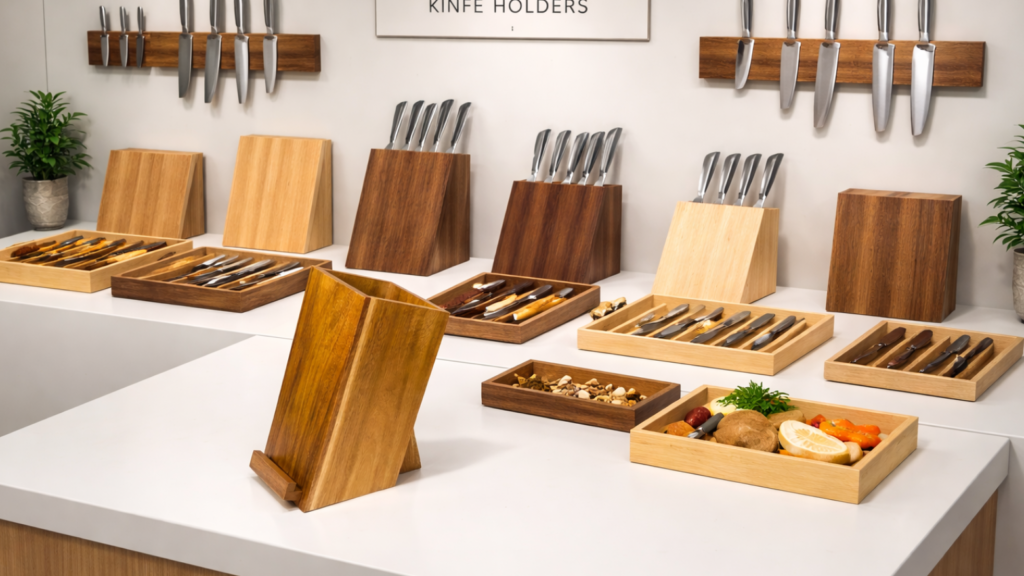
- Vertical knife block: Classic countertop block with angled slots. Pay attention to footprint size, center of gravity and slot length for long chef knives.
- Universal block with flexible insert: Uses plastic or bamboo rods, or a bristle-style interior to accept different knife combinations.
- Magnetic knife holder: Wall-mounted or stand-style with embedded magnets. Requires precise magnet placement and strong bonding to avoid safety issues.
- Drawer knife organizer: Flat organizer with channels for blades and handles. Needs accurate compartment sizing based on target knife sets.
- Box-style storage: A lidded or open-top box that can double as presentation packaging and storage, drawing on experience from custom wooden boxes.
3.2 Key structural checkpoints
During OEM/ODM development, walk through these structural points with your factory partner:
- Slot dimensions and spacing: Confirm the thickness and width of each knife blade you plan to include. Tolerances should allow easy insertion without wobbling or scraping.
- Stability and tipping risk: The base should be wide and heavy enough to support a fully loaded block. Discuss bottom weight options, rubber feet and angle of the block.
- Magnet strength and layout: For magnetic holders, test sample strength with the intended knife set. Magnets must hold securely but allow safe removal without sharp jerks.
- Finger clearance: Ensure users can grip handles comfortably without knuckles hitting the wood when removing or inserting knives.
- Hardware and fasteners: If hinges, metal plates or mounting brackets are used, align hardware selection with your brand’s target quality and the environmental conditions of a kitchen.
3.3 Moisture control and structural durability
Kitchen products live in a humid, high-use environment. Moisture control at the factory and in your design is crucial.
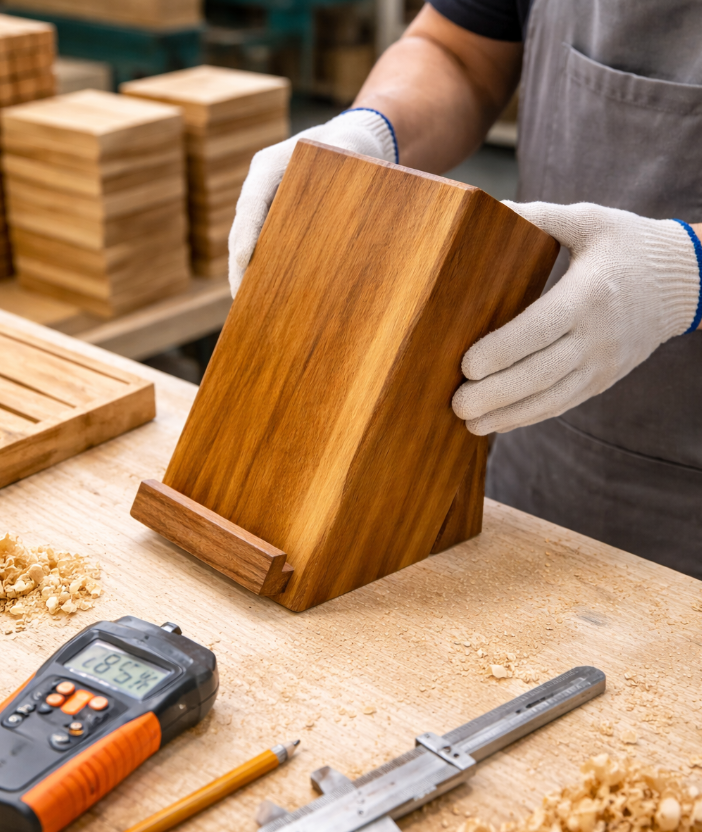
- Wood moisture content: Request that moisture levels be controlled according to your main export markets. Inconsistent moisture can lead to warping, cracking or joint gaps after arrival.
- Ventilation and drainage: In enclosed or box-style holders, consider ventilation holes, open bases or drainage channels to avoid trapped moisture from wet knives.
- Glue and bonding: Discuss glue types used for laminated structures or bamboo panels, especially if you are selling into markets with specific chemical compliance expectations.
4. Surface Finishing and Color Control for Knife Holders
Surface finish is what your customer sees and touches first. It must align with your price point and brand intent, while being durable enough for daily kitchen use.
4.1 Sanding consistency
Uneven sanding creates a low-quality feel and can cause issues with staining and coating. When approving samples, check:
- All edges and corners for smoothness and uniform radius.
- Flat surfaces for sanding marks or wave patterns, especially on larger panels.
- Slot openings, inside corners and routed areas for rough spots.
4.2 Stain, paint and clear coating options
- Natural / clear oil or lacquer: Shows off the wood grain and is common for acacia, walnut and bamboo. Ask about gloss level (matte, satin, gloss) and how it impacts scratches and fingerprints.
- Stained finishes: Can unify color across boards and create a consistent brand tone. Provide a master color sample or Pantone reference, and discuss how the chosen species accepts stain.
- Painted finishes: Often applied on MDF or smooth pine. A good option if you want a white, black or colored modern look that matches other kitchen accessories.
4.3 Repeat-order color and texture consistency
One of the main B2B concerns is maintaining the same appearance across multiple production runs. To support repeat-order consistency:
- Approve and archive a master reference sample with clear labeling.
- Ask your factory to use the same coating supplier and formula between runs, or notify you before any changes.
- Request production photos or pre-shipment samples for larger reorders, especially if color is critical to your brand identity.
5. Branding, Logo Application and Mixed Materials
Custom wooden knife holders offer multiple branding positions: front panels, side faces, top surfaces or even hardware. Consider how visible your brand should be once knives are in place.
5.1 Common logo techniques
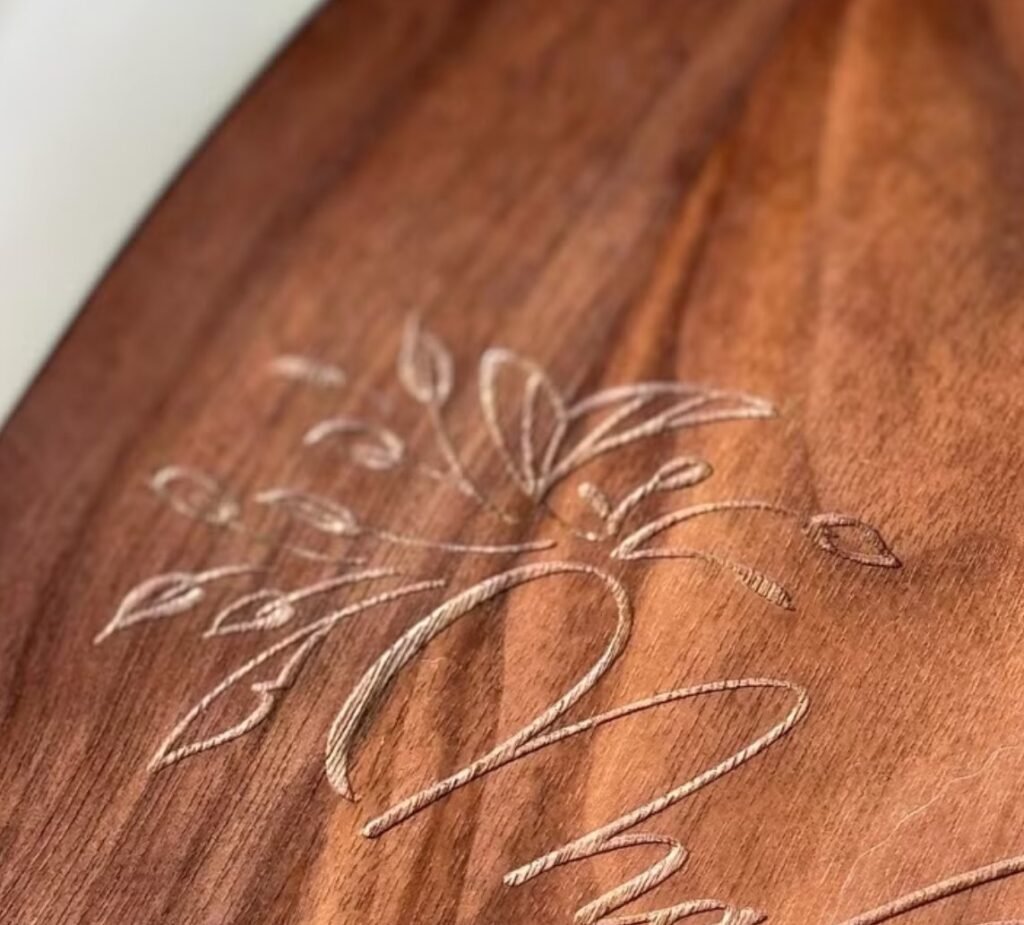
- Laser engraving: Clean, precise and durable. Works especially well on acacia, walnut, bamboo and pine. Suitable for understated, premium branding.
- Silk-screen printing: Good for color logos. Best on flatter surfaces or painted finishes. Discuss color-fastness and resistance to cleaning.
- Debossed or metal badge: A metal plate or debossed area can elevate a premium private label range, but adds hardware and assembly steps.
- Foil stamping on packaging: For color boxes or sleeves, foil stamping can convey a premium impression without changing the wooden piece itself.
5.2 Using mixed materials strategically
Combining wood with other materials can help differentiate your range:
- Wood + metal: Brushed stainless steel or black metal frames around a wooden block can create a modern, industrial look.
- Wood + acrylic: Transparent panels to show knife blades, used carefully to avoid a cheap appearance. Requires careful bonding and scratch considerations.
- Wood + leather or fabric pads: As handle rests, drawer bases or decorative accents.
When you explore mixed materials, discuss assembly steps, adhesive choices and potential weak points in the production process.
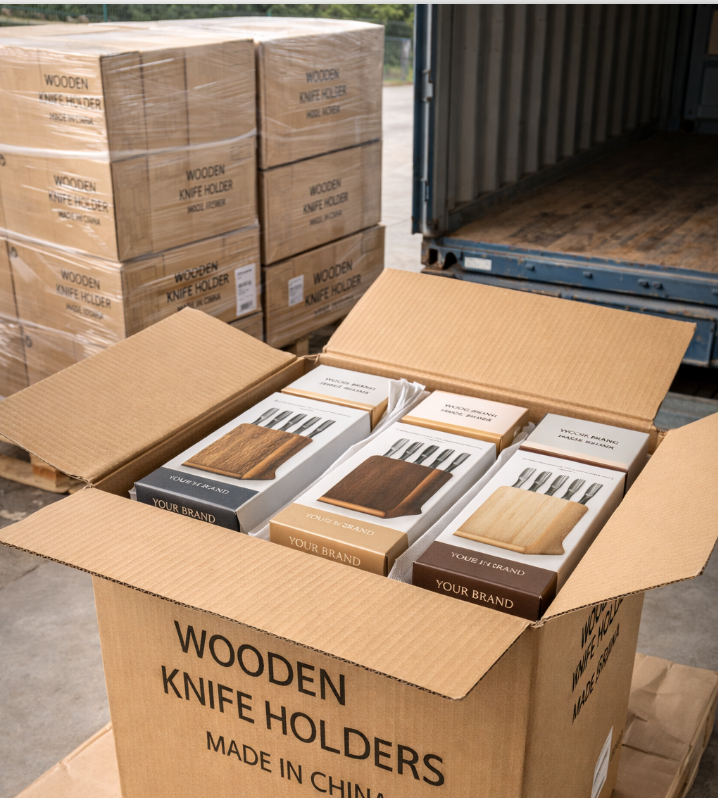
6. Packaging, Export Readiness and Damage Control
For B2B buyers, packaging is not just about aesthetics. It is a major cost driver and a key factor in damage rates, warehouse handling and compliance with retailer requirements.
6.1 Retail packaging options
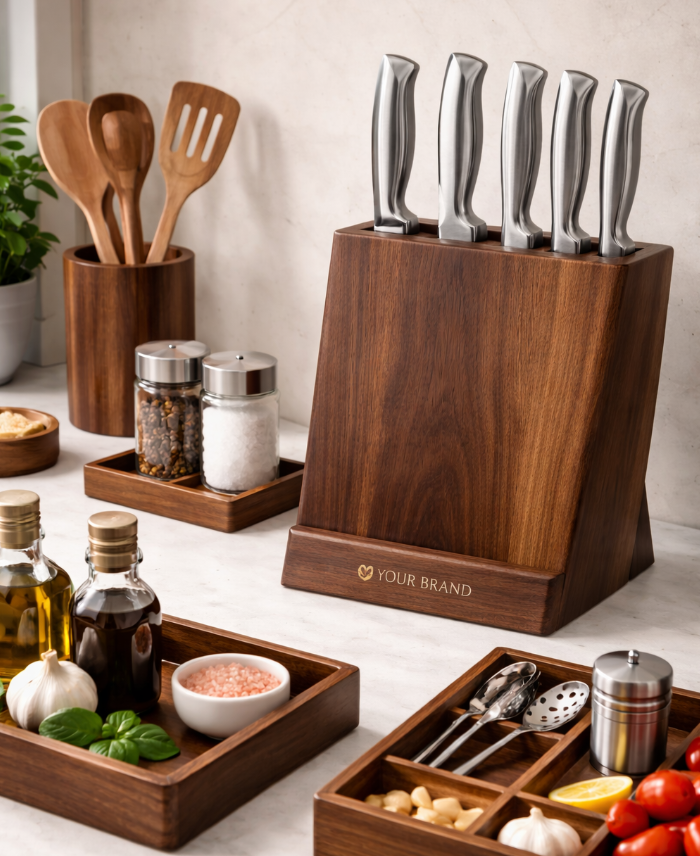
- Color box: A printed box with branding and product information. Ideal for retail shelves and online listings where imagery matters.
- Mailer carton: Brown or printed carton designed for direct-to-consumer shipping. Common in Amazon FBA projects where the mailer is also the shipping carton.
- Sleeve + inner box: A combination that allows one neutral inner box with different printed sleeves for multiple markets or languages.
6.2 Protecting wooden knife holders in transit
Because knife holders are often weighty, with corners and edges that can dent, damage control is a core sourcing topic:
- Inner protection: Use foam inserts, corrugated buffers, corner protectors or molded pulp where needed. Ensure knives (if included) do not pierce surfaces during transport.
- Carton drop-test thinking: Plan packaging to withstand standard drop scenarios, particularly for e-commerce shipments. Discuss inner layout with your manufacturer to reduce movement inside the carton.
- Carton marks and barcodes: Align outer carton printing with your warehouse and retailer requirements: SKU, quantity, gross weight, dimensions, barcodes and handling icons.
6.3 Optimizing for freight and storage
The structure of your knife holder influences how many units fit per carton and per pallet. In early design stages:
- Review nested or flat-packed options for modular holders or wall-mounted racks.
- Discuss carton size limits for your main sales channels – large retail chains and Amazon have clear maximums.
- Check how changes in holder dimensions affect CBM, container loading and landed cost.
7. OEM/ODM Workflow: From Concept to Mass Production
Moving from idea to repeatable production requires a structured OEM/ODM process. A factory-oriented partner will help you clarify technical details at each step to prevent misunderstandings and hidden costs.
7.1 Briefing your project
When you first contact a manufacturer, prepare a clear brief:
- Product type and target channel (retail chain, distributor, Amazon, etc.).
- Preferred material (acacia, bamboo, pine, paulownia, walnut, MDF veneer, plywood veneer) and finish style.
- Preliminary dimensions, number of knives to hold and any special blades (e.g., cleavers, steak knives, scissors).
- Expected order quantity range (starting order and potential annual volume).
- Packaging preference (color box, mailer, sleeve) and any required certifications or testing standards.
7.2 Sample development and testing
Sample development is where design intent meets real-world constraints:
- Structural test: Load the sample with your actual knives. Check stability, slot fit, magnet strength and clearance.
- Finish and logo check: Confirm that color, grain visibility, coating gloss and logo size/position match your brand requirements.
- Packaging test: If possible, conduct informal drop tests or ship samples via courier to observe actual transit wear.
- Feedback loop: Communicate clearly what should be changed, and request a modified sample if adjustments are significant.
7.3 Discussing MOQ, lead time and price structure
MOQ and pricing are typically linked to material choice, structural complexity and packaging specification:
- MOQ: Solid wood blocks and custom magnets usually require higher MOQs than simpler MDF-based designs due to material purchasing and set-up costs.
- Lead time: Clarify lead time for sample development, first order and repeat orders. Include extra time if you require pre-shipment inspection or third-party testing.
- Price structure: Request breakdowns where relevant – product ex-works price, color box cost, special inserts, logo surcharge, and any tooling or set-up fees for magnets or hardware.
7.4 Quality control and repeat-order consistency
For long-term cooperation, establish clear QC expectations:
- Define key checkpoints: moisture content range, sanding standard, color tolerance, logo clarity, assembly tolerance, magnet embedding depth.
- Align on acceptable defect levels and handling of non-conforming goods.
- Request that any material or process change be communicated and new approval samples be provided when necessary.
8. Compliance, Documentation and Market-Specific Requirements
Sourcing for EU and US markets often means more than just producing a good product. Buyers need support with documentation and compliance planning.
8.1 FSC-oriented sourcing discussions
If your buyers or retailers require FSC-related sourcing, discuss early whether your chosen materials can support those requirements. This often affects:
- Which wood species or suppliers are used for the project.
- How materials are separated and traced in the factory.
- What documentation can be provided during audits or supplier reviews.
8.2 Chemical and safety considerations
While knife holders are not food-contact surfaces in a strict sense, some markets expect similar attention to coatings and adhesives used in kitchen environments. Working with an experienced wooden products factory in China can help you align product design with the kind of testing your customers might request.
8.3 Documentation and communication
Project-based compliance communication should cover:
- Material lists at a basic level (wood species, main coatings, adhesives).
- Any existing test reports that are relevant to similar items.
- Packaging material details if retailers require packaging reduction or recyclability documentation.
9. Practical Tips for Sourcing Custom Wooden Knife Holders
As you move through supplier selection and project kick-off, the following practical points can help prevent issues later:
- Start with one or two core designs: Instead of launching many variations at once, start with proven structures and then extend the line after you confirm market response.
- Align design across ranges: Coordinate finishes, logos and hardware across your knife holders, cutting boards and kitchen organizers to build a coherent family.
- Plan ahead for replenishment: If your channel is sensitive to stockouts (e.g., retail promotions or Amazon listings), align safety stock and reorder points with realistic lead times from the factory.
- Use early shipments to refine specs: Treat the first production run as both a commercial batch and a learning opportunity; adjust packaging, labeling and minor design details based on returns and reviews.
Conclusion: Turn Wooden Knife Holders into a Stable, Branded Category
Custom wooden knife holders are more than accessories; they can become a stable, brand-defining category in your kitchen range. By paying attention to material selection, moisture control, structural design, surface finishing, logo execution and export packaging, you can reduce quality risk and support consistent repeat orders.
A manufacturing partner with OEM/ODM experience in wooden storage, organizers and gift packaging can help you translate your concept into a production-ready, export-optimized product. From acacia knife blocks to bamboo magnetic racks and paulownia drawer organizers, a structured development process makes the difference between a one-off purchase and a reliable long-term SKU.
If you are planning a new range or upgrading an existing line of knife sets, now is a good time to review your specifications, packaging and branding options with a factory-oriented manufacturer who understands real B2B requirements. Discuss your next knife holder project, sampling plan and timeline directly with Chic Homeware’s team to align design, cost and quality from the outset.