
Custom Wooden Boxes for Brand Packaging: Decisions to Make Before You Brief a Factory
For importers, distributors, and private label brands, custom wooden boxes can upgrade perceived value, protect fragile contents, and differentiate your packaging on the shelf and online. But the quality of the final box is decided long before mass production starts. The earliest decisions you make on material, MOQ and logo process will define your cost structure, risk level, and how smoothly your project runs with a factory.
This article is written from a factory-floor perspective to help you structure your first discussion with an OEM/ODM partner like Chic Homeware. It focuses on practical decisions you should lock in early, so sampling, quotations and production control are grounded in the realities of wood manufacturing and export logistics.
Start With the Use Case, Not the Drawing
Before you debate hinges or stain color, clarify two things: how the box will be used, and how it will be shipped. These answers will guide which material route, structure and logo process make sense.
- Use scenario: Gift packaging for spirits, cosmetics, food, jewelry, tools, or general storage?
- Product sensitivity: Heavy glass bottles, delicate jars, electronics, or light textile items?
- Sales channel: E‑commerce (Amazon/online), retail gift sets, subscription boxes, or corporate gifting?
- Logistics route: Direct FCL/LCL shipments to distribution centers, or parcel-level fulfillment?
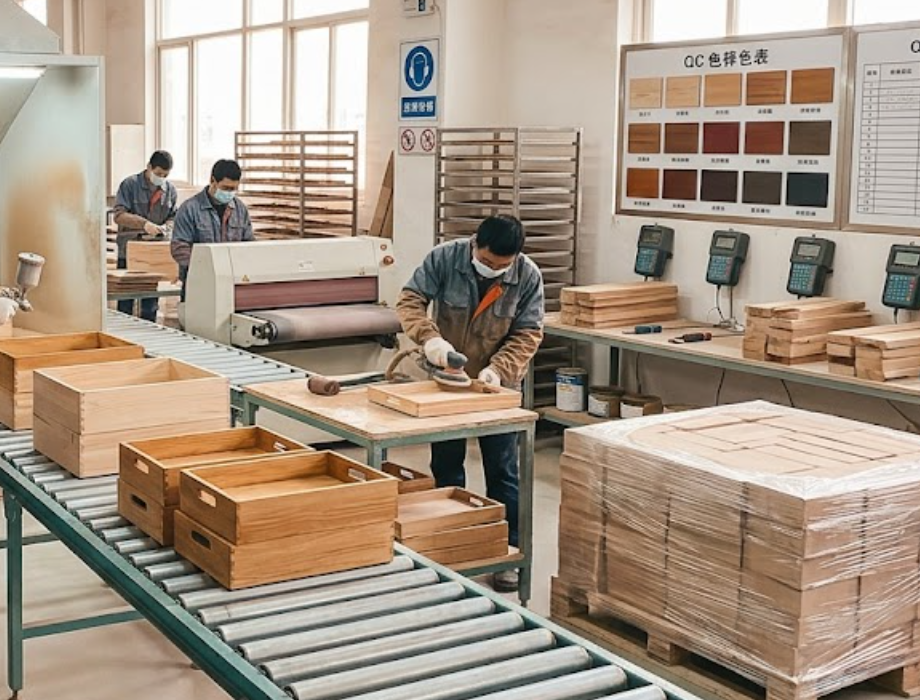
When Chic Homeware receives a custom wooden box inquiry, the first internal discussion is not about design aesthetics, but about load-bearing requirement, moisture exposure risk, and target landed cost. A box for a 1 kg whisky bottle and a box for a lightweight candle set will not be engineered in the same way, even if they look similar in a photo.
Material Decisions: Matching Wood Species to Your Project Reality
For brand packaging, you are not just choosing a wood that looks good; you are choosing a combination of visual, mechanical and cost properties that affect MOQ, lead time and export performance. Chic Homeware works mainly with acacia, pine, paulownia, bamboo, walnut, MDF veneer and plywood veneer. Each has a typical use profile.
Acacia: Premium Look for Gift and Tabletop Boxes
Best for: Premium spirits, watch and jewelry boxes, high-end gift sets, and boxes that may be reused as home organizers.
Key characteristics:
- Rich natural grain and warm tone, upgrade perceived value without heavy finishing.
- Denser and heavier than softwoods, which adds a quality feel but also shipping weight.
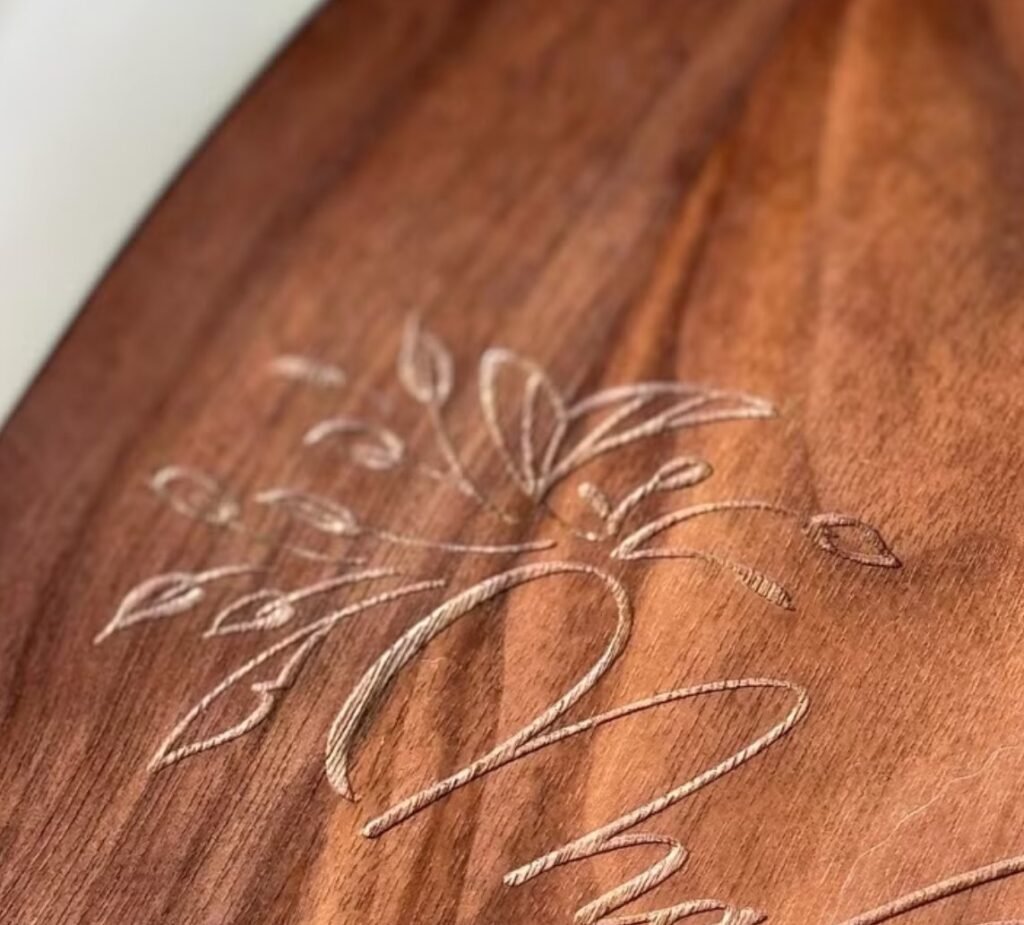
- Works well with clear lacquer, oil finishes and laser engraving.
What buyers should decide early:
- Are you selling a premium experience where weight and grain visibility justify a higher material cost?
- Is your logistics set up comfortable with slightly higher carton weights?
- Do you plan for a clear finish that highlights grain, or a stained color that standardizes batches?
Pine: Cost-Effective and Versatile for Volume Projects
Best for: Mid-range gifting, food boxes, display crates, and multi-size box series.
Key characteristics:
- Softwood with reasonable strength and a friendly cost level.
- Accepts stains and paints easily, useful for color-consistent collections.
- Visible knots and grain; can be rustic or more refined depending on grading and finishing.
What buyers should decide early:
- How much rustic character (knots, color variation) is acceptable for your brand?
- Will you use solid pine throughout, or just for key components with MDF/ply for others?
- Do you need a tighter knot specification or upgraded grade, which will affect cost and material yield?
Paulownia: Lightweight for E‑Commerce and Larger Gift Sets
Best for: Larger boxes that must still meet parcel weight limits: wine sets, tea sets, cosmetic kits, and subscription box packaging.
Key characteristics:
- Very light, making it ideal for air and parcel shipments.
- Soft and easy to process, but less impact resistant than denser woods.
- Light color base that takes stain evenly with suitable pre-treatment.
What buyers should decide early:
- Are reduced shipping costs and easier handling a priority over impact resistance?
- Will boxes be reused by the end consumer, or mainly function as one-time gift packaging?
- Do you accept a softer feel, or do you require reinforcement with plywood bases or internal frames?
Bamboo: Sustainability Narrative and Hard Surface
Best for: Brands that want a sustainability story, kitchen-related gift sets, tea and food packaging.
Key characteristics:
- Technically a grass; engineered into panels and boards.
- Harder surface, good for a modern, clean appearance.
- Pairs well with laser logos and minimalistic designs.
What buyers should decide early:
- Do you need bamboo throughout, or is bamboo veneer over MDF/ply enough for your positioning?
- Is a sustainability message central to your marketing, affecting material choice and documentation?
- What color tone (natural, caramelized, dark) suits your brand palette?
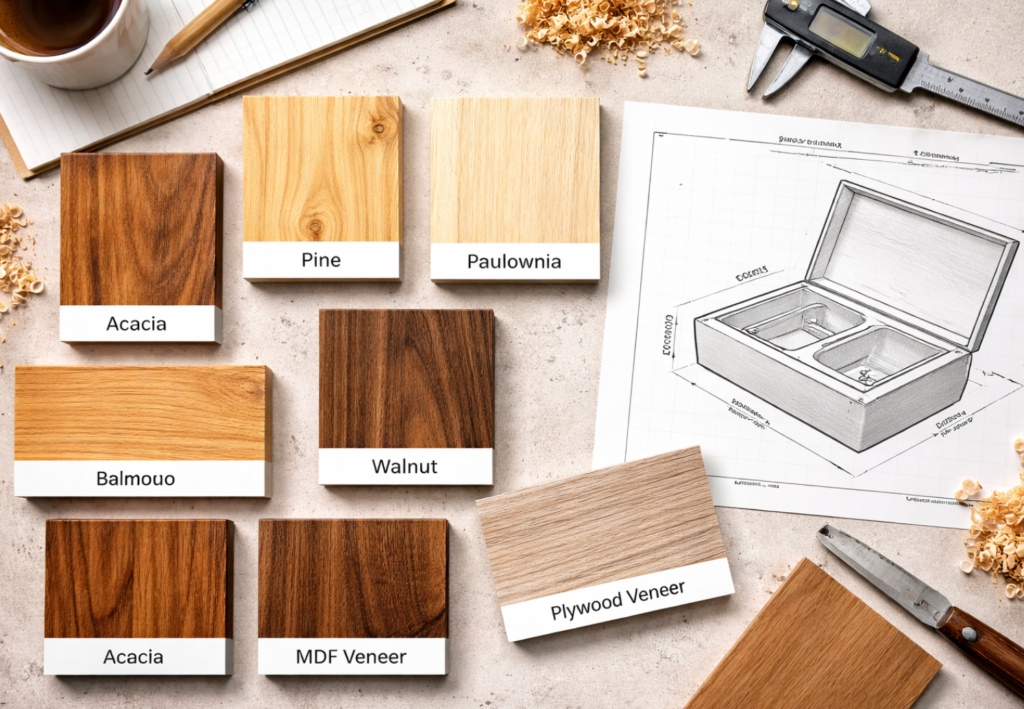
Walnut: High-End, Dark-Tone Branding
Best for: Limited edition spirits, premium corporate gifts, and high-value jewelry or watch sets.
Key characteristics:
- Dark natural tone and elegant grain, naturally premium feel.
- Higher material cost and longer lead time in many cases.
- Typically used as solid components or veneer to manage cost.
What buyers should decide early:
- Is the box a primary value driver of the gift set, or a supporting element?
- Is solid walnut required, or is walnut veneer over stable MDF sufficient?
- Are you comfortable with potential color variation between batches, or do you require tighter tolerance?
MDF Veneer: Cost Control with a Premium Surface
Best for: Boxes where surface consistency, flatness and cost control are priorities, such as cosmetic sets and retail display packaging.
Key characteristics:
- Stable, smooth substrate; ideal for veneer and paint finishes.
- Helps achieve uniform color and surface, useful for retail consistency.
- Frequently combined with real wood edges or frames.
What buyers should decide early:
- Will you accept an engineered wood core as long as the visible surface is wood veneer?
- Do you prefer natural wood grain visuals, or a fully painted finish?
- Is weight a concern, especially for larger gift boxes?
Plywood Veneer: Strength and Stability for Structural Boxes
Best for: Boxes that need strength-to-weight balance, such as tool gift sets, large storage boxes, and stacked display units.
Key characteristics:
- Layered structure provides good structural stability.
- Works well for large panels that must resist warping.
- Veneers give the appearance of solid wood at a controlled cost.
What buyers should decide early:
- Do you have specific load-bearing or stacking requirements (for example, carton-on-carton stacking height)?
- Are exposed edges acceptable, or should they be edge-banded or framed with solid wood?
- What veneer species aligns with your brand look and budget?
How Chic Homeware Helps Buyers Choose Material Routes
In many projects, Chic Homeware recommends a mixed-material approach: solid acacia lids with MDF veneer bodies, pine frames with plywood bases, or bamboo veneer tops with MDF interiors. These combinations balance appearance, structural behavior, and target price. Sharing your target FOB price range and positioning early helps the factory suggest realistic combinations instead of over- or under-engineering the box.
Moisture Control and Finishing: Protecting Your Brand From Warping and Color Issues
Wood is a living material and reacts to humidity changes during ocean transport and storage. For export buyers, moisture control is not a technical detail; it directly impacts claims, returns and review scores.
Moisture Content and Kiln Drying Expectations
For custom wooden boxes, internal standards often target a moisture content that suits the destination climate and intended storage conditions. Chic Homeware focuses on stable moisture control in line with common export practices. Buyers should clarify:
- Destination climate: Dry inland warehouses vs. humid coastal areas.
- Product integration: Are you inserting items that release or absorb moisture (soaps, food, scented items)?
- Packing duration: How long cartons may stay in containers or warehouses before retail or fulfillment.
Discussing these conditions early helps the factory adjust drying time, storage conditions and packaging options (such as desiccant use or stretch wrapping of pallets).
Sanding and Surface Consistency
For brand packaging, touch and visual uniformity matter. Key points you should decide and communicate in your specification:
- Surface level: Do you require fully smooth surfaces suitable for high-end lacquers, or is a mildly rustic feel acceptable?
- Edge treatment: Sharp, crisp edges vs. slightly rounded edges for safer handling and less chipping.
- Interior surfaces: Should inside faces be as refined as the outside, or can they be simplified to manage costs?
Chic Homeware typically sets internal sanding standards and sample approval checkpoints for both exterior and interior surfaces to support repeat-order consistency.
Stain, Paint, and Clear Finish Choices
Finishing defines not only appearance but also how your logo behaves on the surface. Decide early:
- Finish type: Clear lacquer, oil, stain plus topcoat, or full paint.
- Gloss level: Matte, satin, or gloss, depending on your branding.
- Color tolerance: How much shade variation you can accept between batches.
For example, a fully painted MDF-veneer box can achieve very stable color from batch to batch, while natural acacia boxes will show more individual grain and color variation. Chic Homeware aligns finishing specifications with your brand expectations and channel needs (e.g., stricter uniformity for sets sold on marketplaces with side-by-side comparison photos).
Logo and Branding: Choosing the Right Process Before Sampling
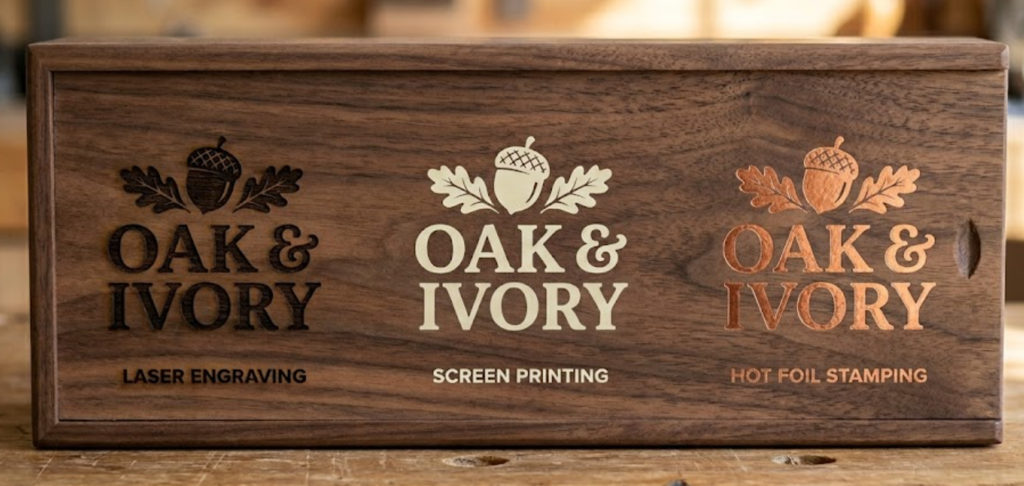
Logo decisions impact tooling cost, MOQ, and how quickly you can repeat orders without new setup. When you develop custom wooden boxes, it is not enough to say “laser logo” or “print logo.” You should decide on process, position, and hierarchy of branding elements before sampling.
Common Logo Processes for Custom Wooden Boxes
- Laser Engraving
- Ideal for: Natural or stained wood, bamboo, acacia, and walnut.
- Benefits: No additional color matching, durable, precise details.
- Considerations: Contrast depends on base color; may require test pieces.
- Screen Printing
- Ideal for: Flat surfaces, painted or lightly finished wood, MDF veneer.
- Benefits: Strong color presence, suitable for brand colors and graphics.
- Considerations: Screen and color setup costs; typically better for larger volumes.
- Hot Stamping / Foil
- Ideal for: Premium gift packaging that needs metallic gold, silver or other foils.
- Benefits: High perceived value, sharp edges when correctly tooled.
- Considerations: Requires metal dies and more careful surface preparation.
- UV Printing / Digital Printing
- Ideal for: Multi-color artwork on flat surfaces.
- Benefits: Flexible for detailed designs and gradients.
- Considerations: Surface flatness and pre-treatment are critical; usually better suited to certain substrates like MDF veneer or plywood.
Logo Position, Size, and Multi-Location Branding
Early in the development phase, decide:
- Primary location: Lid top, front panel, inside lid, or bottom.
- Secondary branding: Small discrete logo on the back or inside, especially for private label brands that want clean aesthetics outside.
- Logo hierarchy: Is the product brand different from the corporate brand? Do you need both on the box and on the color box or mailer carton?
Chic Homeware usually builds logo location and process into the packaging drawing and BOM (bill of materials) so that screen frames, laser files and hot-stamping dies can be reused reliably across reorders.
Logo Sampling and Color Approval
To avoid misunderstandings, you should request logo samples on the actual production material and finish, not only on blank sample boards. Provide:
- Vector artwork files for precise reproduction.
- Brand color codes (Pantone or CMYK/RGB references) when color is important.
- Clear scaling rules for different box sizes within a series.
Approving a pre-production sample with the correct logo process, position and finish is the best protection for your brand when moving forward with a mass order.
MOQ Planning: How Many Boxes Do You Really Need to Start?
MOQ for custom wooden boxes is driven by a combination of material sourcing, finishing process, logo method, and packing requirements. Setting realistic MOQ expectations early saves time on both sides.
What Actually Drives MOQ in a Wooden Box Factory
- Material purchase lots: Boards, panels and veneer are purchased in certain minimum quantities. Using uncommon thicknesses or species can raise MOQ.
- Finishing setup: Stain and paint lines have setup costs and cleaning cycles that make very small runs inefficient.
- Logo tooling: Printing screens, foiling dies and color matching become economical above certain quantities.
- Packing materials: Custom color boxes and printed mailers have their own MOQs with packaging suppliers.
For simpler boxes (for example, pine or paulownia with basic laser logos and standard mailer cartons), Chic Homeware can often support lower MOQs than for multi-color printing and custom hardware boxes. The exact MOQ often varies by project, so sharing your realistic first-order quantity and expected reorder rhythm helps the factory propose a practical structure.
Strategies to Manage MOQ While Protecting Unit Cost
If you want to test the market or launch a new design, consider:
- Standardizing sizes: Use one or two base sizes that can serve multiple SKUs with different inserts or labeling.
- Using shared hardware and finishes: Keep hinges, magnets, and finish colors consistent across models to aggregate volume.
- Phased rollout: Start with a core size and finish, then add variants once the main SKU is established.
- Neutral branding layers: Use a base box with a permanent logo and switch specific campaign messages into removable inserts or sleeves.
Chic Homeware’s custom wooden products manufacturer experience allows you to structure collections that respect both your marketing plan and realistic factory MOQs.
Structural Details You Should Decide Early
Hardware and structure decisions are often treated as secondary, but they affect assembly time, quality control points, and packaging design.
Hinges, Magnets, and Closures
Clarify from the beginning:
- Hinge type: Simple butt hinges, concealed hinges, or piano hinges depending on look and durability requirements.
- Opening angle: Full 180° opening vs. limited; this impacts hinge selection and lid design.
- Closure method: Magnets, clasps, elastic bands, or simple friction fit.
Magnets add perceived premium quality but also require careful positioning and packing design to avoid magnetic attraction issues during transport when multiple boxes are stacked.
Compartments and Inserts
For brand packaging, the interior is just as important as the exterior. Early decisions include:
- Fixed vs. removable dividers: Fixed dividers increase strength but reduce flexibility; removable ones can fit multiple product configurations.
- Material of inserts: Wood, EVA, cardboard, or fabric-lined trays.
- Protection level: How much drop or vibration the product inside must withstand without damage.
For fragile items, Chic Homeware often recommends test-packing sample sets and simulating handling before finalizing insert design.
Structural Stability for Export and Retail
Wooden boxes may face stacking in warehouses, container vibration, and carton drops. To manage these risks, you should discuss:
- Box wall thickness and corner joints: To handle expected loads.
- Stacking height: How many filled boxes will be stacked in your warehouse and during transport.
- Carton drop-test expectations: Establishing a realistic drop-test concept (for example from common courier heights) helps guide design.
Chic Homeware integrates these requirements into structural drawings and export packaging plans, leveraging its experience as a wooden products factory in China serving EU and US buyers.
Export Packaging and Damage Control: Planning Beyond the Box Itself
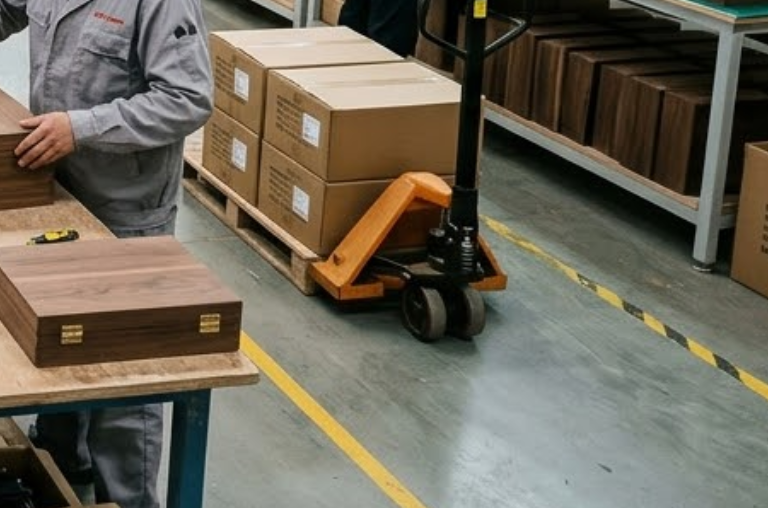
Even a well-made wooden box can reach your warehouse damaged if export packaging is not considered early. When discussing your project, be prepared to cover:
Color Box, Mailer Carton, and Master Carton Choices
- Color box: Do you need a printed color box around each wooden box for retail? This impacts MOQ, artwork timelines and packing line capacity.
- Mailer carton: For e‑commerce, do you ship in a dedicated mailer carton per piece? Oversized mailers increase cost but protect better.
- Master carton: How many units per carton, with what orientation and buffering?
Chic Homeware typically recommends inserting a protective layer between wooden box surfaces to avoid friction damage, especially on dark-stained or painted finishes.
Carton Marks and Handling Instructions
Clear carton marks are not only a compliance requirement but also a damage-prevention tool. Decide early:
- Standardized carton information for all SKUs (brand, item, color, quantity, country of origin).
- Handling marks (fragile, keep dry, this way up) according to your logistics partner’s recommendation.
- Barcode or QR requirements for warehouse management systems.
By defining these before mass production, you avoid last-minute changes that can delay shipments and create confusion.
Sampling, Lead Time, and Price Structure: Setting Expectations
Sampling Roadmap
For custom wooden boxes, a practical sampling route often includes:
- Design confirmation: 2D drawings or 3D files with material notes and finishing ideas.
- First physical sample: Focused on structure and material; finish and logo may be provisional.
- Refined pre-production sample: With finalized finish, logo, hardware, and packing design.
Every revision can impact lead time. Providing consolidated feedback on each round helps maintain schedule and minimize sampling cost.
Lead Time Influencers
Lead time for custom wooden boxes depends on:
- Material availability and whether special material must be sourced or reserved.
- Complexity of machining, sanding, finishing and assembly steps.
- Capacity planning in the finishing and logo application areas.
- Packaging component readiness (color boxes, labels, inserts).
Chic Homeware plans production considering both box manufacturing and export packaging preparation, so aligning your requested ship date with realistic production windows is essential.
Price Structure Transparency
A clear quotation for custom wooden boxes should usually break down:
- Base box (material and craftsmanship).
- Finish and logo process.
- Hardware and inserts.
- Individual packing, color box, and mailer if applicable.
- Master carton and export packing.
Understanding these elements allows you to adjust design choices to hit your target price without sacrificing key functional requirements.
Ensuring Repeat-Order Consistency
Brand packaging projects succeed when the second and third orders look and perform like the first. To protect consistency:
- Document specifications: Maintain agreed drawings, material specs, finish codes, logo positions, and QC points.
- Approved golden samples: Store at both your office and the factory, including packaging.
- QC and communication: Align on inspection criteria and acceptable variations before mass production.
Chic Homeware’s experience with custom wooden boxes for multiple markets emphasizes stable workflow: the same processes, material suppliers, and inspection checkpoints are reused across repeat orders whenever possible.
Conclusion: Structure Your Next Custom Wooden Box Project for Success
Successful custom wooden box packaging is not only about an attractive design. It is the result of early, well-informed decisions about material, MOQ, and logo processes, supported by realistic structural and packaging planning. When you align your brand positioning, logistics model and budget with the factory’s technical capabilities from the beginning, you reduce sampling rounds, protect your margins, and deliver a consistent experience to your customers.
Chic Homeware supports OEM/ODM projects through material selection, moisture control, finishing, logo application, structural optimization and export packing tailored to EU and US buyers. If you are planning a new gift box series, an Amazon-ready packaging upgrade, or a private label launch, share your concept, target quantity and price range early so we can propose a practical, factory-ready solution.
To discuss your next custom wooden box project, request sampling, or review material options for your brand packaging, please reach out to Chic Homeware’s project team and start building a clear, efficient development plan.