
Introduction: The “Profit Illusion” in Sourcing Woodenware from China
It is a scenario we witness every single quarter.
A sourcing manager from Europe or the US lands on a B2B platform. They find a supplier offering a sleek Acacia wood serving tray for $2.50. They immediately do the mental math: “Competitors are selling this for $25.00. That’s a 10x markup. If I order 2,000 units, I clear $40,000 in gross profit.”
The sample looks good. The deposit is paid. The buyer feels like a genius.
Six months later, the container arrives. But when the Profit & Loss (P&L) statement for that SKU is finalized, the net profit is near zero. Even worse, some buyers find themselves losing money on every unit sold.
What happened?
The amateur buyer focused entirely on the FOB Unit Price (Free On Board). The professional buyer focused on the Total Landed Cost.
In the wood manufacturing industry, the gap between “Price” and “Cost” is wider than in electronics or textiles. Wood is heavy, bulky, sensitive to climate, and increasingly regulated. If you do not account for the “Hidden Costs” lurking in the supply chain, they will eat your margin alive.
At [Xiamen Chic Homeware] we don’t just manufacture products; we manage the entire lifecycle of the wood to protect your bottom line. Here is the brutal, unfiltered truth about the costs generic factories won’t tell you about.
Understanding the complexities of Sourcing Woodenware from China is essential for maintaining profitability in this market.
Chapter 1: The Logistics Nightmare (Paying for Air)
When you import a silicone phone case, shipping is a rounding error. When you import [wooden crates or furniture] shipping can cost more than the product itself.
1. The Volumetric Weight Trap
Shipping lines don’t just bill you based on weight; they bill based on space.
- The “Generic Factory” Way: Most production lines pack items in the fastest way for them, usually side-by-side in a master carton.
- The Math of Loss:
- You buy 1,000 wooden crates.
- Packed poorly, they occupy 28 CBM (Cubic Meters).
- At current sea freight rates, you are paying thousands of dollars to ship the empty air inside those crates.
2. The “Chic Homeware” Engineering Standard
We view packaging as part of the product design phase, not an afterthought.
- Nesting Strategy : We engineer our molds so the small box fits perfectly inside the medium box, and the medium inside the large. This can reduce shipping volume by 60-70%.
- Knock-Down (KD) Structures: For larger items, we use precision hardware that allows the product to ship flat (Flat-pack) and be assembled by the end-user in minutes.
- Real-World Case: A client recently switched to us for a pet furniture line. By redesigning the packaging to be flat-packed, we reduced their per-unit ocean freight from $4.20 to $1.15. That is $3.05 of pure profit added back to every single sale.
Chapter 2: The “Living Material” Risk (Moisture & Cracking)
This is the single biggest difference between a “Workshop” and a “Professional Supplier.” Wood is a living material—it breathes, expands, and contracts.
1. The Climate Discrepancy
- The Science: Wood seeks “Equilibrium Moisture Content” (EMC). If a product is made in a humid region (like Southern China in summer) and shipped to a dry climate (like Arizona, Las Vegas, or a central-heated home in Northern Europe), it loses moisture rapidly.
- The Result: The fibers shrink. The glue joints fail. The wood cracks.
- The Hidden Cost: It costs roughly $0 for a cheap factory to skip the final 48 hours of kiln drying to save electricity. But it costs $50+ per unit for you to process a return, refund the customer, and suffer the brand damage of a 1-star review.
2. Our “Dry Chain” Protocol
We don’t leave moisture content to chance.
- Region Selection: We center our production in Cao County (Northern China), where the climate is naturally drier and more stable for wood processing than the humid South.
- The “Pin-Test” Mandate: We do not rely on the oven’s digital display. Our QC team uses handheld Pin-Type Moisture Meters to test the core of the wood (not just the surface) before packaging.
- Customized Standards:
- Shipping to UK/Germany? We target 10-12% MC.
- Shipping to US West Coast/Middle East? We target 8-10% MC.
- (Unsure about your region’s requirements? [Ask our specialists for a free climate assessment]https://xmchichomeware.com/contact/
Deep Dive: Selecting the Right Wood Species for Your Budget
Many buyers simply ask for “Wood.” This is a mistake. The species you choose determines 40% of your unit cost and 80% of your product’s durability. Here is a breakdown of the materials we work with in Cao County:
1. Acacia (The Industry Standard)
- Pros: Highly durable, water-resistant, and has a beautiful, rich grain that commands a premium price at retail. Perfect for cutting boards and serving trays.
- Cons: Hard to machine, heavier (increases shipping cost).
- Best For: Premium Kitchenware, Bathroom Accessories.
2. Paulownia (The Cao County Specialty)
- Pros: Extremely lightweight (saves massive freight costs), grows fast (sustainable), and resists warping. It has a beautiful silky texture.
- Cons: Soft. It dents easily. Not suitable for cutting boards.
- Best For: Wall shelves, decorative boxes, lightweight storage crates.
- Insider Tip: If you are selling large storage boxes on Amazon, switch from Pine to Paulownia. You will save 30% on ocean freight due to the weight difference.
3. Rubberwood (The Eco Option)
- Pros: Uniform color (easy to stain), eco-friendly (upcycled from latex industry), moderate price.
- Cons: High starch content makes it prone to mold/insects if not treated chemically.
- Best For: Furniture legs, small kitchen items.
4. Pine (The Budget Choice)
Best For: Rustic crates, pallet displays, cheap promotional items.Chapter 3: Compliance & Safety (The 2025/2026 Standard)
Pros: Cheap, easy to paint or stain.
Cons: Contains knots, releases resin (yellowing over time), soft.
In the past, you just needed a commercial invoice. Today, sourcing non-compliant wood is a legal liability.
1. EUDR (European Union Deforestation Regulation)
Starting late 2025, if you sell to the EU, “not knowing” is not an excuse.
- The Requirement: You must provide the Geolocation Coordinates (latitude/longitude) of the specific plot of land where the wood was harvested.
- The Risk: Goods without this digital passport will be seized at customs. Fines can reach 4% of your company’s annual turnover.
- Our Readiness: We are already integrating FSC-certified sources and blockchain traceability into our supply chain to ensure your inventory is future-proof.
2. Chemical Safety (FDA/LFGB)
If you sell [kitchenware such as cutting boards or trays](🔗 Link to: Kitchenware Category):
- The Trap: Cheap varnishes are glossy and fast-drying, but often contain Lead, Formaldehyde, or Xylene.
- The Consequence: A competitor buys your product, tests it, and reports you to Amazon or consumer protection agencies. Your listing is suspended immediately.
- Our Promise: We exclusively use Food-Safe Wax Oils and certified lacquers. We provide transparency on exactly what finish is used.
Chapter 4: The “Quality Fade” Phenomenon
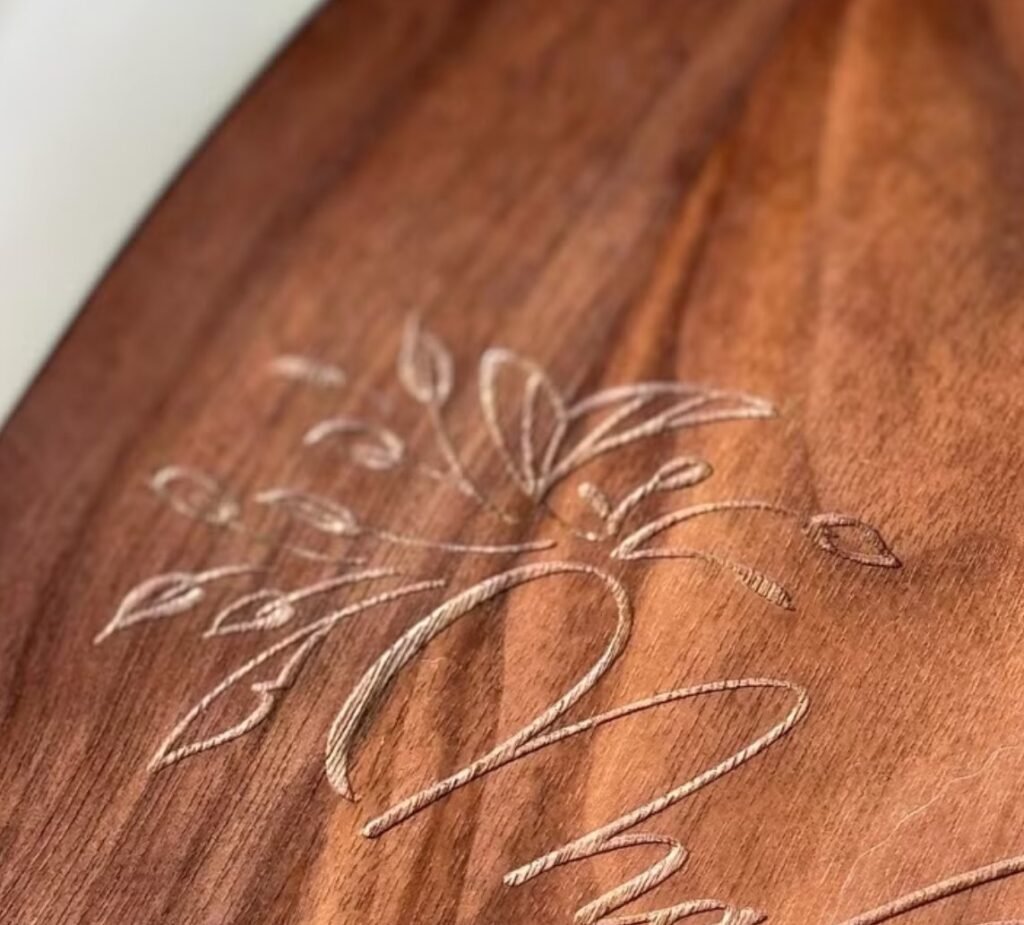
You approved the “Golden Sample.” It was flawless. Smooth sanding, sharp laser engraving, premium feel. But when the mass production arrives, the wood feels rough, the logo is blurry, and there are knots filled with wood putty.
Why? This is called “Quality Fade.” Many suppliers quote a price that is too low to make a sustainable profit. To recoup their margin during mass production, they quietly cut corners:
- Material Swap: Mixing in “B-Grade” lumber or sapwood (the white, soft part of the log) into the batch.
- Sanding Shortcuts: Using 120-grit sandpaper instead of the agreed 240-grit. The wood feels “fuzzy” instead of smooth.
- Finish Dilution: Watering down the oil or varnish to stretch coverage.
How We Prevent This: We operate on a “What You See Is What You Get” contract.
- We define the specs strictly: “Acacia Heartwood only. No Sapwood. 240 Grit Sanding. 2 Coats of Oil.”
- Our QC process rejects these “cost-saving” attempts on the line, so you never have to deal with them in your warehouse.
Chapter 5: The “Invisible” Service Value
Finally, there is the cost of your own time.
- Communication Lag: How much is your time worth? If you have to email a supplier 10 times just to get a correct box dimension, that is a hidden cost.
- Photography Ready: Generic factories send you goods in plain brown boxes. We can assist with and even provide production-line photos and videos that you can use for your social media marketing before the goods even arrive.
FAQ: Common Sourcing Questions
Q: Can you handle DDP (Delivered Duty Paid) shipping? A: Yes. For many clients, we handle the entire logistics chain—from our factory floor to your warehouse door (or Amazon FBA center). You get one final price, with no surprise customs fees.
Q: What is the minimum order quantity (MOQ) for custom packaging? A: Typically, 500-1000 units are needed for fully printed color boxes to be cost-effective. However, for smaller test orders, we can offer high-quality logo branding and custom stickering options to keep costs low.
Q: Do you offer samples before mass production? A: Absolutely. We never recommend starting mass production without a signed-off “Golden Sample” in your hands.
Conclusion: Partnering for Profit
Sourcing from China remains the most competitive option for woodenware globally, if—and only if—you navigate these hidden costs correctly.
At Xiamen Chic Homeware, we bridge the gap between Chinese manufacturing efficiency and Western quality expectations. We are not just selling you a wooden box; we are selling you commercial certainty.
Stop looking at the Unit Price. Start protecting your Profit Margin.
Ready to audit your next order? Contact us today. Let us review your target product and show you how we can optimize the packaging, ensure compliance, and stabilize quality.